The most dangerous mushroom in Polish forests
Show on mapThe death cap is behind the vast majority of fatal mushroom poisonings. By the time symptoms appear, the toxin is already at work.
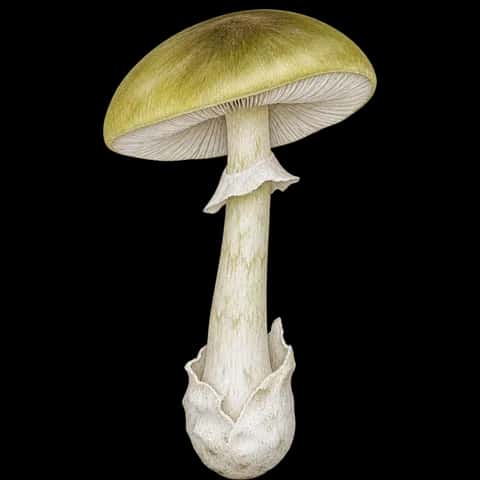
About 30 grams, roughly half a cap, is enough to kill an adult. The death cap (Amanita phalloides, muchomor sromotnikowy in Polish) causes about 90% of fatal mushroom poisonings worldwide, and in Poland it is common from June to November in broadleaf and mixed forests, most often under oaks and beeches.
What makes it so dangerous is that it gives no warning. It tastes mild, and the first symptoms usually appear 6–24 hours after the meal, when the toxin is already in the blood. Then comes a deceptive recovery, during which the toxins destroy the liver. Boiling, drying, pickling and freezing do not remove them.
Its Polish name was coined in 1889 by botanist Franciszek Błoński. It mirrors the Latin phalloides, meaning “like a stinkhorn” (the fungus genus Phallus, sromotnik in Polish). In 1992 mycologist Władysław Wojewoda proposed “greenish amanita” (muchomor zielonawy) after the cap’s color, and Poland’s Chief Sanitary Inspectorate now uses that name in its reports. In everyday speech, Poles still say sromotnik.
Why is the death cap so deadly?
The death cap carries two groups of toxins: phallotoxins and amatoxins. The amatoxins, above all alpha-amanitin, are the killers. Alpha-amanitin enters liver cells and blocks an enzyme the cell needs to read its own genes and make proteins. Liver cells die, and in the following days the kidneys fail too.
The toxin lingers. About 60% of absorbed amanitin is excreted into the bile, returns to the gut and is absorbed again, so the liver takes hit after hit. That is why hospitals give activated charcoal, among other treatments, to bind the toxin in the digestive tract.
Amatoxins are remarkably stable. Doctors have described a fatal poisoning from mushrooms kept in a freezer for 7–8 months, and the toxin has been detected in herbarium specimens at least 20 years old. Taste is no guide either: people who ate death caps reported that they tasted good.
How to identify a death cap
The death cap’s most important feature hides in the ground: a bulbous stem base wrapped in a white, loose sac called a volva, like an egg in an egg cup. Anyone who cuts mushrooms with a knife just above the leaf litter will never see it. So any gilled mushroom with a greenish cap must be lifted out whole and the base of its stem examined.
- cap 5–15 cm across, olive green, yellowish green or grayish green, with radiating fibers, sometimes almost white
- gills white, crowded and free (not attached to the stem); they never turn pink or brown
- a drooping whitish ring on the stem, often with a zigzag greenish pattern below it
- a bulb up to 4 cm across at the base, inside a white, membranous volva
- white spore print
- fruits from June to November, mostly under oaks but also under beech, hornbeam, hazel, birch and even pine and spruce
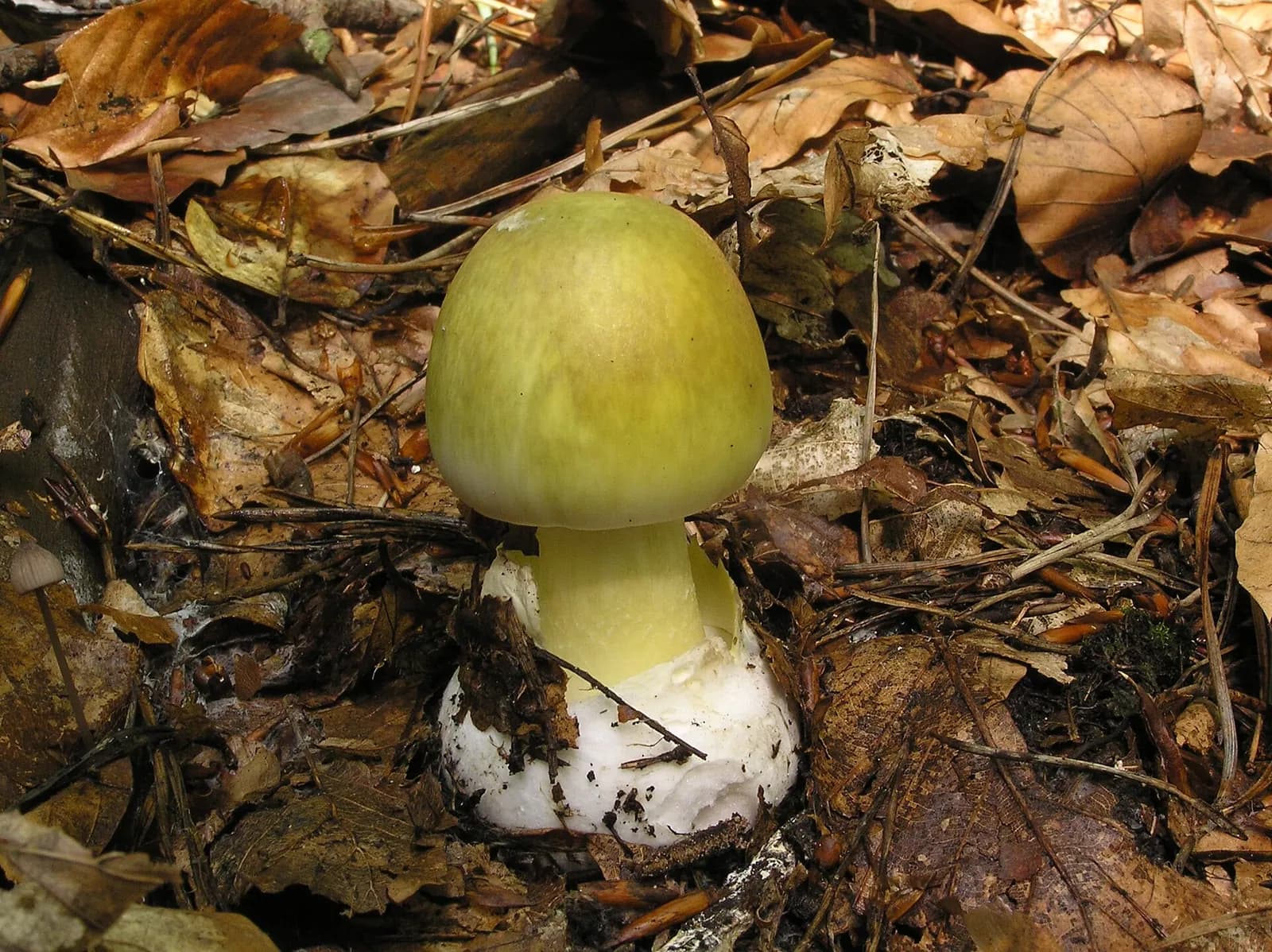
Egg, button, adult: how a death cap changes
A young death cap pushes out of the soil as a white “egg” fully wrapped in a veil, and at this stage it can be mistaken for a puffball. Sliced lengthwise, it shows the outline of a cap, gills and stem inside, while a puffball is uniform throughout. When the veil breaks, its remains stay at the base as the volva and sometimes as white patches on the cap.
Young mushrooms with undeveloped caps are the most treacherous, because the features of the species are not yet visible. Poland’s Ministry of Health advises picking only mature specimens with fully developed features, since young ones are behind many fatal mistakes.
An adult cap peels easily, which disproves the folk belief that mushrooms with peelable caps are edible. There is also a form with a very pale, almost white cap, so color alone is never a reliable clue.
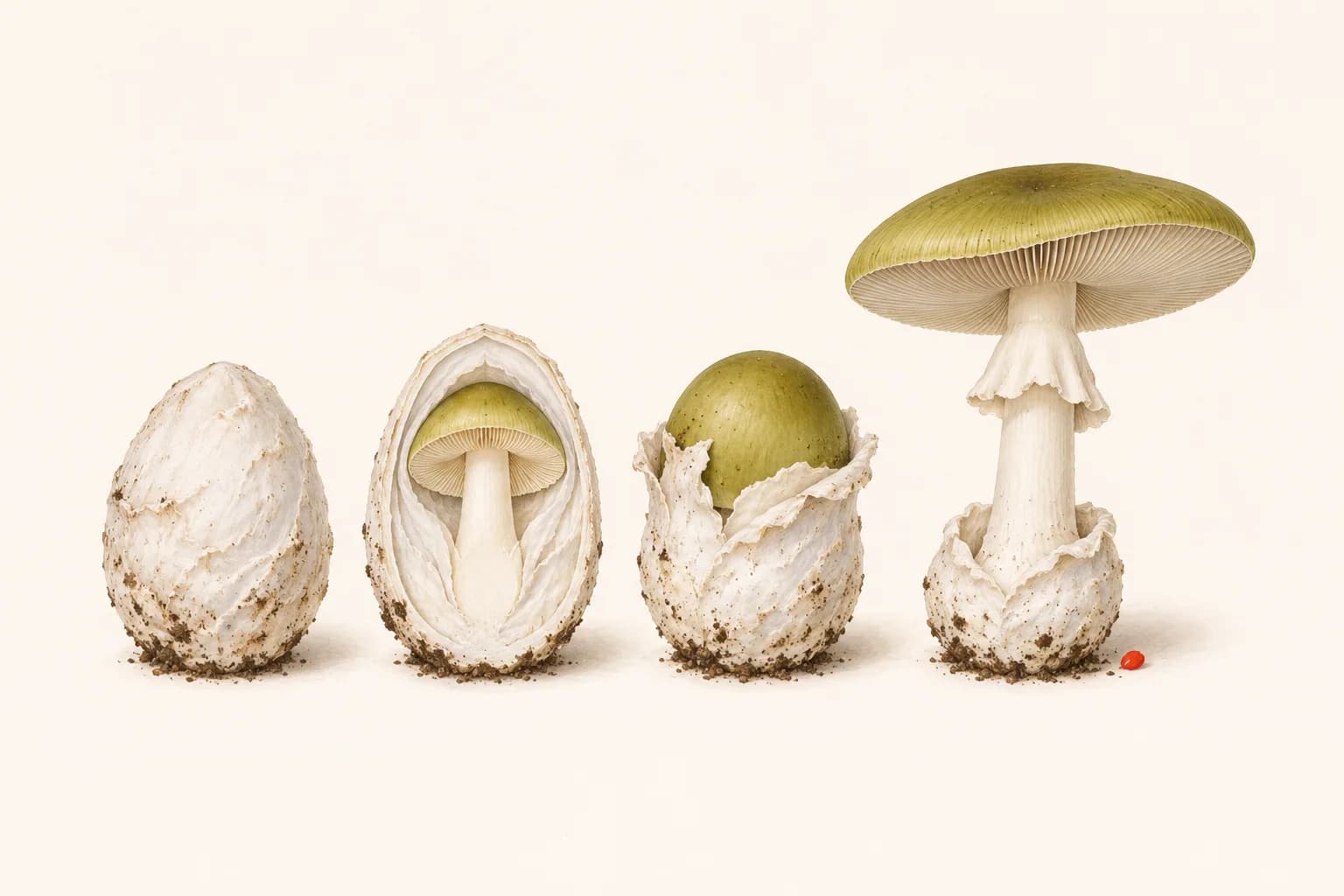
Death cap vs. yellow knight, green brittlegill, field mushroom and parasol
Poland’s Chief Sanitary Inspectorate names the two mushrooms most often confused with the death cap: the parasol mushroom and the yellow knight. Mycologists add greenish brittlegills and young field mushrooms. In mature specimens the differences are clear; in young ones they blur.
The yellow knight has its own controversy. It is on Poland’s official list of mushrooms approved for sale, yet in France 12 cases of severe muscle breakdown were described between 1992 and 2001 after large meals of it, 3 of them fatal. Researchers from Poznań, in a 2018 review, judged the evidence inconclusive. The dispute does not change the key point: a greenish mushroom with white gills, a ring and a bulb in a sac is a red flag.
- yellow knight (Tricholoma equestre): grows from October to December in dry pine forests on sand, has yellow gills, no ring and no volva, and its cap is often caked with sand
- green brittlegill (Russula virescens): the cap cracks into small patches with age, the stem is white and brittle, with no ring and no bulb; fruits from July to September
- field and horse mushrooms (Agaricus): gills turn pink, then brown, and there is no volva; Poland’s official list excludes wild Agaricus “whose gills have not yet turned pink”
- parasol mushroom (Macrolepiota procera): a large cap with brown scales, a ring that slides along the stem, a stem banded in dark stripes and a bulb without a volva
Death cap poisoning symptoms: why do they come so late?
The poisoning unfolds in phases, which is what makes it so treacherous. For the first hours nothing happens, although amanitins are already in the blood and a urine test can detect them after 90–120 minutes. After 6–24 hours come sudden vomiting, watery diarrhea and severe abdominal pain, easily mistaken for a stomach bug.
After a day or two the symptoms ease and the patient feels better. This is the false recovery: liver enzymes are rising and the toxin is destroying liver cells. Between days 3 and 6, jaundice, blood clotting problems and kidney failure set in. Without effective treatment or a liver transplant, the poisoning can be fatal within 1–3 weeks.
Medicine has cut the death rate. In the mid-20th century 60–70% of patients died; a European review of cases from 1971–1980 found 22.4%, and recent studies give 10–20%. There is no specific antidote. Doctors use silibinin from milk thistle, N-acetylcysteine and high-dose penicillin, among other treatments, and when the liver fails, a transplant may be the only option.
What to do if you suspect mushroom poisoning
If you suspect a meal contained a death cap, call 112 in Poland immediately, even if everyone feels well. Tell the dispatcher when the mushrooms were eaten and how many people shared the meal.
Doctors can consult a poison control center. In Poland they operate in Gdańsk, Kraków, Lublin, Łódź, Poznań, Rzeszów, Szczecin, Warsaw and Wrocław, among other cities.
Better still, prevent it, and remember that home tests do not work. Poland’s Ministry of Health explicitly lists an onion darkening, a silver spoon blackening and a bitter taste as false methods of spotting poisonous mushrooms. Slug bites mean nothing either: the death cap is harmless to slugs and insects.
- see a doctor immediately, even if the symptoms seem mild
- everyone who ate the same dish should see a doctor, including those without symptoms
- bring leftovers, peelings and any uneaten mushrooms: identifying the species helps treatment
- say what time the mushrooms were eaten, since a late onset of symptoms is an important clue
- do not drink milk or alcohol, which speed up absorption of the toxins
Four names for one mushroom in the early books
In Sébastien Vaillant’s flora of the Paris region, turn to plate XIV and look at figure 5. Harvard’s Farlow Library identifies it as an early portrait of the death cap. The book appeared in 1727 after Vaillant’s death. Its name for the mushroom was Fungus phalloides. The name printed in field guides today was still more than a century away.
In 1797 Christiaan Hendrik Persoon placed it among the amanitas as Amanita viridis. In 1821 Elias Fries used Agaricus phalloides. The familiar combination Amanita phalloides appeared in a work by Heinrich Friedrich Link in 1833. Someone tracing this one mushroom through old books has four different names to look up.
Which tree is the death cap actually growing with?
The nearest trunk is easy enough to spot. Underground, the roots of several trees can cross beneath a single cap. Benjamin Wolfe and Anne Pringle examined root tips in mixed woodland at Point Reyes in California to see which trees actually hosted the fungus. Of the trees available there, the native coast live oak, Quercus agrifolia, was a particular favorite.
The answer changed with the continent and even the coast. In its native Europe the death cap often partners with oaks and seldom with pines. On the eastern seaboard of North America the researchers found it associated almost exclusively with pines. The tree listed in a field guide tells you something about the woods where a mushroom was recorded. On its own it cannot settle an identification.
What can a dried death cap tell us about its travels?
The death cap is native to Poland. Was it native to California too? Anne Pringle and her colleagues checked dried mushrooms in herbarium collections. Several early Californian “death caps” turned out to be other Amanita species. The earliest specimen the team could confirm came from the garden of the Del Monte Hotel in Monterey in 1938. Another turned up on the Berkeley campus in 1945.
The labels told the researchers when the mushrooms had been found. Their DNA held a clue to where they came from. At a single California site the team found genetic variants that occurred far apart in Europe. The evidence points to a European origin for California’s death caps and suggests they made the journey more than once.
How many people in Poland are poisoned by mushrooms?
Poland’s national register of mushroom poisonings is kept by the regional sanitary station in Poznań, based on reports from medical facilities. In 2023, 13 poisonings were reported; everyone was hospitalized and no one died. Seven of the cases were caused by the death cap: 3 in the Podlaskie region and 4 in Świętokrzyskie.
In 2024 there were again 13 poisonings, with 11 hospitalizations and 1 death. The death cap poisoned 2 people, in the Lubelskie and Lubuskie regions; other cases involved morels, false morels, a saffron milk cap and fly agaric, among others. The register only includes reported cases, so mild poisonings that never reached a doctor are not in it.
Foragers’ knowledge has gaps. In the 2018 CBOS survey, 20% of Polish adults admitted they cannot tell edible mushrooms from inedible ones, and 53% can recognize only the most popular species. That is why sanitary stations run free checks in season: a certified mushroom expert or classifier will assess mushrooms picked for personal use.
Poisoning hour by hour
- 0 hThe meal. The mushrooms taste good, and cooking does not destroy amatoxins.
- 1.5–2 hAmanitins are already in the blood and urine. A urine test can detect them before any symptoms.
- 6–24 hSudden vomiting, watery diarrhea, severe abdominal pain, risk of dehydration.
- 36–72 hFalse recovery. Symptoms ease, but liver enzymes keep rising.
- Days 3–6Liver and kidney damage: jaundice, clotting problems, drops in blood sugar.
- 1–3 weeksWithout effective treatment, multiple organ failure. A liver transplant may be the only rescue.
Questions and answers
How long after eating a death cap do symptoms start?
Usually 6–24 hours after the meal. Vomiting, diarrhea and abdominal pain come first, then a false recovery, and after 3–6 days signs of liver damage.
Does cooking destroy death cap toxin?
No. Amatoxins survive boiling, frying, drying, pickling and freezing. A fatal poisoning has been described from mushrooms kept frozen for 7–8 months.
Can one death cap kill you?
Yes. About 30 g, roughly half a cap, can be a lethal dose for an adult, and a large death cap weighs about 60 g.
How do you tell a death cap from a green brittlegill?
The death cap has a ring on the stem and a bulb in a white sac (volva) at the base. A green brittlegill has neither, its stem is brittle, and its cap cracks into small patches with age.
Is there an antidote for death cap poisoning?
There is no specific antidote. Treatment includes silibinin, N-acetylcysteine and penicillin, and a liver transplant if the liver fails. Time is critical, so go to a hospital immediately.
Where can I get mushrooms checked for free in Poland?
At the local sanitary-epidemiological station (sanepid). In season, certified experts check mushrooms picked for personal use free of charge; bring whole mushrooms including the stem base.
Sources
- Polish patient portal: first aid for suspected poisoning (in Polish) (opens in a new tab)
- Wikipedia: Death cap (in Polish) (opens in a new tab)
- Wikipedia: Amanita phalloides (opens in a new tab)
- Review: amatoxin poisoning, mechanisms and management (PMC, 2024) (opens in a new tab)
- Chief Sanitary Inspectorate: sanitary report for 2023, section 6.5 (in Polish) (opens in a new tab)
- Chief Sanitary Inspectorate: public health report for 2024, section 5.5 (in Polish) (opens in a new tab)
- Chief Sanitary Inspectorate: choosing mushrooms safely (in Polish) (opens in a new tab)
- Ministry of Health: safe mushroom picking (in Polish) (opens in a new tab)
- Polish Ministry of Health regulation on mushrooms approved for sale (in Polish) (opens in a new tab)
- Bedry et al. (2001), New England Journal of Medicine: rhabdomyolysis after Tricholoma equestre (opens in a new tab)
- Pringle et al. (2009), tracing California death caps through DNA and herbarium records (opens in a new tab)
- Harvard University Herbaria, early illustrations and names of the death cap (opens in a new tab)
- ETH Library, plate XIV of Vaillant’s Botanicon Parisiense (1727), figure 5 (opens in a new tab)
- Wolfe and Pringle, host trees of the death cap in Europe and North America (opens in a new tab)
- Klimaszyk and Rzymski (2018), Toxins: review of Tricholoma equestre edibility (opens in a new tab)
- CBOS: mushroom picking survey, 2018 (in Polish) (opens in a new tab)
- Medycyna Praktyczna: list of Polish poison control centers (in Polish) (opens in a new tab)