How Poland came to have 9.3 million hectares of forest
Show on mapForest cover rose from 20.8% of Poland in 1945 to 29.6% in 2025. Where did the new forests grow, and how do surveyors measure them?
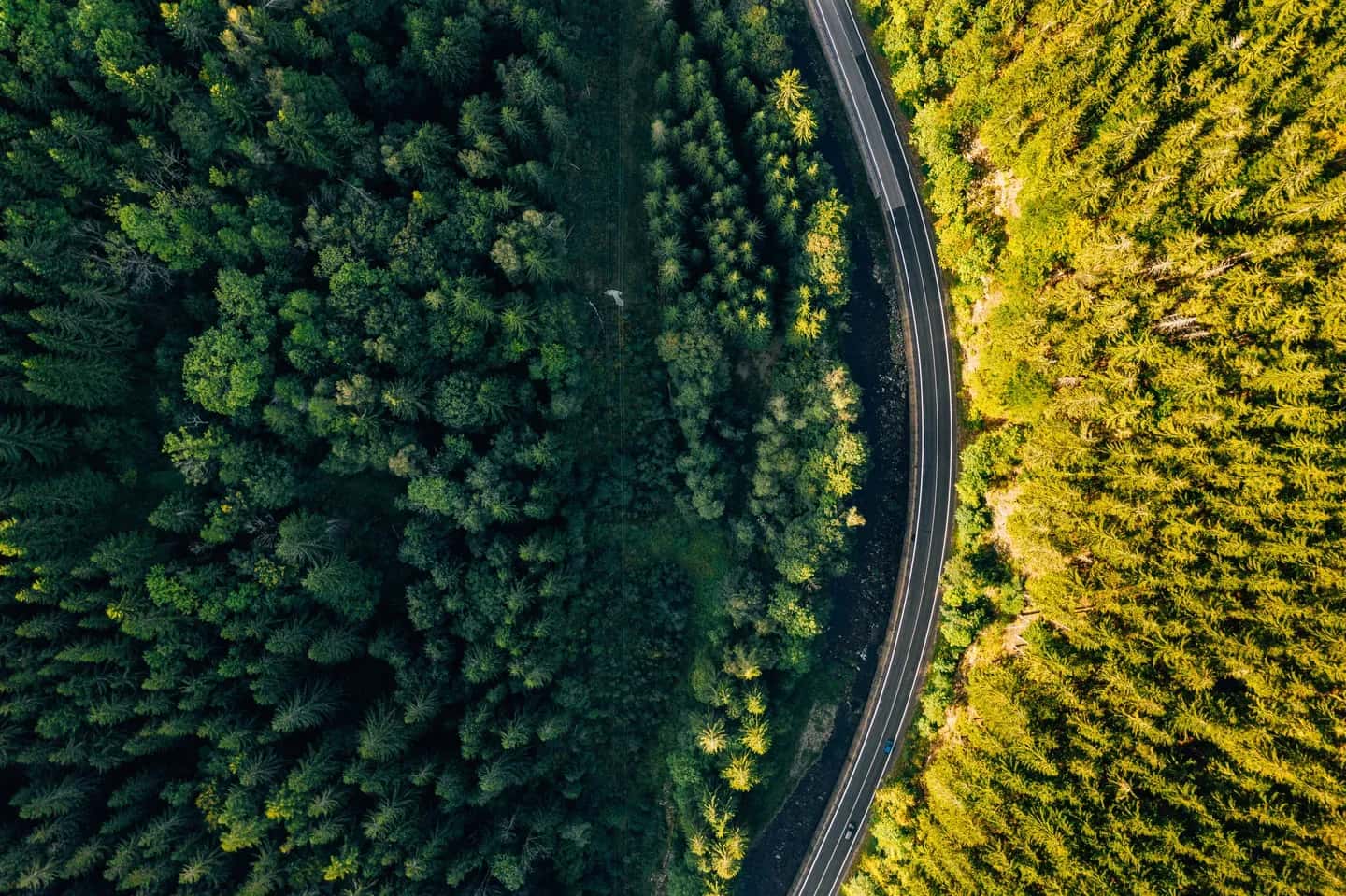
In 1945 Polish forests held about 906 million m³ of standing timber. Today they hold 2.7 billion m³, three times as much. The forest did not just spread onto new land: it also grew taller and older, and there are now two and a half times as many stands over 80 years old as there were after the war.
According to Statistics Poland (GUS), at the end of 2025 forests covered 9,290.8 thousand hectares, or 29.6% of the country. In 1945 forest cover stood at 20.8%. The difference is more than 2.5 million hectares, roughly the size of Vermont, and about half of that gain was planted by hand on former fields and wasteland.
Most of this forest is state-owned and open to the public. You can walk in it, pick mushrooms and, since 2021, legally sleep in it. Here is where it came from, what it is made of and what rules apply.
Compare forest cover in Poland, Germany and Czechia
How much forest does Poland have? The latest figures
Statistics Poland counts forest land and forests separately. Forest land, which includes forest roads, nurseries and firebreaks, totaled 9,489.5 thousand ha at the end of 2025. Forests proper, meaning land covered by trees or awaiting replanting, made up 9,290.8 thousand ha. That second number gives the 29.6% forest cover.
In 2025 the forest area grew by 1.8 thousand ha. That is a modest gain compared with the 1960s. Each resident now has 0.249 ha of forest, on paper at least.
The state or local governments own 80.9% of the forests. Lasy Państwowe, the State Forests, a self-financing state agency, manages 77.1% of all forest land, and national parks hold a small share of the rest. Private woodland makes up 19.1%, concentrated in the Mazovia (370.8 thousand ha) and Lublin (241.5 thousand ha) regions, where thousands of small woodlots were left over from old family farms.
How did Poland plant 1.5 million hectares of new forest?
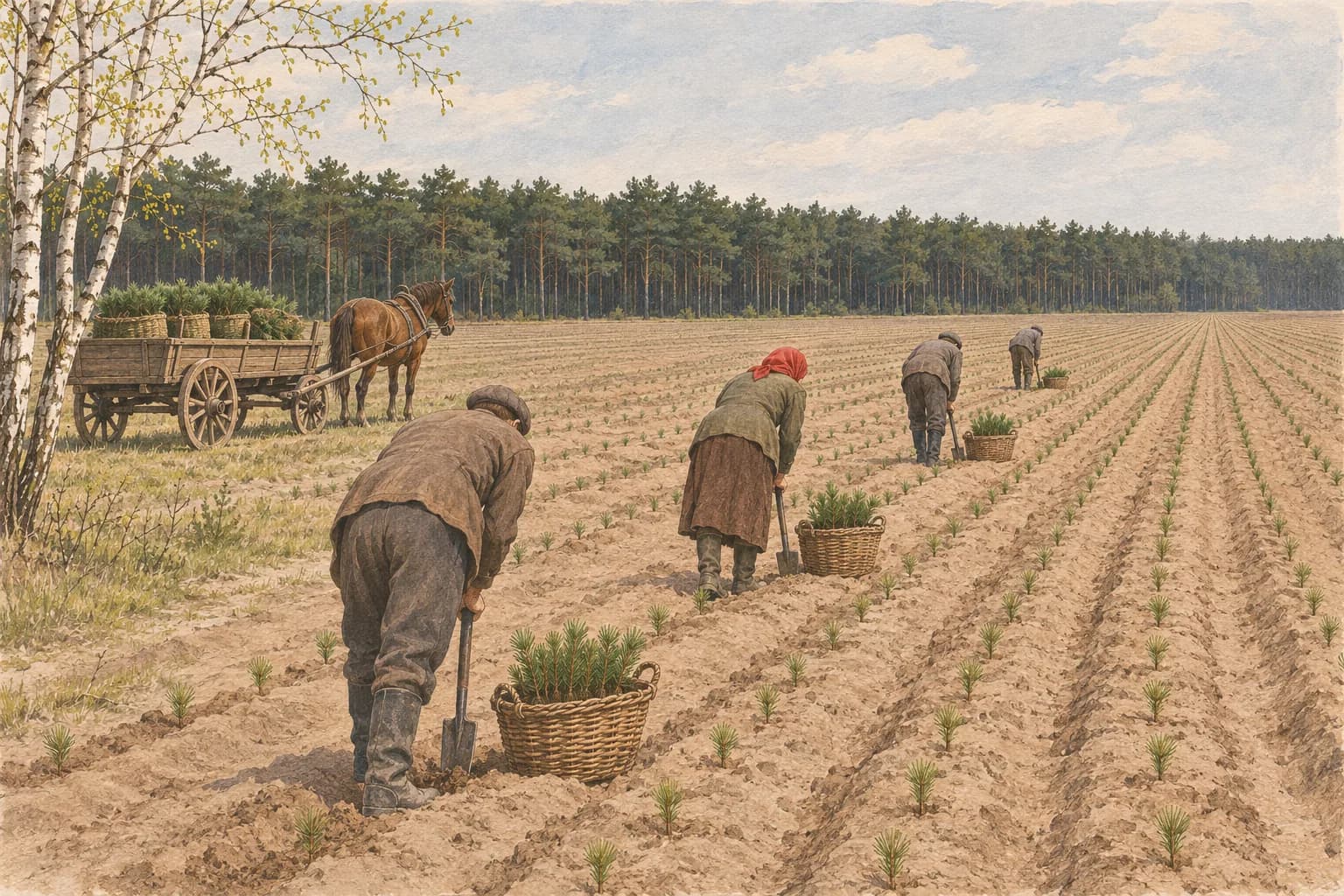
Between 1945 and 2024 Poland afforested 1,497.8 thousand ha of land that had not been forest before. The peak came in 1956–1965, when on average about 50 thousand ha of new forest were planted each year, with 62.1 thousand ha in the record year. Seedlings went mainly onto the poorest sandy fields and wasteland, where farming barely paid.
The pace then slowed. In the 1980s only 6–7 thousand ha a year were planted, picking up again after 1995, when the government adopted a National Program for Increasing Forest Cover. Its target is 33% of the country under forest by 2050. In 2025, however, just 794 ha were planted, while another 118 ha were recognized as forest that had grown back on its own.
Forest cover also grows in other ways. Birch and pine can turn a disused field or meadow into young woodland in a decade or two. Older plantings that only later show up in the land register also add to the total. On the other side of the ledger, forest is lost to roads, mines and housing.
Why are Polish forests mostly pine?
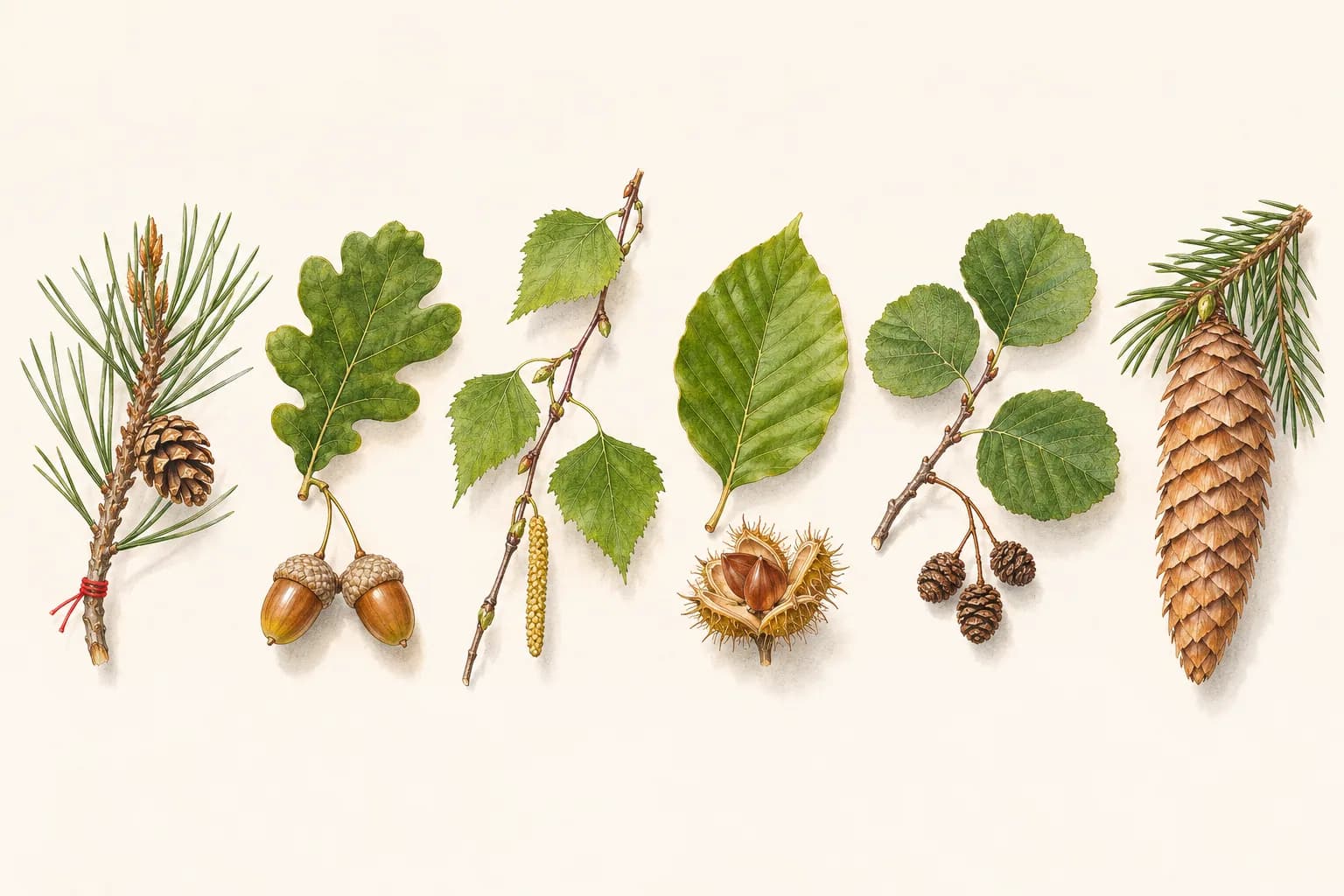
Scots pine is the dominant species on 59.1% of the forest area and accounts for 61.7% of the standing timber. The reason is soil: almost half of Poland's forest sites are poor, sandy pine-forest habitats where pine grows better than broadleaved trees. Postwar planting made the share even larger, because pine was the easiest tree to raise and plant at scale.
Foresters have been shifting the balance for decades. In 1945 broadleaved stands covered 13% of the forests, while pine and larch covered 75.5%. Today broadleaved stands make up 31.2%, and oak, beech and linden are planted on richer soils to make forests more resistant to drought, windstorms and pests.
The densest forests are the fir stands in the mountains, with an average of 423 m³ of timber per hectare, against a national average of 293 m³. Yet silver fir covers only 3.4% of the forest area.
- Scots pine: 59.1% of the forest area
- oak: 8.0%
- birch: 6.5%
- beech: 6.4%
- alder: 5.9%
- Norway spruce: 4.9%
- silver fir: 3.4%
- hornbeam, aspen, poplar and others: the rest
How old are Polish forests, and how much wood do they hold?
The average forest stand in Poland is 62 years old. Private forests are younger, at 57 years, because many grew up on former farmland in recent decades. Stands aged 41–80 years are the most common, and those over 80 now cover 2.3 million ha, or 24.7% of the forest. In 1945 the figure was 925 thousand ha.
Older forest means more wood. According to the National Forest Inventory for 2020–2024, Polish forests hold 2,721 million m³ of standing timber, an average of 293 m³ per hectare. In 1945 the stock was put at 906 million m³. In 2025 foresters harvested 38 million m³ of merchantable timber, about 4 m³ per hectare.
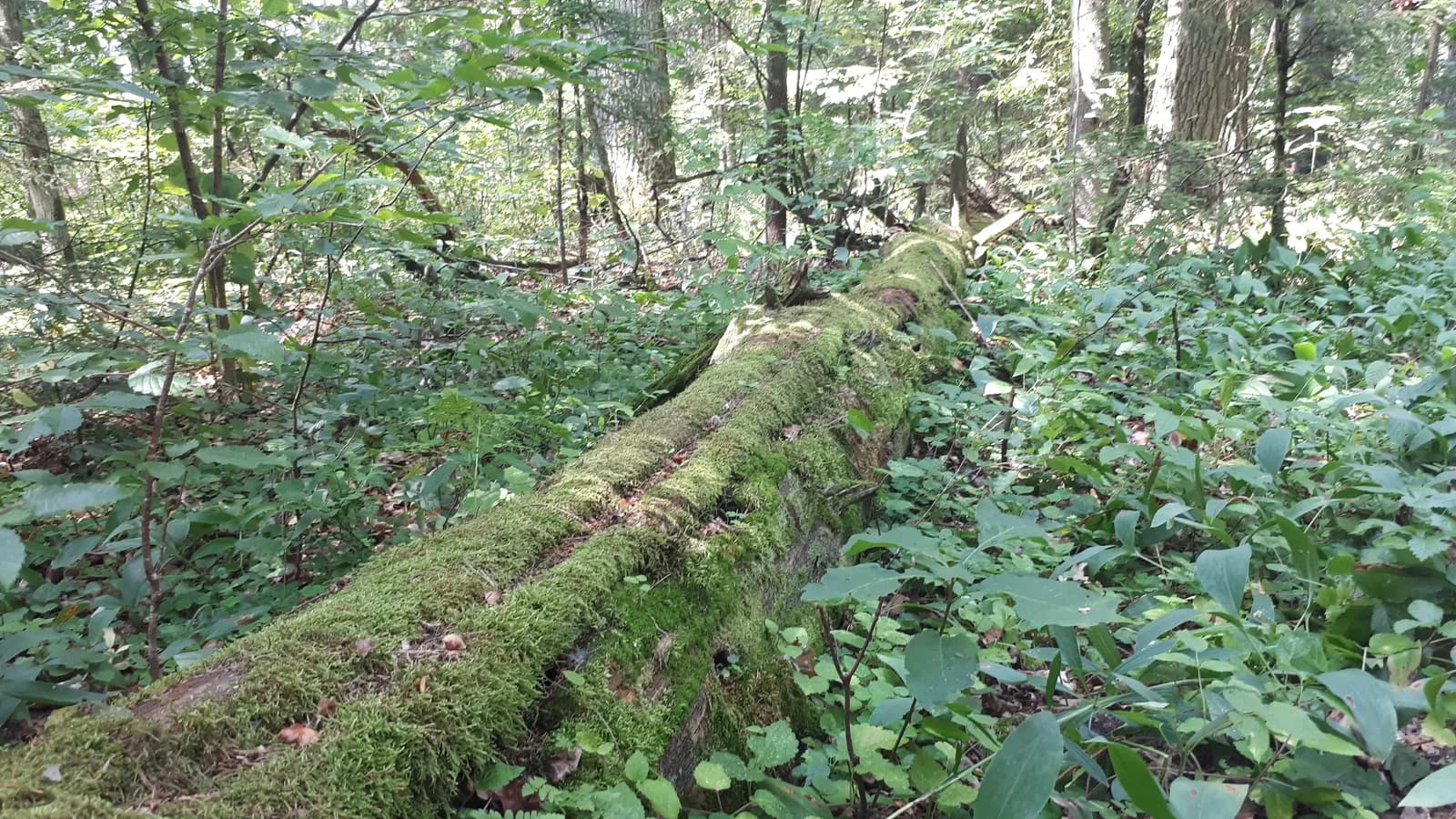
The oldest trees are protected individually as natural monuments. Poland's oldest is usually said to be a yew in Henryków Lubański in Lower Silesia, although its age is disputed, with estimates of up to about 1,300 years. In the Białowieża Forest, 300–400 living oaks have trunks more than 5 m around; they have a story of their own.
How do you measure a country’s forests?
Start with a map of Poland and draw a grid at 4 km intervals. Around each grid point, mark five sites 200 m apart in an L shape. This is how Poland’s National Forest Inventory selects its sample. Each year survey crews visit about a fifth of the permanent forest plots. Five years later they return to the same ground and can work out how much wood has grown between visits.
The crews also look down. A fallen trunk goes into the survey if its thicker end measures at least 10 cm across. Within a smaller circle around the same center, the crews record young trees and shrubs separately. The measurements tell us how much dead wood remains and which trees are coming up beneath the canopy.
A former field can grow into woodland while the land register still lists it as farmland. The inventory started surveying places like this in 2015. In 2025 it estimated that Poland had 1.19 million hectares of forest outside the register. That estimate can rise when crews identify woodland that has already stood for years. The official forest cover percentage published by Statistics Poland uses the area recorded as forest in the register.
Why do 60,000 hectares of young trees barely change the map?
In 2025 Statistics Poland recorded 60,300 hectares of forest regeneration and only around 800 hectares of new forest established on other land. Picture two rows of identical young pines. One replaces a stand that was felled. The other grows on a former field. The first counts as regeneration, on land already recorded as forest. The second counts as afforestation and adds to the forest area.
People can plant or sow the next generation. Trees can also seed themselves or send up shoots from surviving parts of older trees. Statistics Poland counts this as natural regeneration once surveyors accept the young growth as viable and it covers at least half the area. Finding a handful of seedlings in a clearing is only a first step toward counting the whole clearing in that total.
What goes into a forest gene bank?
At the Kostrzyca Forest Gene Bank, a seed collection starts with cones, fruit or loose seeds gathered from trees. What happens next depends on the species. Pine seeds can be extracted from their cones and kept in cold storage. Acorns are trickier. They tolerate drying and prolonged storage poorly, so researchers at Kostrzyca have investigated whether parts of the oak embryo can be preserved at very low temperatures.
Why store seed from trees still growing in the woods? Some collections preserve material from threatened populations. If those trees disappear from a site, the bank can supply seed to raise their descendants and bring them back once conditions improve. Two forests of the same size, both dominated by the same species, can hold quite different stocks for the next generation.
Can you go anywhere in a Polish forest? Rules and camping
Poland's Forest Act is explicit: forests owned by the State Treasury are open to the public. A permanent ban applies only to plantations under 4 m tall, research plots and seed stands, wildlife refuges, river and stream sources, and areas at risk of erosion. The local forest district can also close a forest temporarily, for instance when the fire risk is high or after a windstorm.
Picking mushrooms and berries for your own use is free and needs no permit. Cars may drive only on public roads or on forest roads signed as open to traffic, and horse riding is allowed only on roads designated by the forest district. Lighting fires outside designated spots, littering, letting dogs run loose and making noise are all banned.
Since May 1, 2021, a State Forests program called "Zanocuj w lesie" ("Spend the night in the forest") has let people sleep in the woods legally. It grew out of a pilot launched in 2019, and 425 forest districts have set aside areas for sleeping under the stars, in a hammock or in a tent. The State Forests' online map (Bank Danych o Lasach) shows the areas, and each district publishes its own rules.
- Groups of up to 9 people may stay up to 2 nights in a row in one spot without notice.
- Larger groups or longer stays: email the forest district at least 2 working days ahead and wait for a reply.
- Campfires only at designated spots; before you go, check that the forest is not closed because of fire risk.
Timeline
- 1945Forests cover 20.8% of Poland; broadleaved stands only 13%.
- 1956–1960One of these years sets the planting record: 62.1 thousand ha of new forest.
- 1961–1965The peak of postwar afforestation: 277.6 thousand ha in five years.
- 1991Parliament passes the Forest Act, opening state forests to everyone.
- 1995A national program sets the goal of 33% forest cover by 2050.
- 2019The State Forests pilot legal overnight stays in the woods.
- 2021From May 1, camping in designated forest areas is allowed in 425 forest districts.
- 2025Forests cover 9,290.8 thousand ha, or 29.6% of Poland.
Questions and answers
How many hectares of forest does Poland have?
According to Statistics Poland, 9,290.8 thousand ha of forest at the end of 2025, or 9,489.5 thousand ha including forest roads and other forest land.
What is the forest cover of Poland?
At the end of 2025 it was 29.6%. Using the international standard, which counts all forest land, the share of Poland’s land area is 31.0%.
How much forest did Poland have after World War II?
In 1945 forest cover was 20.8%. Since then almost 1.5 million ha have been planted, and natural regrowth on abandoned land has added more.
What trees grow in Polish forests?
Mostly Scots pine, the dominant species on 59.1% of the forest area, followed by oak (8.0%), birch (6.5%), beech (6.4%) and alder (5.9%).
Is mushroom picking free in Poland?
Yes. Picking for your own use in state forests needs no fee and no permit, except in areas closed to the public and in nature reserves and national parks.
Is wild camping legal in Poland?
Only in designated areas of the "Zanocuj w lesie" program in 425 forest districts. Groups of up to 9 may stay up to 2 nights without notice; larger groups must email the district.
Sources
- Statistics Poland (GUS): Forestry in 2025 (in Polish) (opens in a new tab)
- Lasy Państwowe, the State Forests (in Polish) (opens in a new tab)
- Statistics Poland (GUS): Statistical Yearbook of Forestry 2025 (opens in a new tab)
- State Forests: Polish forests (in Polish) (opens in a new tab)
- Polish National Forest Inventory survey methods (in Polish) (opens in a new tab)
- National Forest Inventory results, including woodland outside the land register (in Polish) (opens in a new tab)
- Statistics Poland’s definition of natural regeneration (in Polish) (opens in a new tab)
- Poland’s second national report on forest genetic resources (in Polish) (opens in a new tab)
- Poland’s first national report on forest genetic resources, including the Kostrzyca gene bank (opens in a new tab)
- Forest Act of 28 September 1991 (in Polish) (opens in a new tab)
- Ministry of Climate and Environment: "Zanocuj w lesie" (in Polish) (opens in a new tab)
- National Geographic Polska: Poland's oldest yew (in Polish) (opens in a new tab)