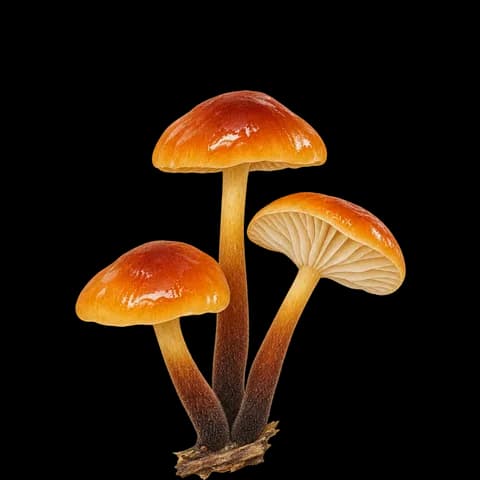
Białowieża Forest, the last of Europe's lowland primeval forests
Show on mapA remnant of the forest that covered Europe's lowlands for thousands of years, and Poland's first natural site on the UNESCO list.
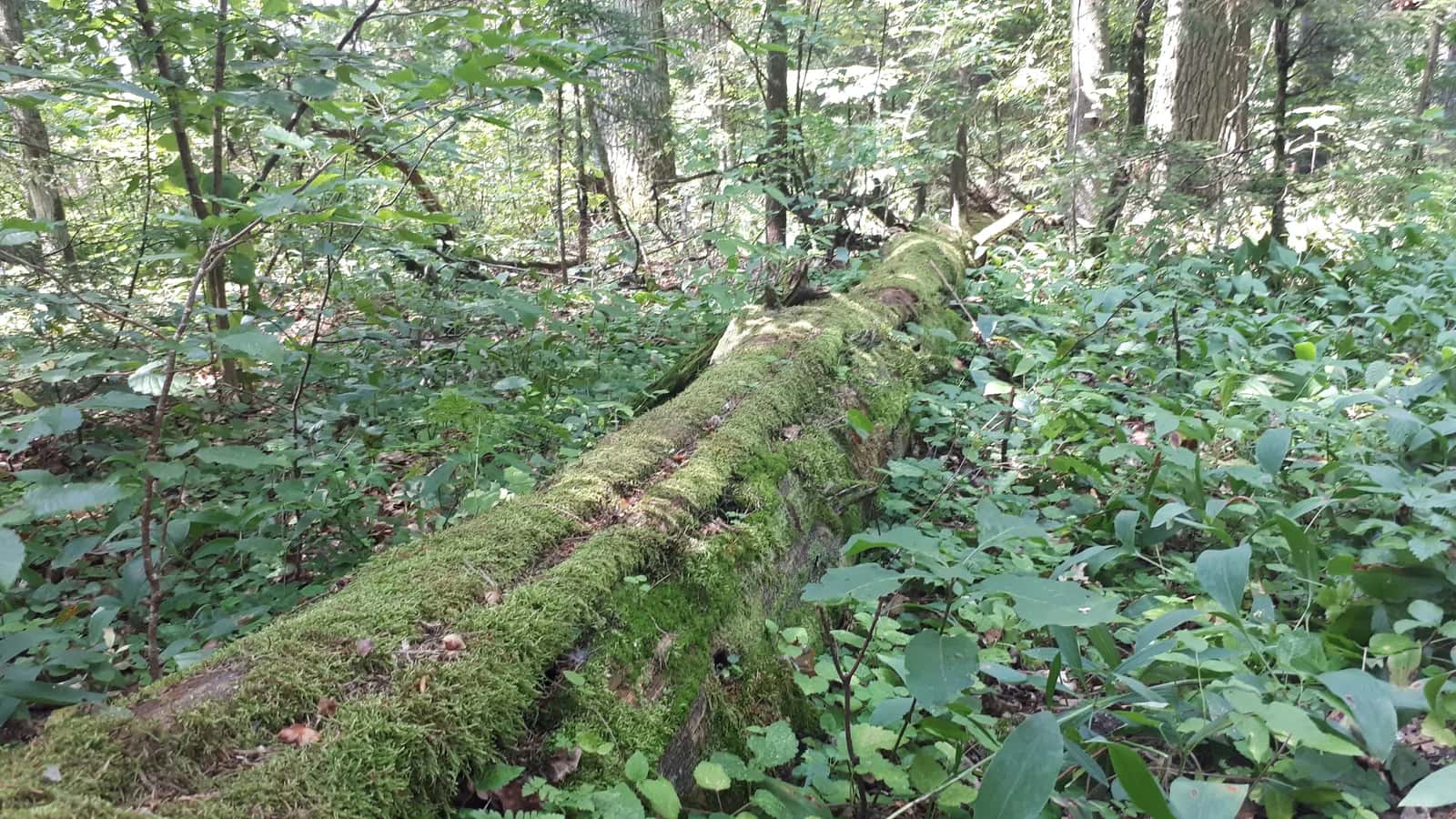
In the southern part of Białowieża National Park, nobody has felled a tree for more than a hundred years. The forest here, protected as a reserve since 1921, grows, falls and rots on its own. An oak known as the "Tsar" (Car), hailed in the 1930s as the mightiest tree in Poland, has stood dead in the forest for decades, and nobody has taken it away.
The Białowieża Forest (Puszcza Białowieska) straddles the border between Poland and Belarus. It is the best-preserved fragment of natural lowland forest left in Europe: oaks, lindens, hornbeams, spruces and pines grow side by side, and thousands of species of fungi and insects live in the dead wood. In 1979 it became Poland's first natural site on the UNESCO World Heritage List.
It survived thanks to royal hunts, the tsars' bans and the people who decided to protect it after World War I. This is the story of the forest, its biggest trees and what threatens it today.
Why did the Białowieża Forest survive?
From around 1400 the forest belonged to the king and was protected for royal hunting. Historians have confirmed 13 royal hunts and visits between 1409 and 1784. The first was described by the chronicler Jan Długosz: in the winter of 1409 King Władysław Jagiełło hunted here for eight days, and the meat was salted in barrels and shipped down the Narew and Vistula rivers as supplies for the coming war with the Teutonic Knights.
The forest was never empty, though. Kings granted nobles, towns and churches the right to use specific parts of it. In the 16th century there were 44 such grants, and in three quarters of them people collected honey and wax from "bee trees." This tree beekeeping (bartnictwo), keeping wild bees in hollows carved into living trees, was added to UNESCO's intangible heritage list in 2020 as a shared tradition of Poland and Belarus.
In 1752 King Augustus III staged a hunt here in which 57 animals were killed; a sandstone obelisk marks the occasion and is the oldest monument in the village of Białowieża. After the partitions of Poland the forest passed to the Russian tsars, who built a hunting palace in Białowieża in 1889–1894, set in an English-style park. The palace is gone, but the park, about 50 ha, is open to visitors.
What is the strict reserve in Białowieża National Park?
World War I brought heavy logging and the slaughter of game. In response, on December 29, 1921, a meeting at the forestry department in Warsaw decided to create five reserves in the forest. In 1924 a forest district called "Rezerwat" was set up, renamed Białowieża National Park in 1932 and given its present name, Białowieski Park Narodowy, in 1947.
The park covers 10,517 ha, one sixth of the Polish part of the forest. Strict protection applies to 6,059 ha, or 57.6% of the park, including 4,747 ha of the former Strict Reserve, protected without a break since 1921. Strict protection means nobody fells trees, plants, clears up after storms or fights bark beetles.
Visitors may enter this zone only with a guide licensed by the park, in groups of up to 10. The only tourist route, the Jagiełło Oak Trail, takes 3–4 hours. The oak itself, estimated at just under 450 years old and 39 m tall, was blown down on November 2, 1974. Its trunk still lies where it fell.
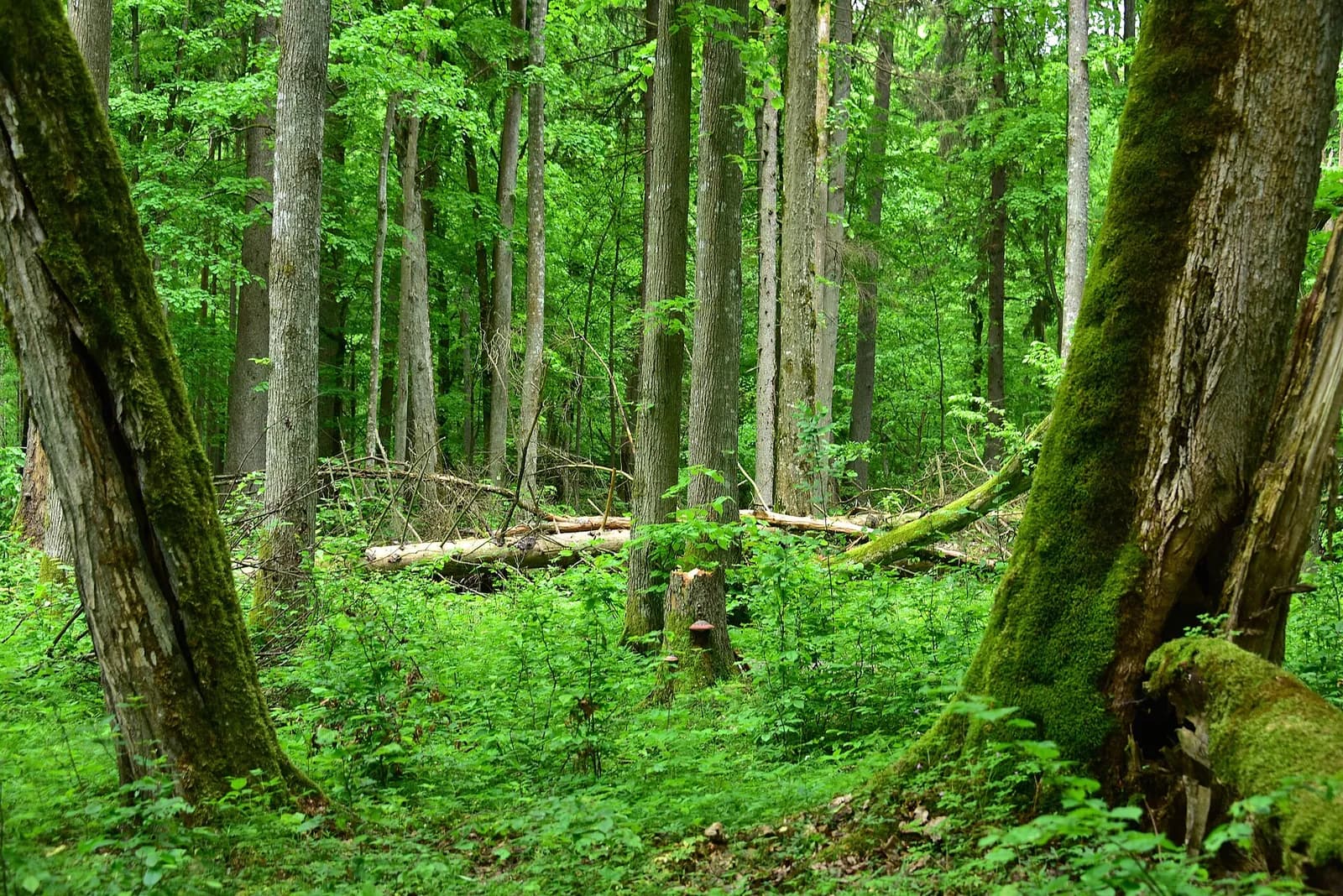
Why does dead wood matter so much in Białowieża?
In a managed forest, trees are cut long before they grow old. In Białowieża they stand until they die, then stand dead, fall and spend decades decaying on the forest floor. UNESCO singles out this wealth of dead wood, both standing and lying, as the reason for the forest's exceptional variety of fungi and of invertebrates that live in wood.
Białowieża National Park has recorded 809 species of vascular plants, more than 3,000 species of spore-bearing plants and fungi, 283 lichens, more than 8,000 invertebrates, about 120 breeding bird species and 52 mammals. Some are rarely found outside the forest because they depend on old and dead trees.
For comparison, an average Polish forest holds about 12 m³ of dead wood per hectare, and the forests of national parks, taken together, about 50 m³. These figures are our calculation based on Statistics Poland data from the 2020–2024 forest inventory.
- the Eurasian pygmy owl, Europe's smallest owl, nests in holes carved by woodpeckers
- three-toed and white-backed woodpeckers feed on dying spruces and broadleaved trees
- beetles such as the longhorn Monochamus urussovi, the hermit beetle and Boros schneideri depend on old and dead wood
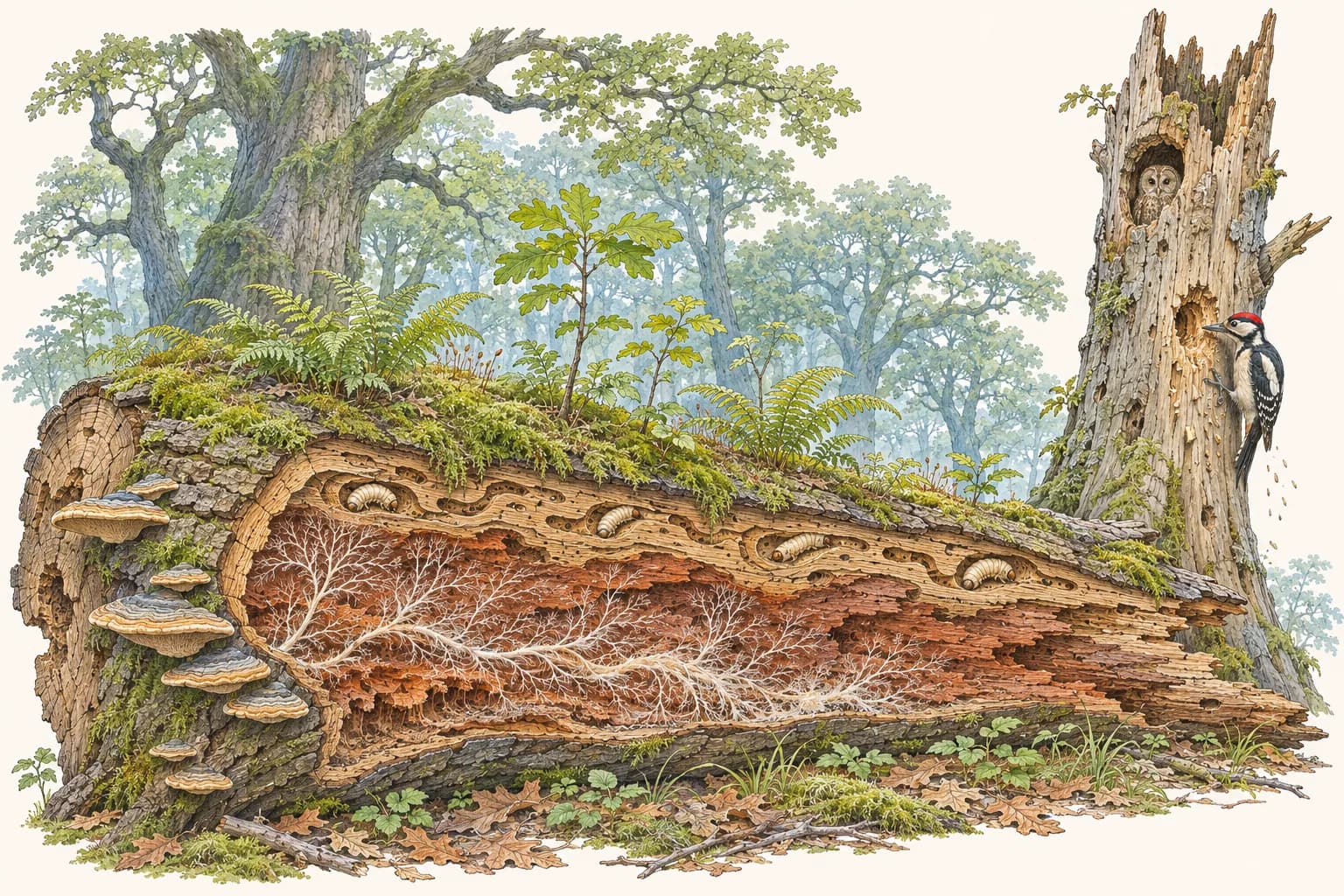
What can you hear by the forest ponds in spring?
In a warm year the amphibians of Białowieża start moving toward their breeding ponds in late March. In a cooler year the migration can wait until April. Common frogs, moor frogs and common toads are among the first to call. For the brief courtship season, male moor frogs turn blue. Later comes one of the loudest sounds in the forest. From April almost to the end of June, the chorus of eastern tree frogs carries well beyond the ponds.
The forest is home to 13 amphibian species. On the road from Białowieża to Pogorzelce and beside the ponds in Palace Park, the spring migration crosses the path of traffic. The low fences you may see there in spring are part of the park’s annual rescue effort. Rangers and volunteers help the animals across the road, including newts making their way to water alongside the frogs and toads.
Which tree hole does a great tit choose?
Hang a nest box and you have already decided how deep the chamber will be and how wide to drill its round entrance. In Białowieża’s old forest the birds do the choosing. Marta Maziarz and her colleagues gathered records over 39 breeding seasons. Great tits usually nested in living trunks, in deep hollows that had formed without a woodpecker excavating them. From the outside the entrance often looked like a narrow slit.
Only 6% of the 308 entrances measured were round. The median depth of a cavity was 30 cm. A great tit builds its nest at the bottom, largely out of moss. The birds laid down a thicker bed of nest material in deeper cavities, yet the nest still sat farther from the entrance. A slit in the bark gives little away about how far inside the bird is sitting.
How did archaeologists find old fields beneath the canopy?
Walking through the Szczekotowo reserve, you could easily miss the low earth bank at the edge of an ancient field. An airborne laser survey picked up reflections from the ground between the trees. On a digital map made from those returns, the banks form a pattern of adjoining plots. Close by are burial mounds and the remains of kilns where people made charcoal. These traces share a patch of forest but come from different periods.
Archaeologists checked selected features on foot with GPS receivers, consulted archival material and dug small test trenches. A slight rise on the map becomes easier to interpret once you know what lies beneath it. That combination makes it possible to point to particular places in today’s woodland where people cultivated fields or worked timber, each with a history of its own.
How big are the oaks of Białowieża? The Tsar, Dunin and others
The forest's most famous oak is the "Tsar." In the 1930s it was recognized as the mightiest tree in what was then Poland. In 1953 it was entered in the register of natural monuments as number 49, and by the end of its life its trunk measured 660 cm around. It has stood dead for about 44 years, which researchers of Białowieża's trees say may be a record for an oak.
Between the world wars the strict reserve had 20–30 oaks more than 5 m in circumference. Today 300–400 such oaks are alive in the forest, most of them in the strictly protected zone. On the Wolf's Trail in the north of the park grows an oak over 5.5 m around and about 350 years old. The tallest trees are spruces: they are the only species here known to have passed 50 m.
In 2022 the Dunin oak from the Białowieża Forest won the European Tree of the Year contest. Near the village of Pogorzelce, a nature trail called the Trail of Royal Oaks and Lithuanian Princes leads past several dozen old oaks, each named after a ruler of Poland or Lithuania.
Logging and a border wall: what threatens the forest?
In 2014 UNESCO enlarged the listing: the Polish part grew from 5,069 ha to 59,576 ha and now includes forests managed by the State Forests. The whole site, on both sides of the border, covers 141,885 ha, with a 166,708 ha buffer zone. It is listed under natural criteria, for its ecosystems and biodiversity.
In 2017, during an outbreak of the European spruce bark beetle, logging took place in the Polish part of the forest, including century-old spruces and pines. The European Commission took Poland to the EU Court of Justice, which ruled on April 17, 2018, that Poland had breached EU law protecting Natura 2000 sites.
In 2022 Poland built a barrier 186 km long and 5.5 m high along the border with Belarus, cutting through the forest as well. Scientists say it hampers the movement of large animals such as lynx and bison. UNESCO lists the border fence among the threats that need continuous monitoring.
Timeline
- 1409King Władysław Jagiełło hunts in the forest before the war with the Teutonic Knights, the first recorded royal hunt.
- 1752King Augustus III holds a hunt: 57 animals and an obelisk, the oldest monument in Białowieża.
- 1889–1894The tsar builds a hunting palace and park in Białowieża.
- 1921On December 29, five reserves are created, the seed of the national park.
- 1932Białowieża National Park is established, under its present name since 1947.
- 1974A storm topples the Jagiełło Oak in the strict reserve.
- 1979UNESCO World Heritage listing, extended to the Belarusian side in 1992.
- 2014UNESCO enlarges the Polish part of the site from 5,069 ha to 59,576 ha.
- 2018The EU Court of Justice rules that logging in the forest breached EU law.
Practical info
- Where
- Białowieża, in Podlaskie province in northeastern Poland, on the Belarusian border. The park headquarters, museum and Palace Park are in the village center.
- Getting there
- By car or bus via the town of Hajnówka, then about 20 km on the road to Białowieża. Bikes can be rented in the village.
- Tickets
- The strict reserve can be visited only with a guide licensed by the park, booked through local travel agencies. Tickets for park sites are also sold online; check current prices on bpn.gov.pl.
- On site
- The Nature and Forest Museum (a 55-minute tour), the Palace Park, and the Bison Show Reserve 3 km before Białowieża. The northern part of the park needs no guide and has more than 25 km of hiking trails and 14 km of bike trails.
- Best time
- Forest areas are open from half an hour before sunrise to half an hour after sunset. In winter and early spring, bison gather at feeding sites. Check the park's visitor notices before you go, as restrictions may apply near the border.
Questions and answers
Do you need a guide to visit the Białowieża Forest?
Only for the strict reserve of Białowieża National Park, in groups of up to 10. The northern part of the park and trails in the surrounding forest can be explored on your own.
How big is Białowieża National Park?
It covers 10,517 ha, one sixth of the Polish part of the forest. Strict protection applies to 6,059 ha, or 57.6% of the park.
When did the Białowieża Forest become a UNESCO site?
In 1979, as Poland's first natural World Heritage Site. The Belarusian part was added in 1992, and the site was greatly enlarged in 2014.
Where can you see bison in Białowieża?
Guaranteed at the Bison Show Reserve on the road from Hajnówka. In the wild, in winter at the Kosy Most and Czoło feeding sites, and at other times often in meadows near Pogorzelce and Teremiski.
Is Białowieża Forest the last primeval forest in Europe?
It is the best-preserved natural lowland forest left in Europe, protected strictly in part since 1921. Other old-growth fragments exist, mainly in mountains and in the north.
Can you bring a dog to Białowieża National Park?
Not into the strictly or actively protected areas, the museum or the Bison Show Reserve, except assistance dogs. In the Palace Park dogs must be leashed and muzzled.
Sources
- UNESCO: Białowieża Forest (opens in a new tab)
- Białowieża National Park (in Polish) (opens in a new tab)
- Wikipedia: Białowieża Forest (in Polish) (opens in a new tab)
- Białowieża National Park (in English) (opens in a new tab)
- M. Maziarz and colleagues on natural great tit nest sites in Białowieża (opens in a new tab)
- Antiquity research report on Białowieża’s archaeological heritage (opens in a new tab)
- Białowieża National Park bulletin on forest amphibians (2025, in Polish) (opens in a new tab)
- Białowieża National Park: about the park (in Polish) (opens in a new tab)
- Białowieża National Park: nature protection (in Polish) (opens in a new tab)
- Białowieża National Park: visitor FAQ (in Polish) (opens in a new tab)
- T. Samojlik, Mammal Research Institute PAS: traditional use of the Białowieża Forest, 15th–18th c. (in Polish) (opens in a new tab)
- OKO.press: the custodian of Białowieża's trees (2025, in Polish) (opens in a new tab)
- EU Court of Justice: press release on case C-441/17 (opens in a new tab)
- UNESCO: Tree beekeeping culture, decision 15.COM 8.b.42 (opens in a new tab)
- National Geographic: the Polish-Belarusian border wall (opens in a new tab)
- Wikipedia: Jagiełło Oak (opens in a new tab)
- Statistics Poland: Statistical Yearbook of Forestry 2025 (opens in a new tab)