Every bison in the world descends from the same twelve animals
Show on mapA hundred years ago not a single European bison lived in the wild. The species was rebuilt from just over a dozen zoo animals.
In 1923 a census in Berlin counted 54 European bison in the whole world, every one of them behind a fence. Today there are more than 12,000, and all of them descend from just twelve animals. One of those was a Caucasian bison bull named Kaukasus, and his genes still set the bison of Poland's Bieszczady Mountains apart from those of Białowieża.
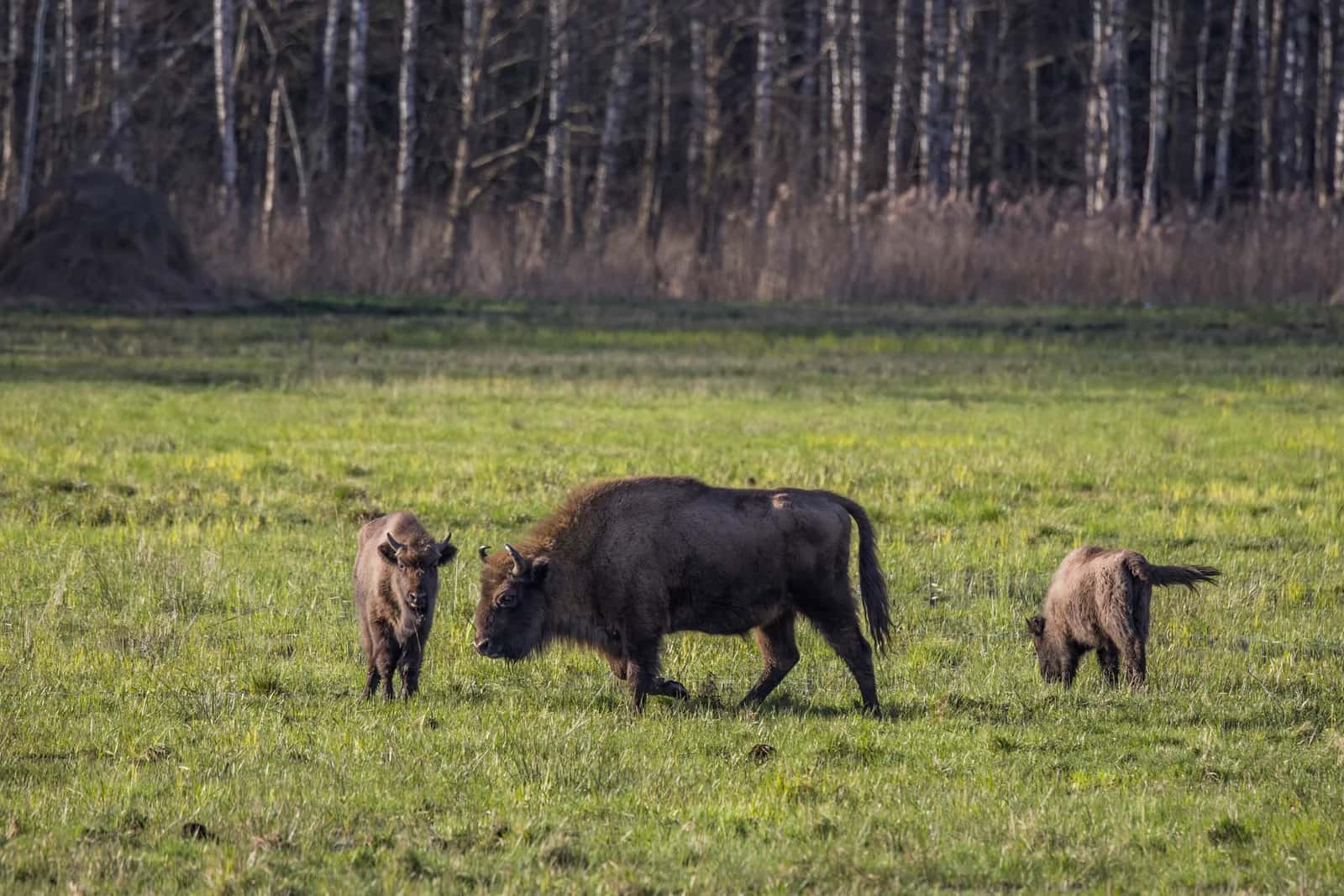
The European bison, or wisent (żubr in Polish), is Europe's largest land mammal. A bull weighs nearly 800 kg, and the biggest reach 900 kg. In the Middle Ages bison still roamed many of the continent's forests, but hunting and forest clearance pushed them into a few last refuges, and in 1919 a poacher shot the last free-living bison in the Białowieża Forest.
Saving the wisent became a model for rescuing other species. According to the European Bison Pedigree Book, Poland had 3,060 bison at the end of 2024, one in four of all the bison on Earth. Here is how that happened, and where to see them today.
How did the European bison go extinct in the wild?
In the mid-19th century about 1,800 bison lived in the Białowieża Forest, protected by the Russian tsars, who kept the forest as a hunting ground. World War I changed everything: soldiers and poachers shot bison for meat, and after the war none were left in the forest. The last free Białowieża bison was killed in 1919.
The other subspecies, the Caucasian bison, lived in the Caucasus Mountains and died out in the wild in 1927. The species survived only in zoos and private game parks, and some of those animals had been crossed with American bison or domestic cattle, which made them useless for saving the species.
Who saved the bison? The Pedigree Book and the return to Białowieża
In 1923 the Polish zoologist Jan Sztolcman appealed for the bison's rescue at an international nature protection congress in Paris. That same year an International Society for the Protection of the European Bison was founded in Germany. In 1931 one of its members, Goerd von der Groeben, listed every surviving purebred bison, and that list became the start of the European Bison Pedigree Book.
It was the world's first studbook kept to save a threatened species. Every bison gets a number, and breeders pair animals so as to avoid mating close relatives. Since 1991 the book has been edited at Białowieża National Park, which publishes a world census of the species every year.
In 1929 the first bison arrived in Białowieża from zoos in Germany and Sweden, and in 1930 the first calf was born there. The herd survived World War II: after the war there were 22 bison in the forest and about 90 in the world. In 1952 the first bison were released back into the wild in the Białowieża Forest.
Lowland and Lowland-Caucasian bison: what is the difference?
Since breeding began, bison have been managed as two separate lines. The Lowland line, also called the Białowieża line, descends from seven founders and carries only lowland bison genes. The Lowland-Caucasian line descends from all twelve founders, including one Caucasian bull, Kaukasus, that ended up in a German breeding center in the early 20th century.
The two lines are bred separately, and the Pedigree Book keeps them strictly apart. In Poland, only the bison of the Bieszczady Mountains belong to the Lowland-Caucasian line. In 1963 Poland decided to remove Lowland-Caucasian animals from its breeding centers to keep the two lines apart for good, and those were the bison sent to the Bieszczady.
The price of such a narrow start is very low genetic diversity. A 2022 pedigree analysis put inbreeding at about 44% in the Lowland line and 26% in the Lowland-Caucasian line. Scientists suspect this is linked to the bison's susceptibility to disease, such as posthitis, an inflammation of the prepuce in bulls.
How many bison live in Poland, and where?
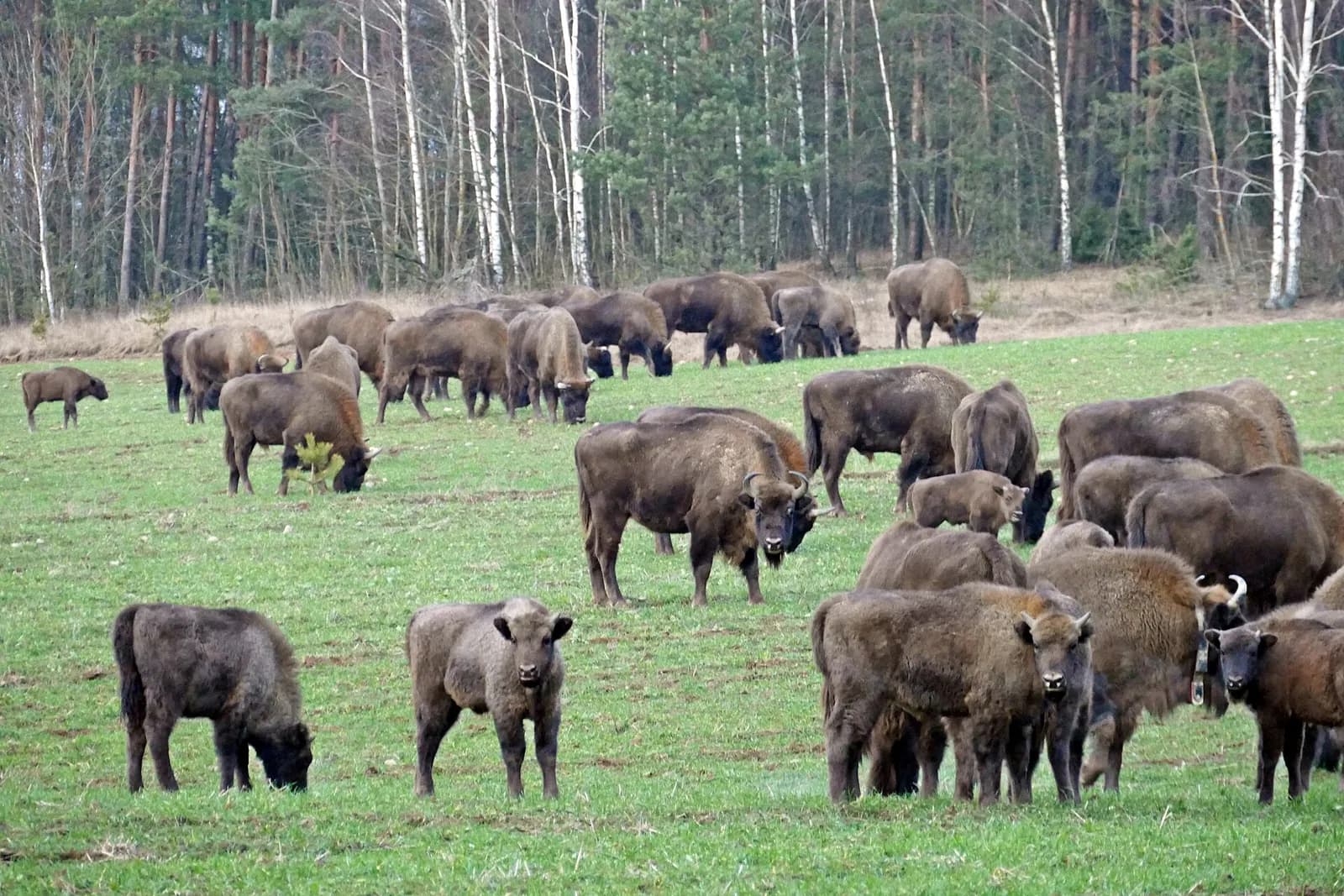
At the end of 2024 Poland had 3,060 bison, about 2,900 of them in free-living herds and the rest in enclosures. The world total was 12,209. Growth has been fast: at the end of 2017 Poland had 1,873 bison, so the population rose by more than 60% in seven years.
The newest herds are in the Augustów Forest, where seven young bison from the Borecka Forest were released in 2018, and in the Romincka Forest and the Janów Forests, both founded in 2021. Foresters move animals to new areas because large, dense herds raise the risk of disease and damage to farm crops.
- Białowieża Forest: 870 (Polish side; another 726 on the Belarusian side)
- Bieszczady Mountains: 764
- Knyszyn Forest: 562
- herds in western Poland: 465
- Borecka Forest: 138
- Augustów Forest: 31
- Janów Forests: 14
- Romincka Forest: 11
Where to see European bison in Poland
For a guaranteed sighting, go to the Bison Show Reserve on the road from Hajnówka to Białowieża, 3 km before Białowieża. Its roughly 27 ha hold a group of bison along with moose, red deer, Polish konik horses, wolves, lynx and żubroń, a bison and domestic cattle cross. In the wild, bison in the Białowieża Forest gather in winter at the Kosy Most and Czoło feeding sites, linked by a yellow-marked trail, "Tropem Żubra" (On the Bison's Trail), about 20 km long.
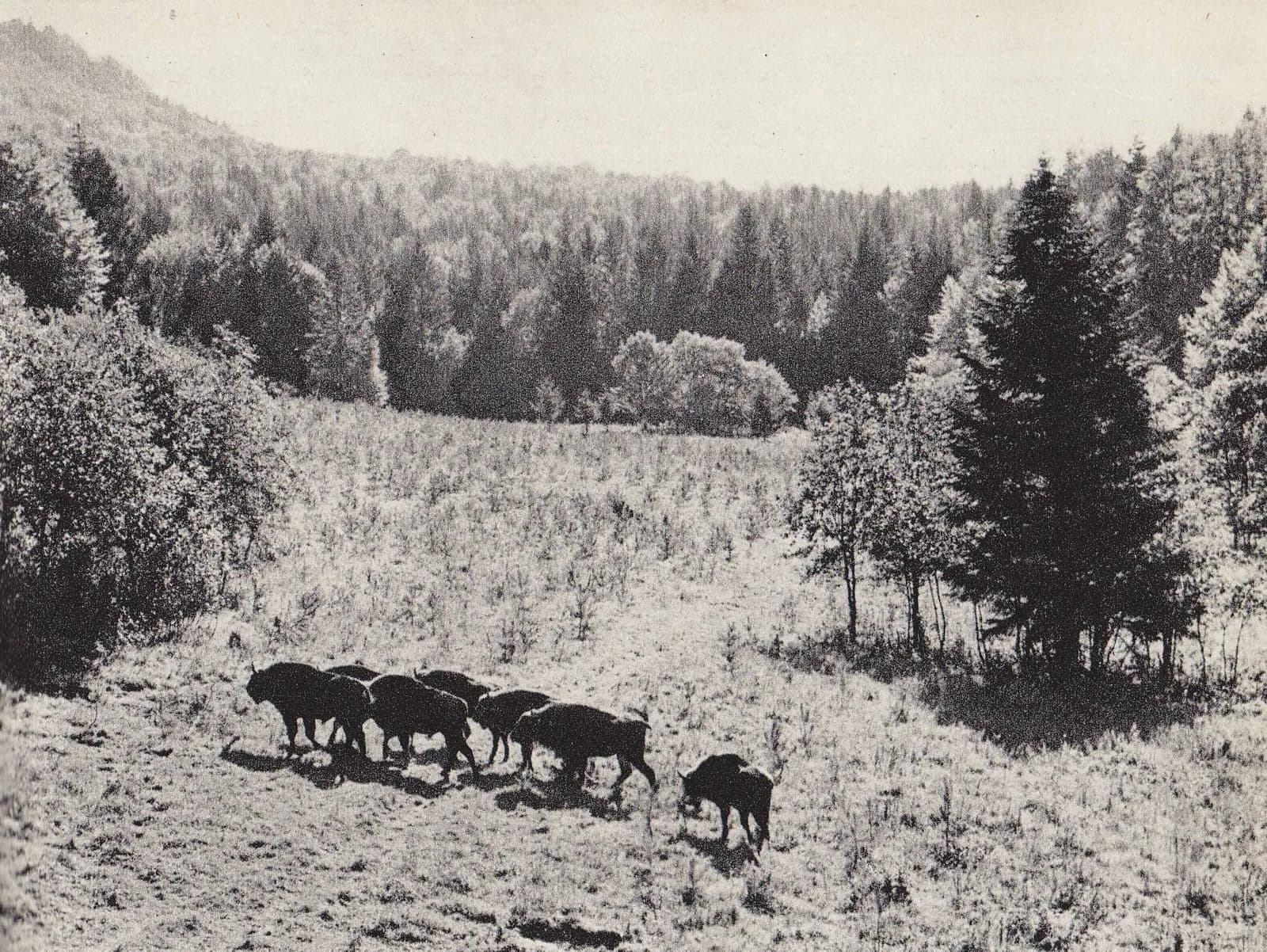
Bison returned to the Bieszczady on October 30, 1963, when the first animals from Pszczyna and Niepołomice arrived at an enclosure in the Stuposiany forest district. They were released in May 1964. Today you can see them at the show enclosure in Muczne, opened in 2012, and in winter herds come to the feeding racks.
There are also show enclosures at Kopna Góra in the Knyszyn Forest and at Wolisko in the Borecka Forest, 10 km from the village of Kruklanki. Captive herds also live in Pszczyna and Niepołomice, among other places. Never approach free-living bison closer than 50 m.
Which plants hitch a ride with a bison?
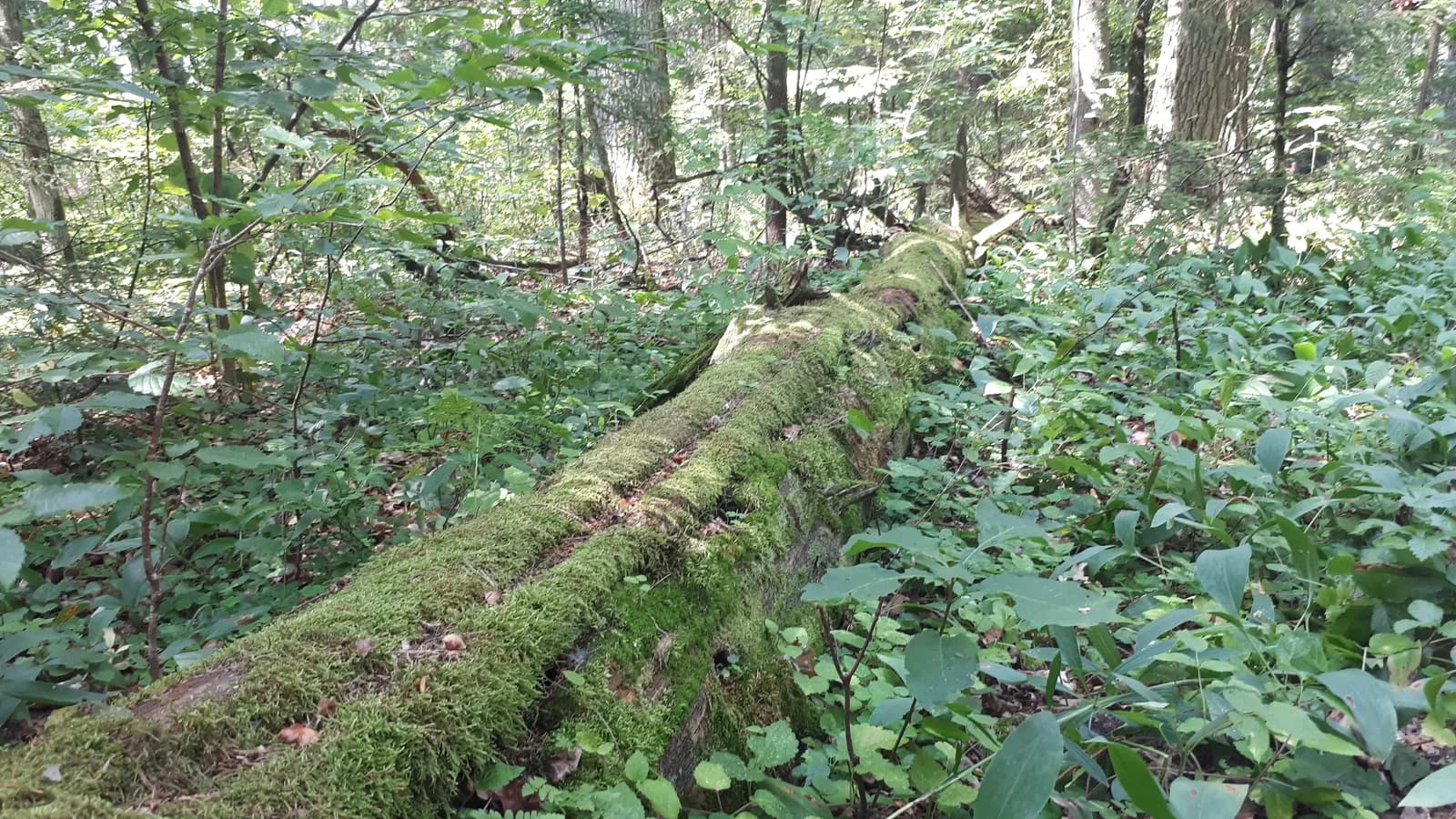
When a bison grazes, it swallows seeds along with the plants. Some can still germinate after passing through its gut. In Białowieża, Bogdan Jaroszewicz and Ewa Pirożnikow watched what grew from 75 samples of bison dung. They counted 12,392 seedlings belonging to 173 species. The study included both captive and wild animals. Samples from free-ranging bison alone yielded 102 plant species.
The seeds can leave a trace years later. In a second experiment, Jaroszewicz sampled the soil in a conifer wood in Białowieża where bison dung had been deposited three years earlier. The top 5 cm of soil held more seeds of stinging nettle, soft rush and remote sedge than nearby soil samples did. A bison can carry seeds from a wet meadow into a stand of conifers, where they can stay in the ground long after the animal has moved on.
How does snow change a bison’s winter range?
During winters from 2005 to 2012, researchers in Białowieża tracked 43 bison fitted with radio or GPS collars. They compared the locations of 19 cows and 24 bulls with weather records and the distance to winter feeding sites. On colder days the animals stayed closer to the fodder. They also moved closer when snow lay deeper over the plants they could graze.
During the warmest spells the cows ranged over about four times the area they used on the coldest days with snow on the ground. For bulls the area was 28 times as large. Even within one season a thaw could take the animals well beyond the area they had used during a cold spell.
What happens in the forest after a bison dies?
Between 1997 and 2001, Nuria Selva’s team watched what came to feed on 12 bison carcasses in Białowieża. Across 303 checks they recorded 13 species of birds and mammals. Ravens, red foxes and wolves were the most frequent visitors. Ravens and white-tailed eagles turned up more often at carcasses in clearings than under the canopy. A carcass fed visitors for an average of 106 days.
Long after the birds and mammals have gone, the soil can still carry a trace. In a separate study of six carcasses, researchers compared soil directly under the center of each animal with samples taken farther away. Both calcium levels and pH were higher at the center. The effect was detectable up to seven years after death. Most of the other nutrients tested showed a much less consistent pattern.
How big is a European bison, and how does it live?
Bulls are far more massive than cows and have a distinctive hump on their shoulders. Bison see poorly but have an excellent sense of smell, and a dense three-layer coat keeps them warm in winter. In spring they molt into a thinner summer coat.
Bison live in herds led by cows, while adult bulls often roam alone or in small groups. Their typical call is a low grunt. Despite their bulk they can run at 60 km/h, so a meeting with a bison in the forest is something to take seriously.
- weight: bulls nearly 800 kg, cows about 550 kg
- height at the shoulder up to 180 cm, body length up to 300 cm
- eats about 50 kg of food a day, 80% of it grasses and herbs
- pregnancy lasts 9 months; calves are born from May to July
- lives 18–24 years; cows live longer than bulls
Timeline
- 1919The last free bison in the Białowieża Forest is killed.
- 1923A census counts 54 bison worldwide. An international society to save the species is founded.
- 1927The Caucasian bison dies out in the wild.
- 1929The first bison from zoos arrive in Białowieża.
- 1952Bison return to the wild in the Białowieża Forest.
- 1963On October 30, the first Lowland-Caucasian bison reach the Bieszczady Mountains.
- 1991The European Bison Pedigree Book moves to Białowieża National Park.
- 2021New free herds in the Romincka Forest and the Janów Forests.
- 2024Poland has 3,060 bison; the world has 12,209.
Practical info
- Where
- The Bison Show Reserve near Białowieża, the enclosure at Muczne in the Bieszczady Mountains, Kopna Góra in the Knyszyn Forest and Wolisko in the Borecka Forest.
- Best time
- Free-living bison are easiest to see in winter and early spring, when they gather at feeding sites. In summer they scatter through the forest.
- Getting there
- The Bison Show Reserve is on the road from Hajnówka to Białowieża, with a turnoff to a parking lot by the visitor pavilion. Muczne is in Lutowiska municipality, deep in the Bieszczady Mountains.
- Tickets
- Show enclosures charge admission, and opening hours differ in and out of season. Check current prices and hours on the park or forest district website.
- On site
- Keep at least 50 m from free-living bison, never feed them, and never get between a cow and her calf. Drive slowly on forest roads, as bison often step onto the road.
Questions and answers
How much does a European bison weigh?
An adult bull weighs nearly 800 kg, and the largest reach 900 kg. A cow weighs about 550 kg.
How many European bison are there in Poland?
According to the European Bison Pedigree Book, 3,060 at the end of 2024, about 2,900 of them in free-living herds. That is roughly one in four bison in the world.
Where can you see wild bison in Poland?
The biggest herds live in the Białowieża Forest, the Bieszczady Mountains and the Knyszyn Forest. They are easiest to spot in winter near feeding sites.
Are European bison dangerous?
Bison usually avoid people, but they are large wild animals that can run at 60 km/h. Keep at least 50 m away, especially from cows with calves.
Why are the Bieszczady bison different?
They belong to the Lowland-Caucasian line, which carries genes of a Caucasian bison bull. The Białowieża herd and the other Polish herds belong to the Lowland line.
What is a żubroń?
A cross between a European bison and domestic cattle. You can see żubroń at the Bison Show Reserve near Białowieża.
Sources
- Wikipedia: European bison (in Polish) (opens in a new tab)
- Białowieża National Park (in Polish) (opens in a new tab)
- Winter tracking study of bison movements in Białowieża (opens in a new tab)
- N. Selva and colleagues on scavengers at European bison carcasses (opens in a new tab)
- Field study of soil and vegetation around bison carcasses (opens in a new tab)
- B. Jaroszewicz and E. Pirożnikow on plant species dispersed by bison (2008) (opens in a new tab)
- B. Jaroszewicz on bison and the soil seed bank in coniferous forest (2013) (opens in a new tab)
- Białowieża National Park: European Bison Pedigree Book (in Polish) (opens in a new tab)
- European Bison Pedigree Book 2024 (opens in a new tab)
- Białowieża National Park: Bison Show Reserve (in Polish) (opens in a new tab)
- State Forests: bison facts infographic (in Polish) (opens in a new tab)
- Scientific Reports (2024): a reduced SNP panel for the European bison (opens in a new tab)
- PLOS ONE (2022): genealogical analysis of the European bison population (opens in a new tab)
- PAP: 60 years since bison returned to the Bieszczady (in Polish) (opens in a new tab)
- Ministry of Climate and Environment: new bison herd in the Augustów Forest (in Polish) (opens in a new tab)
- Dzieje.pl: bison in Białowieża National Park (in Polish) (opens in a new tab)
- Mazury.travel: bison in the Borecka and Romincka forests (in Polish) (opens in a new tab)
- RMF24: the bison enclosure at Kopna Góra (in Polish) (opens in a new tab)