The mushroom that grows in the dead of winter
Show on mapThe velvet shank fruits after the frosts, from late fall to spring. Frozen solid, it can thaw and keep growing.
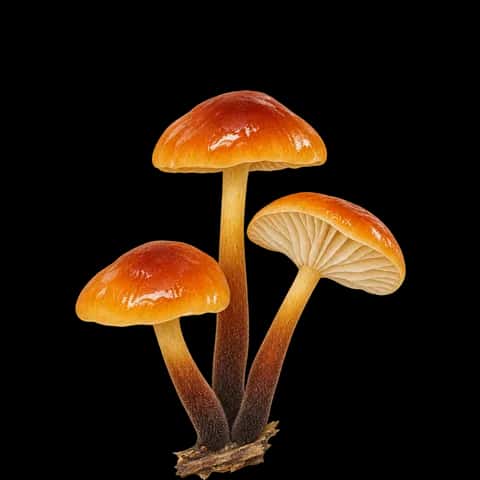
When the thermometer drops below zero and pickers have long put their baskets away, orange clusters glow on the trunks of riverside willows and poplars. This is the velvet shank (Flammulina velutipes, płomiennica zimowa in Polish), one of the few mushrooms that fruit in the coldest months of the year. It can freeze solid and, after a thaw, keep growing and releasing spores.
It is edible, and since 2022 it has been on Poland’s official list of mushrooms that may be sold. It also has a famous relative: the white, noodle-thin enoki sold in Asian groceries. For decades the two were thought to be one species. Only DNA studies in 2018 showed they are different mushrooms.
Winter foraging has a catch, though. Until the first frosts, the same dead wood can host the funeral bell, which carries the same toxin as the death cap. So the velvet shank has to be known really well, and any doubt settled by a certified mushroom expert at the local sanitary inspection office (sanepid).
How does the velvet shank survive frost?
Most cap mushrooms end their season with the first frosts. The velvet shank is just getting started. It fruits from October to December and, in mild winters, through March. During frost it stops growing but does not rot: the frozen mushrooms simply wait, and when temperatures climb above zero they carry on.
The secret is partly chemical. Japanese researchers extracted xylomannan, a sugar-based antifreeze compound, from the velvet shank’s mycelium and fruiting bodies. It slows the growth of ice crystals, which in ordinary tissue tear cell membranes apart. Other studies found that near freezing the fungus builds up glycerol, arabitol and trehalose, substances that act like a natural antifreeze.
The cap is built for the weather too. When wet it turns slimy and glossy, as if varnished, and it dulls as it dries. The stem is tough, hollow and covered toward the base in brown velvet, which gives the species its Latin name: velutipes means “velvet foot.”
Where and when to find velvet shank
The velvet shank is a saprotroph: it breaks down wood, usually dead, though it can also grow on living trees, sometimes several meters above the ground. Its favorites are poplars and willows, so good places are floodplain woods, river embankments, old willows along country lanes and city parks. In Poland it is very common, even in towns and gardens.
Its list of hosts is long. Mycologists in Poland have recorded it on elder, birch, beech, oak, hornbeam, apple, ash, horse chestnut, linden, alder, walnut, black locust, elm, maple and several other broadleaf trees and shrubs. On conifers it is very rare; Polish records list only arborvitae.
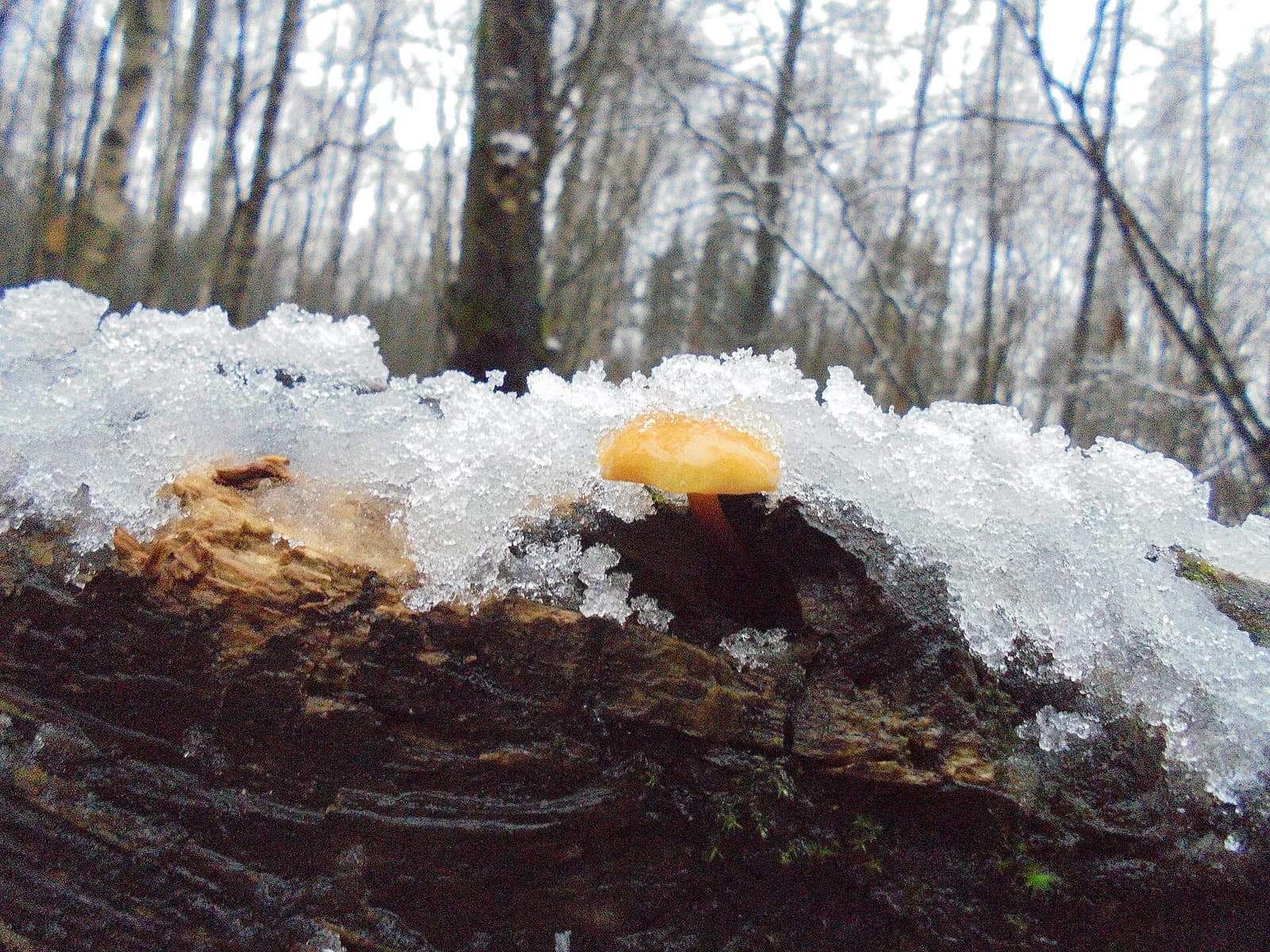
It almost always grows in clusters of a few to a dozen or more caps from one spot on a trunk or stump. In winter it is easy to spot from a distance, as the orange caps stand out against gray bark and snow. The best days to look are during a thaw, since the fungus does not grow while it is freezing.
How does a velvet shank know which way is up?
A velvet shank can grow out of the side of a log and still turn its cap upward. Researchers tested this on Earth by tipping a growing mushroom onto its side. Over about 12 hours its stem bent through a right angle. The part that senses the pull of gravity is just a few millimeters long, right below the cap.
In 1993 researchers sent Flammulina mushrooms into orbit aboard Spacelab. For about eight days some grew in microgravity while others rode in a centrifuge that simulated gravity on Earth. In the centrifuge the stems all pointed toward the center of rotation, which for those mushrooms was up. In the neighboring batch, growing in microgravity, the stems pointed every which way.
How to identify the velvet shank
Several features together make up the velvet shank’s typical look. None of them is enough on its own, and the final word always belongs to someone who knows mushrooms well. Mycologists look at:
- a cap 1–7 cm across, yellow-orange to honey-brown, darker in the center, slimy and shiny when wet
- widely spaced gills, whitish at first, later cream to ochre-yellow
- a stem 5–10 cm long, thin and tough, pale at the top, blackish-brown and velvety toward the base, with no ring
- a white spore print, the mark a cap leaves on paper after a few hours
- clusters on broadleaf wood, from October into winter
Velvet shank or funeral bell? The deadly look-alike on the same log
The most serious risk is the funeral bell (Galerina marginata, hełmówka jadowita). It is about the same size, has a brownish-yellow cap and grows in groups on wood, in the Polish lowlands mostly beech and in the mountains spruce. It contains amanitins, the same toxin that makes the death cap the deadliest mushroom in Poland.
There are differences, but they take experience to see. The funeral bell has a fragile ring or ring zone on the stem, below which the stem is streaked with silvery fibers. Its gills turn rusty brown with age and its spore print is rusty. The velvet shank has no ring, a dark velvety stem and a white spore print. A white print is not a test of edibility, though: the death cap has one too.
The two seasons overlap. The funeral bell fruits from August until the first frosts, exactly when the first velvet shanks appear. The velvet shank can also be confused with the sulphur tuft and the sheathed woodtuft. The latter is edible, yet Poland’s official list allows it to be sold only if cultivated.
If a cluster from a trunk shows a ring, rusty gills, or leaves you with any doubt at all, do not eat it. Polish sanitary stations offer free checks by certified mushroom experts to anyone picking for personal use.
What is a velvet shank relative doing in dry grassland?
In November and December 2012 researchers from Kielce collected over 50 Flammulina mushrooms on hills near Pińczów in southern Poland. It was a far cry from the velvet shank’s riverside willows. These mushrooms grew among grasses on a warm, dry slope. Follow a stem down and it led to the root of a spiny restharrow, a low, prickly plant. In 2014 the team published the first Polish record of this velvet shank relative, Flammulina ononidis.
Several members of the genus share an orange cap and a velvety stem. The researchers examined the cap skin under a microscope and measured 50 spores from five mushrooms. Together with the evidence from the restharrow roots, those details gave other mycologists something to check the next find against.
Do all velvet shanks grow up at the same pace?
Three Polish strains from a collection at Poznań University of Life Sciences gave three different answers. Researchers wanted to compare mushrooms at the same stage of development. The first strain reached it in 36 days, the next in 43 and the last in 51. Sampling all three on the same morning would have meant comparing mushrooms of quite different maturity.
The team went on sampling for four more days. Even within a single strain, the mushrooms changed. In extracts from the fastest strain, protein was highest in the first sample, while total sugars peaked two days later. The day a sample was taken, as well as the strain it came from, made a difference to what the researchers found.
Is enoki the same as velvet shank? Almost, but not quite
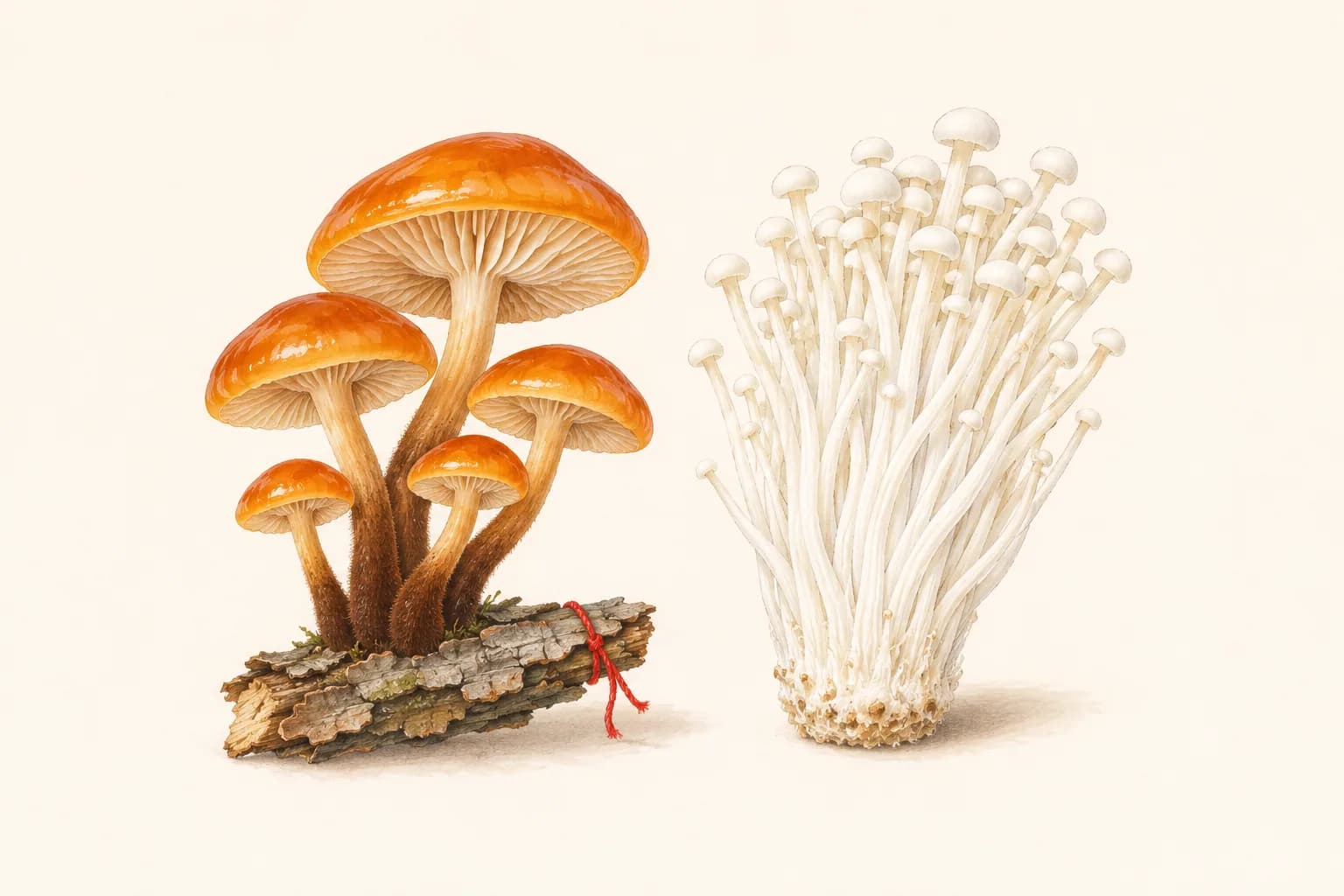
The white, skinny mushrooms sold in bags as enoki or enokitake were long considered the cultivated form of the velvet shank. In 2018, mycologists from China and Europe compared the DNA of Flammulina from several continents and split the Asian form off as a separate species, Flammulina filiformis. European velvet shank and enoki are close relatives, not the same mushroom.
Enoki’s look comes from how it is grown. The mushrooms are raised in the dark on sawdust or straw, and under those conditions they produce long, pale stems with tiny caps. Exposed to light, they grow shorter and brown, much like wild velvet shank. The Japanese name enoki-take means “hackberry mushroom,” after the tree at whose base it often grows in the wild.
It is one of the world’s major cultivated mushrooms. In 2010, China alone produced an estimated 1.57 million tonnes a year and Japan another 140,000 tonnes. In 2020, imported enoki caused a Listeria outbreak in the United States: 36 people fell ill and 4 died. US health authorities reminded consumers then that enoki should be cooked thoroughly before eating.
Can velvet shank be sold in Poland? The official mushroom list
Which mushrooms may be sold and processed in Poland is set by a Ministry of Health regulation of May 17, 2011. Its original list had 44 entries, and the velvet shank was not among them. That changed in November 2022, when the list grew to 72 entries, adding many cultivated mushrooms and a few wild ones.
The velvet shank went in twice: as płomiennica zimowa (entry 47) and as zimówka aksamitnotrzonowa (entry 69), both with the same Latin name. It is a trace of the species’ many Polish names. The name płomiennica zimowa (“winter flame mushroom”) was proposed in 1987 by mycologist Władysław Wojewoda, and other names circulated in the literature too.
Being on the list means the mushroom can be sold, but only with a certificate from a mushroom expert or classifier and only in shops or at markets. For anyone picking for themselves, nothing changes. Only the caps are gathered, since the stems are tough, and they are eaten only cooked: Poland’s Chief Sanitary Inspectorate advises against eating raw mushrooms.
Timeline
- 1782English botanist William Curtis describes the species as Agaricus velutipes.
- 1951Rolf Singer moves it to the genus Flammulina.
- 1987Władysław Wojewoda gives it the Polish name płomiennica zimowa.
- 1993Flammulina mushrooms fly aboard Spacelab so researchers can see which way their stems grow in orbit.
- 2011A Ministry of Health regulation lists 44 mushrooms approved for sale in Poland, without the velvet shank.
- 2018DNA studies split Asian enoki off as a separate species, Flammulina filiformis.
- 2020Enoki imported to the US cause a Listeria outbreak: 36 ill, 4 dead.
- 2022The velvet shank joins Poland’s official mushroom list, under two names at once.
Questions and answers
Is velvet shank edible?
Yes, the caps are edible; the stems are too tough. Eat it only cooked, and only if there is no doubt at all about the identification.
When does velvet shank grow?
From October to December, and in mild winters until March. It stops growing in frost, but the mushrooms do not rot and resume growth after a thaw.
What can velvet shank be confused with?
Above all with the deadly funeral bell (Galerina marginata), which contains amanitins. The funeral bell has a ring or ring zone, rusty gills and a rusty spore print. The sulphur tuft and sheathed woodtuft also look similar.
Is enoki the same as velvet shank?
Not quite. Since 2018, Asian enoki has been classified as a separate species, Flammulina filiformis, a close relative of the European velvet shank. It is white and long because it is grown in the dark.
Where does velvet shank grow?
On trunks and stumps of broadleaf trees, most often poplars and willows, along rivers and in parks and gardens. It grows in clusters, sometimes several meters above the ground.
Sources
- Wikipedia: Velvet shank (in Polish) (opens in a new tab)
- Wikipedia: Flammulina velutipes (opens in a new tab)
- Wikipedia: Flammulina filiformis (enoki) (opens in a new tab)
- Wikipedia: Galerina marginata (in Polish) (opens in a new tab)
- Wang et al. (2018), Mycological Progress: phylogeny of Flammulina (opens in a new tab)
- Moore et al. (1996), how mushroom stems respond to gravity (opens in a new tab)
- Łuszczyński et al., the first Polish record of Flammulina ononidis (opens in a new tab)
- Osińska-Jaroszuk et al., comparing three Polish strains of velvet shank (opens in a new tab)
- Kern and Hock (1996), Flammulina in the Spacelab experiment (opens in a new tab)
- Kawahara et al. (2016), Biocontrol Science: xylomannan from Flammulina velutipes (opens in a new tab)
- Tereshina and Memorskaya (2005), Microbiology: cold adaptation of Flammulina velutipes (opens in a new tab)
- Polish Ministry of Health regulation on mushrooms approved for sale (in Polish) (opens in a new tab)
- Amending regulation of November 3, 2022 (in Polish) (opens in a new tab)
- CDC: 2020 Listeria outbreak linked to enoki mushrooms (opens in a new tab)
- Chief Sanitary Inspectorate: sanitary report for 2023 (in Polish) (opens in a new tab)
- Chief Sanitary Inspectorate: choosing mushrooms safely (in Polish) (opens in a new tab)