Where the letters A, B and O came from
Karl Landsteiner discovered blood groups. Ludwik Hirszfeld and Emil von Dungern showed that they are inherited and gave them the names the whole world uses.
In a paper published in Heidelberg in 1910, Ludwik Hirszfeld and Emil von Dungern reported tests on the blood of 348 people from 72 families. The result was clear: a child never had the A or B property unless at least one parent had it. Blood groups were inherited according to Mendel’s laws.
In the same work the two researchers gave the properties letters. They called the one common in Central Europe A and the rarer one B, and blood with neither O. Those letters are still printed on every blood bag and donor card.
Hirszfeld did not discover blood groups, though. The story begins with Karl Landsteiner in Vienna and runs through the Macedonian front of the First World War, the Warsaw Ghetto and postwar Wrocław, where an institute now carries the Polish scientist’s name.
Who discovered blood groups?
The discoverer was the Austrian physician Karl Landsteiner. In 1900 and 1901 he showed that people’s red blood cells differ and that mixing incompatible blood makes the cells clump. He received the 1930 Nobel Prize in Physiology or Medicine for it.
Landsteiner described three groups and labeled them A, B and C. A fourth, now called AB, was found in 1901 by Alfred von Decastello and Adriano Sturli. Then came confusion. Jan Janský in 1907 and William Moss in 1910 numbered the groups with Roman numerals from I to IV, but with groups I and IV the other way round. The historian of serology Alan Farr wrote that the possibilities for confusion were endless, and in transfusion potentially lethal.
Where do the blood group names A, B and O come from?
Hirszfeld was born in Warsaw in 1884, studied medicine in Würzburg and Berlin and in 1907 completed a doctorate on the clumping of blood cells. He then joined the Cancer Research Institute in Heidelberg, in the serology department run by Emil von Dungern. He later called his four years in Heidelberg the most creative period of his life.
The pair first showed that dogs inherit their blood groups. Then they turned to people. They published “Ueber Vererbung gruppenspezifischer Strukturen des Blutes” (On the inheritance of group-specific structures of the blood) in 1910, in volume 6 of the Zeitschrift für Immunitätsforschung. Writing in 1919, Hirszfeld explained that they had called the property common in Central Europe A, the rare one B, and blood without either group O. Researchers at the Wrocław institute that bears his name note that these names have been used ever since.
The two also named the antibodies in serum alpha and beta, today’s anti-A and anti-B. In 1911 they described a strong and a weak form of group A, now known as A1 and A2. By the rule they set out, A and B are dominant, and group O is the combination of two recessive traits.
How did blood groups help settle paternity cases?
The inheritance rule had a practical side. If a child with A must have a parent with A, a blood test can rule out a man as the father. The Hirszfelds noted in 1919 that the observation would in some cases allow a court to decide who a child’s real father was.
Hirszfeld served as an expert witness. In 1933 he testified in the trial of Rita Gorgonowa, the most famous trial of interwar Poland, and Poland’s National Digital Archive holds a photograph of him in the courtroom.
What did the Hirszfelds find on the Salonika front?
When war broke out in August 1914, Hirszfeld, then working in Zurich, volunteered for the Serbian army. He fought an epidemic of typhus and set up a bacteriology laboratory. At the infectious diseases hospital in Salonika (Thessaloniki) he discovered a paratyphoid bacterium later named Salmonella hirszfeldii. His wife Hanna, a pediatrician, worked alongside him.
The Macedonian front brought together soldiers and refugees from many countries. The Hirszfelds used that to carry out a study that would otherwise have taken years of travel. They mixed a drop of blood from a finger with anti-A and anti-B sera taken only from Serbians and read the result after at least half an hour. They tested 500 to 1,000 people from each group, about 8,000 in all, including English, French, Italian, Serbian, Greek, Bulgarian, Turkish, Arab, Russian, Jewish, Malagasy, Vietnamese and Indian subjects.
They presented the work to the Salonika Medical Society on June 5, 1918, and published it in The Lancet in October 1919. Group A dominated in Europe, and the share of group B rose towards Asia and Africa. The English were about 46% A and 10% B; the Indians tested were 27% A and as much as 49% B. It was the first paper to show that blood group frequencies differ between populations.
The article speaks the language of its time. The authors called the ratio of A to B a “biochemical race-index”, and their idea that B came from India and A from northern or central Europe is long obsolete. The method of comparing blood group frequencies between populations survived in population genetics.
When did the world adopt A, B, AB and O?
According to a historical review by scientists at the Hirszfeld Institute of Immunology and Experimental Therapy, a standardization commission of the League of Nations Health Committee accepted the A, B, O nomenclature “proposed by von Dungern and Hirszfeld” in April 1928. Polish sources repeat that date.
Other accounts tell it differently. The American serologist Alexander Wiener wrote in 1966 that the League of Nations Health Committee recommended the A-B-O system in 1930, and Alan Farr credits Landsteiner with proposing O, A, B and AB on a committee of the US National Research Council. What is certain is that the letters A, B and O appeared in the Heidelberg paper of 1910 and that by the end of the 1920s the letter system had become the international standard.
What did Hirszfeld do in Warsaw between the wars?
From 1920 he worked at the State Serum Testing Institute in Warsaw, which became part of the State Institute of Hygiene (PZH). He was one of PZH’s founders. He organized blood donation, and during the siege of Warsaw in September 1939 he set up a blood transfusion center in the city.
In 1925 he was the first to suggest that a disease of newborns might be linked to antibodies made by the mother. The idea did not catch on at first. The full explanation came in 1940 and 1941, when Landsteiner and Alexander Wiener described the Rh system and Philip Levine the RhD antigen. Hirszfeld did not discover the Rh factor, but he pointed to the mechanism of what is now called hemolytic disease of the newborn earlier than others.
How did Hirszfeld survive the Warsaw Ghetto?
Under the German occupation he was dismissed from PZH because of his Jewish origin. In February 1941 he and his family were forced into the ghetto, and from the summer of 1941 they lived in the rectory of All Saints Church on Grzybowski Square. Hirszfeld studied how typhus spread, chaired the ghetto’s Health Council in 1942 and taught bacteriology and serology on secret medical courses. He vaccinated patients with vaccine donated by Rudolf Weigl of Lviv.
In testimony that later became part of his memoir, he put mortality among the ghetto’s Jews at about 120 per thousand, against 10.5 per thousand before the war. People were dying of hunger, he wrote, not only of epidemics.
In July 1942 he escaped to the “Aryan side” with his wife and daughter. The escape was organized by the pharmacist Konstanty Potocki. The Hirszfelds hid under a false name, among other places with Laura Kenig in Stara Miłosna near Warsaw. Their only daughter, Maria, died in hiding in the village of Kocina and was buried as Maria Halecka. In 1943, still in hiding, Hirszfeld wrote his autobiography, Historia jednego życia (The Story of One Life), published in 1946, in English in 2010 and in German in 2018.
What did the Hirszfelds build in Wrocław?
After Lublin was freed in 1944, Hirszfeld helped found Maria Curie-Skłodowska University there and served as its vice-rector. On August 1, 1945, he arrived in Wrocław, where he became the first dean of the Faculty of Medicine of the new University and Polytechnic. In 1948 he introduced the typing of bacterial strains with bacteriophages, the start of Wrocław’s phage research.
With the obstetrician Kazimierz Jabłoński he put the theory of mother-and-baby blood incompatibility into practice. Exchange transfusions saved the lives of almost 200 children. In 1950 Ernest Witebsky of Buffalo nominated Hirszfeld for the Nobel Prize for his work on blood groups. Three years later Hirszfeld himself nominated Emil von Dungern and the statistician Ronald Fisher.
The Presidium of the Polish Academy of Sciences established the Institute of Immunology and Experimental Therapy on December 2, 1952, and it opened on February 6, 1954. Hirszfeld was its first director for less than a month. He died on March 7, 1954, and the institute bears his name. Hanna Hirszfeld headed the First Department of Pediatrics in Wrocław from 1950 to 1962.
What blood groups do Poles have?
According to the Polish government’s patient portal, the most common group in Poland is A RhD+, found in 32% of people. Close behind is O RhD+ at 31%. Then come B RhD+ (15%), AB RhD+ (7%), A RhD– and O RhD– (6% each), B RhD– (2%) and AB RhD– (1%). Roughly one person in seven in Poland is RhD-negative.
It is still the pattern the Hirszfelds described in Salonika: in Poland, as across Europe, A is more common than B. Poland’s National Blood Center puts the share of O RhD– at about 7% of Poles, and 4 to 9% worldwide.
Where can you find traces of the Hirszfelds in Wrocław?
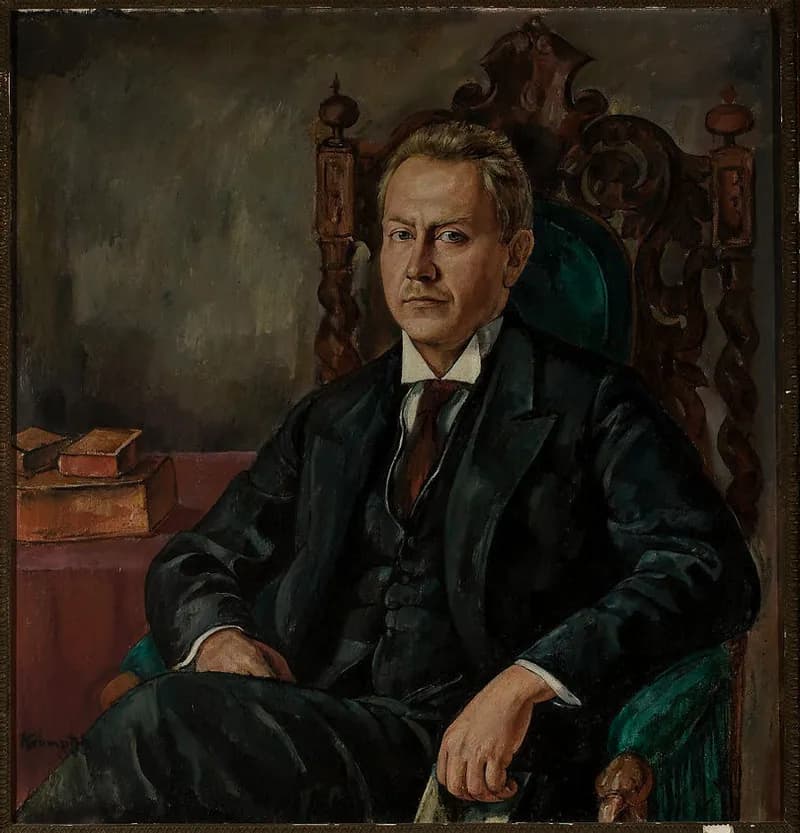
Ludwik and Hanna Hirszfeld are buried together in St. Lawrence parish cemetery on Bujwida Street, in field 3 on the main avenue, in the corner grave beside the cross. The institute named after him stands at 12 Rudolfa Weigla Street, a street named after the scientist whose vaccine Hirszfeld used in the ghetto.
On December 13, 2024, Hanna and Ludwik Hirszfeld became the patrons of one of Wrocław’s trams, so their name now also travels the city’s tracks.
Timeline
- 1900–1901Karl Landsteiner describes blood groups in Vienna.
- 1907Hirszfeld completes a doctorate on blood cell clumping and moves to Heidelberg.
- 1910Hirszfeld and von Dungern show that blood groups are inherited and name them A, B and O.
- 1914Hirszfeld volunteers for the Serbian army and fights typhus.
- 1918Results for about 8,000 people from the Macedonian front go to the Salonika Medical Society.
- 1919Ludwik and Hanna Hirszfeld publish in The Lancet.
- 1925Hirszfeld links a disease of newborns to the mother’s antibodies.
- 1928A League of Nations commission adopts A, B, O (according to the Hirszfeld Institute).
- 1941–1942The Warsaw Ghetto; escape to the Aryan side in July 1942.
- 1945Hirszfeld arrives in Wrocław and becomes the first dean of medicine.
- 1952The Polish Academy of Sciences establishes the Institute of Immunology and Experimental Therapy.
- March 7, 1954Hirszfeld dies in Wrocław, a month after the institute opens.
Practical info
- Where
- Wrocław: the grave in St. Lawrence Cemetery on Bujwida Street (field 3, main avenue, grave 47) and the Institute of Immunology and Experimental Therapy at 12 Weigla Street.
- To read
- His memoir, The Story of One Life, written in hiding in 1943 and published in Polish in 1946 and in English in 2010.
- In Warsaw
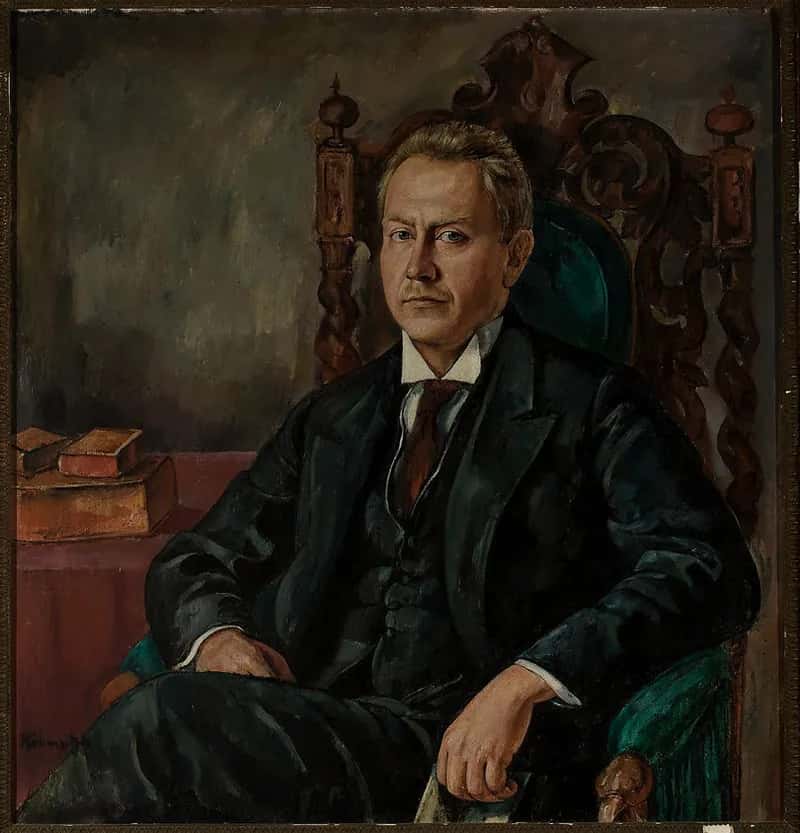
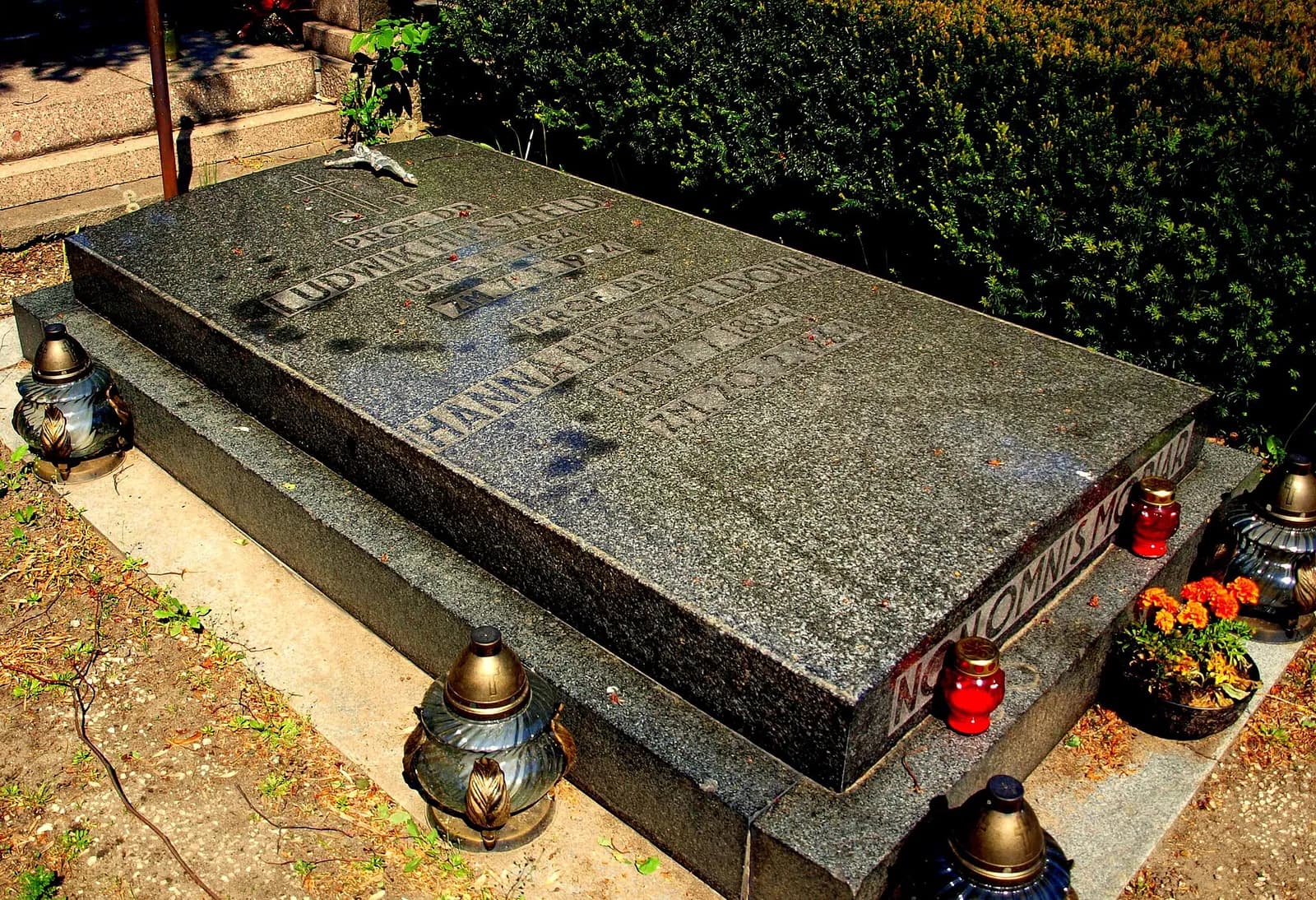
- Roman Kramsztyk’s 1923 portrait of Hirszfeld is in the collection of the National Museum.
Questions and answers
Who discovered blood groups?
The Austrian physician Karl Landsteiner, in 1900 and 1901. He received the Nobel Prize for it in 1930. In 1910 Ludwik Hirszfeld and Emil von Dungern showed that blood groups are inherited.
Who named the blood groups A, B and O?
Emil von Dungern and Ludwik Hirszfeld, in their 1910 paper. They called the property common in Central Europe A, the rarer one B, and the absence of both O. Landsteiner had earlier used the letters A, B and C.
When did A, B, AB and O become the standard?
In 1928, according to the Hirszfeld Institute, when a League of Nations commission adopted them. Other sources point to a recommendation by the League of Nations Health Committee in 1930.
What is the most common blood group in Poland?
A RhD+, found in 32% of people. O RhD+ is second at 31%. The rarest is AB RhD– at 1%.
Did Hirszfeld discover the Rh factor?
No. The Rh system was described in 1940 by Landsteiner and Wiener. As early as 1925 Hirszfeld suggested that a mother’s antibodies could cause disease in her newborn, and after the war he introduced treatment for blood incompatibility in Poland.
Where is Ludwik Hirszfeld buried?
In Wrocław, with his wife Hanna, in St. Lawrence parish cemetery on Bujwida Street.
Sources
- Czerwiński, Kaczmarek, Glensk, Ludwik Hirszfeld, Vox Sanguinis 2022 (opens in a new tab)
- NobelPrize.org: Karl Landsteiner, Nobel Prize 1930 (opens in a new tab)
- Alan D. Farr, Blood group serology: the first four decades, Medical History 1979 (opens in a new tab)
- L. and H. Hirschfeld, Serological differences between the blood of different races, The Lancet 1919 (scan) (opens in a new tab)
- Alexander S. Wiener, History of blood group nomenclature, 1966 (opens in a new tab)
- Hirszfeld Institute of Immunology and Experimental Therapy: history (in Polish) (opens in a new tab)
- Ewa Brojer, Not only Rh conflict, Academia (Polish Academy of Sciences) 2014 (PDF) (opens in a new tab)
- Warsaw Ghetto Museum: Ludwik Hirszfeld (opens in a new tab)
- Polish Center for Holocaust Research: Ludwik Hirszfeld in the ghetto (opens in a new tab)
- Kucharz, Shampo, Kyle, Ludwik Hirszfeld, Mayo Clinic Proceedings 2010 (opens in a new tab)
- Żaczek et al., phage research in Poland, Viruses 2022 (opens in a new tab)
- Nobel Prize nomination archive: Ludwik Hirszfeld, 1950 (opens in a new tab)
- Wrocław Medical University: guide to scientists’ graves (PDF, 2023, in Polish) (opens in a new tab)
- City of Wrocław: the Hirszfelds become tram patrons (2024, in Polish) (opens in a new tab)
- pacjent.gov.pl: blood group frequencies in Poland (in Polish) (opens in a new tab)
- National Blood Center: frequently asked questions (in Polish) (opens in a new tab)