An element named after Poland
Show on mapMarie Skłodowska-Curie discovered polonium in 1898 and named it after a country that was then missing from the map.
On July 18, 1898 the Academy of Sciences in Paris heard a short note from Pierre and Marie Curie. They reported that they had extracted from uranium ore a substance about 400 times more active than uranium. If the new metal was confirmed, they proposed to call it polonium, after the country of origin of one of the authors.
That country was not on the map. Since 1795 Poland had been divided between Russia, Prussia and Austria. Marie Curie, born Maria Skłodowska, put it on the periodic table instead, where it remains: polonium, symbol Po, atomic number 84.
Polonium was the first element detected purely through its radioactivity, and possibly the first whose name was a political statement. Five months later the couple announced a second element, radium. The road to both led from a townhouse on Freta Street in Warsaw to a leaky shed in Paris.
Why did Maria Skłodowska go to Paris to study?
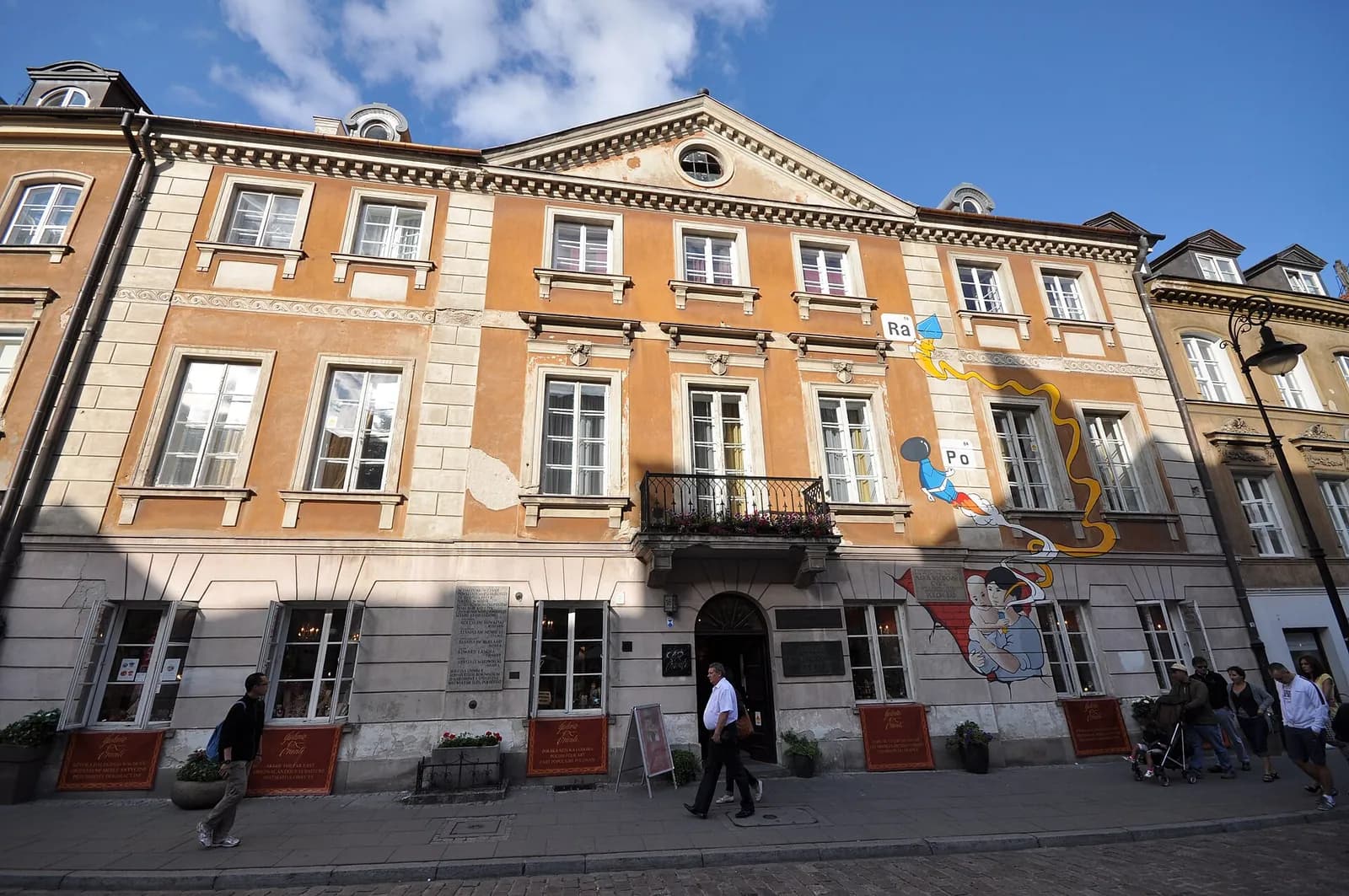
Maria Salomea Skłodowska was born on November 7, 1867 in Warsaw, in a townhouse at 16 Freta Street in the New Town. The family moved out before she turned one. In 1883 she finished secondary school with a gold medal.
In the Russian-ruled part of Poland, women could not attend university. Maria studied at the clandestine Flying University (Uniwersytet Latający), an underground school that moved between private apartments, and learned chemical analysis at a lab in the Museum of Industry and Agriculture in central Warsaw. She and her sister Bronisława made a deal: Maria would help pay for Bronisława's medical studies in Paris, and later Bronisława would help her. For years Maria worked as a governess.
In November 1891 Maria enrolled at the Sorbonne. In 1893 she earned her degree in physics, ranked first, and a year later in mathematics, ranked second. In 1894 she met the physicist Pierre Curie, and on July 26, 1895 they married in a civil ceremony. They went on their honeymoon by bicycle.
How did Marie and Pierre Curie discover polonium?
In 1896 Henri Becquerel found that uranium salts give off rays on their own. Marie chose this effect as the subject of her doctorate. She measured it with a sensitive electrometer based on piezoelectricity, which Pierre and his brother Jacques had discovered years earlier.
The results surprised her. Pitchblende, a uranium ore, was about four times as active as uranium itself, and the mineral chalcolite twice as active. If activity depended on the amount of uranium, the ores had to contain something else, something far stronger. Pierre dropped his work on crystals to join her. On April 14, 1898 they weighed out 100 grams of pitchblende and ground it with a mortar and pestle.
They broke the ore down chemically into fractions and measured each one with the electrometer. The radiation followed the bismuth fraction, even though bismuth itself is not radioactive. By July 1898 they had a product about 400 times more active than uranium. On December 26, 1898 they announced a second new element, radium, and along the way they coined the word “radioactivity.”
- Dissolve the ore and separate it chemically into fractions.
- Measure the radiation of each fraction with the electrometer.
- Keep purifying the most active fraction and set the rest aside.
- Repeat until the activity stops rising.
Why did Marie Curie make her own mineral sample?
In a table published in the spring of 1898, Marie recorded two readings for chalcolite, a mineral containing uranium and copper. One sample came from a natural deposit. She made the other herself from pure chemicals. Radiation allowed a tiny electric current to pass through the air. The natural sample gave a reading of 52 trillionths of an ampere, the laboratory sample just 9. If chalcolite itself accounted for the effect, the two readings should have been similar.
The difference pointed to an extra ingredient in the natural mineral. Was it a new element? Even in July the Curies left the question open. Eugène Demarçay examined the spectrum of their sample from pitchblende, looking for a line of light that would identify an unfamiliar metal. He could find none. The Curies reported that result in the very paper in which they proposed the name polonium.
Why is polonium named after Poland?
The name comes from Polonia, the Latin name for Poland. In their July 1898 note the couple wrote modestly that it was the country of origin of one of the authors. Readers knew which country they meant, and that in 1898 it was absent from the political map of Europe.
Marie hoped the name would draw the world's attention to Poland's lack of independence. Polonium may be the first element named to highlight a political cause. Earlier, a Frenchman had named gallium after Gaul and a German had named germanium after Germany, but both of those countries existed and were doing fine.
Poland regained independence in 1918, twenty years after the discovery. Marie never took Polish citizenship, but she stayed tied to Warsaw: in 1932 she and her sister Bronisława opened the Radium Institute there, having raised money in the United States to buy it a gram of radium. Today it is Poland's National Institute of Oncology, named after her.
How much ore did the Curies process?
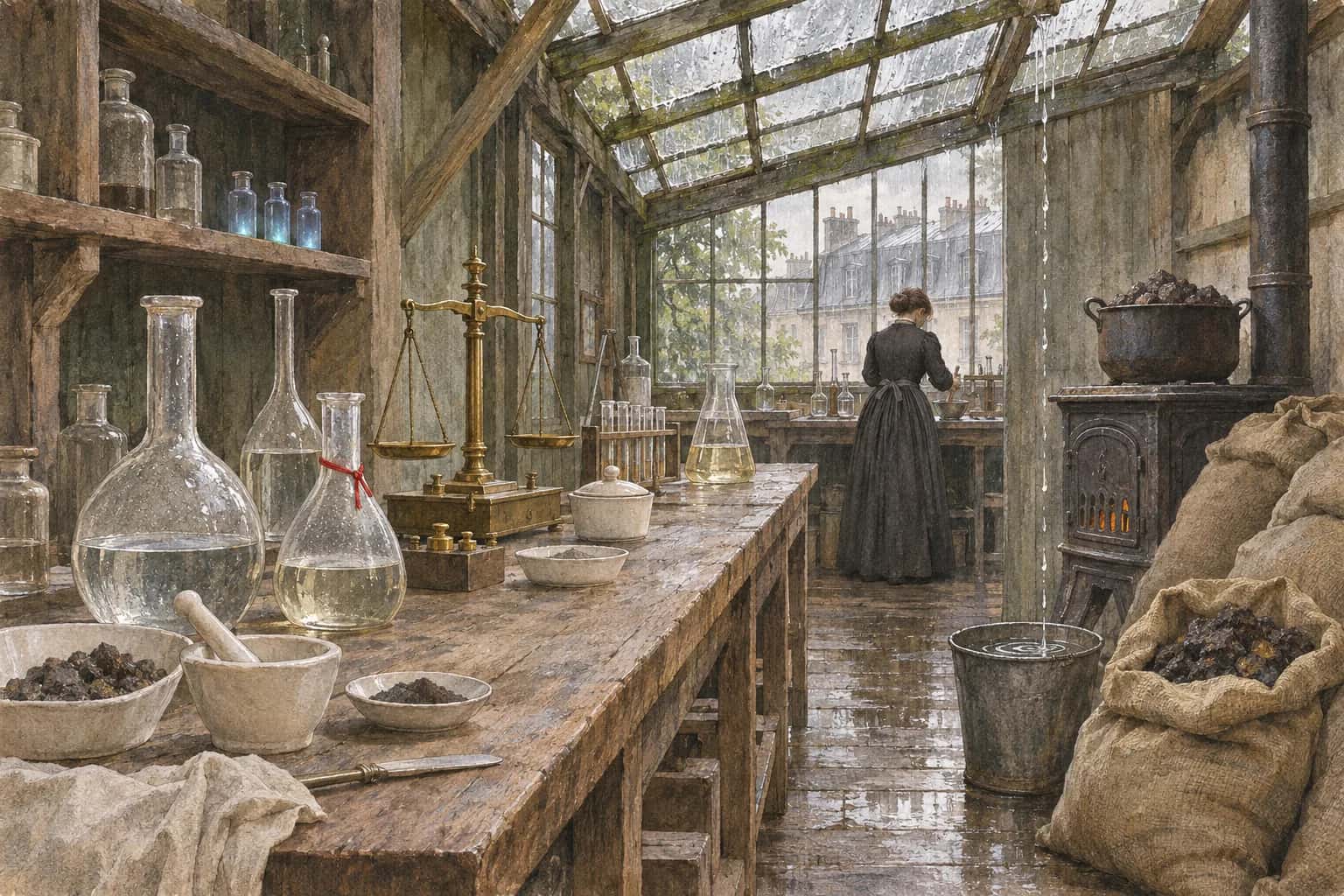
The Curies had no proper laboratory. They worked in a converted shed next to the School of Industrial Physics and Chemistry (ESPCI) in Paris, a former dissecting room of a medical school. It was poorly ventilated and the roof leaked.
The ore came from Joachimsthal in Bohemia (today Jáchymov, Czech Republic). The Austrian government gave them 100 kg (220 lb) of pitchblende residue from which the uranium had been removed but the polonium and radium remained. Later they processed tons of ore. In 1902, from a tonne of pitchblende, they obtained one-tenth of a gram of radium chloride.
Marie never isolated pure polonium. Its longest-lived natural isotope, polonium-210, has a half-life of 138 days, so it disappears faster than it can be collected. The first 3 milligrams were isolated in 1902 by the German chemist Willy Marckwald, who thought he had found a new element and called it radio-tellurium.
Nobody yet knew how dangerous radiation was. Marie carried test tubes of radioactive samples in her pocket. Her notebooks from the 1890s are so contaminated that they are kept in lead-lined boxes, and anyone who wants to consult them must wear protective clothing.
Why did Marie Curie win two Nobel Prizes?
In 1903 Marie defended her doctorate. That same year the Nobel Prize in Physics was split: half went to Henri Becquerel for discovering spontaneous radioactivity, and half to Pierre and Marie Curie for their joint research on the radiation phenomena he had found. Marie became the first woman to win a Nobel Prize.
On April 19, 1906 Pierre was killed in a Paris street, run over by a horse-drawn wagon. Marie took over his chair and on November 5, 1906 gave her first lecture as the first woman professor at the Sorbonne. In 1910 she isolated pure radium metal.
In 1911 she won a second Nobel Prize, this time alone, in chemistry, for discovering radium and polonium, isolating radium and studying its compounds. She remains the only person awarded Nobel Prizes in two different sciences. The same year the French Academy of Sciences turned down her candidacy; it admitted its first woman only in 1962, her former doctoral student Marguerite Perey.
What was the discoverer of polonium doing in an X-ray van?
In the autumn of 1914, surgeons near the front needed pictures that could show a piece of shrapnel or a broken bone. Curie secured cars, sought donations of equipment and persuaded body shops to refit the vehicles. The first of the twenty mobile units she equipped was ready by late October. The radiation used to take the pictures came from an X-ray machine.
Curie learned to drive and studied anatomy and car mechanics. Her seventeen-year-old daughter Irène went with her and eventually ran a radiology unit at the front herself. A photograph in the Musée Curie archive in Paris shows Irène stepping out of one of the vans in 1916. Look for catalogue number MCP165.
Why did Curie cross the Atlantic twice to raise money for radium?
In 1920 the American journalist Marie Mattingly Meloney interviewed Curie. Their conversation led to a fundraising campaign supported mainly by American women. The gram of radium Curie needed for her Paris laboratory cost $100,000. President Warren Harding presented the gift during her visit in 1921. Curie also wanted to see the Pennsylvania plant that had produced it.
Her second trip, in 1929, had a different beneficiary. This time she secured funds to buy a gram of radium for the institute taking shape on Wawelska Street in Warsaw. She opened it in May 1932. The two American campaigns explain how a laboratory in Paris and a new medical institute in Warsaw each came by a gram of a material few institutions could afford.
What is polonium and what is it used for today?
Polonium is a silvery, highly radioactive metal in group 16 of the periodic table, chemically similar to selenium and tellurium. It has no stable isotopes at all. Uranium ores contain only traces of it, so today it is made artificially by bombarding bismuth with neutrons. World production is about 100 grams a year.
Polonium-210 emits alpha particles at a furious rate. A gram of polonium gives off about 140 watts of heat and warms itself to over 500 °C (930 °F), which is why it served as a lightweight heat source in spacecraft such as the Soviet Lunokhod moon rovers. It is also used in devices that remove static electricity.
The same property makes it one of the most toxic substances known. Alpha particles cannot pass through skin, but polonium that is swallowed or inhaled destroys tissue from the inside. In 2006 it was used in London to poison Alexander Litvinenko, a former Russian security officer.
Timeline
- November 7, 1867Maria Skłodowska is born on Freta Street in Warsaw.
- 1891She moves to Paris and enrolls at the Sorbonne.
- 1895Marries Pierre Curie.
- July 1898The note announcing polonium is presented to the Academy of Sciences in Paris.
- December 26, 1898The discovery of radium is announced.
- 1903Nobel Prize in Physics, the first awarded to a woman.
- 1911Second Nobel Prize, in chemistry, for radium and polonium.
- 1932The Radium Institute opens in Warsaw.
- July 4, 1934Dies at a sanatorium in Passy, France; in 1995 her remains are moved to the Panthéon in Paris.
Practical info
- Where
- Marie Skłodowska-Curie Museum, ul. Freta 16, New Town (Nowe Miasto), Warsaw.
- Getting there
- Walk from the Old Town through the Barbican: Freta Street begins right behind it and leads to the New Town Market Square.
- Tickets
- Check current prices, hours and free-admission days on the museum’s website, mmsc.waw.pl.
- On site
- Her personal belongings, recreated interiors, photographs and documents. The facade has a mural with the symbols of polonium and radium.
- Nearby
- On Wawelska Street, in front of the former Radium Institute, stands a 1935 statue of Marie Skłodowska-Curie.
Questions and answers
Why is polonium called polonium?
Marie Curie named it after Polonia, the Latin name for Poland. In 1898 Poland was partitioned between three empires, and the name was meant to remind the world that it had no independence.
Who discovered polonium and when?
Marie and Pierre Curie, in Paris, in 1898. The discovery was announced in a note presented to the French Academy of Sciences on July 18, 1898.
What did Marie Curie win her Nobel Prizes for?
In 1903, the physics prize, shared with Pierre Curie and Henri Becquerel, for research on radioactivity. In 1911, the chemistry prize, on her own, for discovering radium and polonium and isolating radium.
Is polonium dangerous?
Yes, it is one of the most toxic substances known. Its alpha radiation cannot get through skin, but swallowed or inhaled polonium destroys tissue; it was used to poison Alexander Litvinenko in 2006.
Where was Marie Curie born?
In Warsaw, Poland, at 16 Freta Street in the New Town. The building is now the Marie Skłodowska-Curie Museum.
Are Marie Curie's notebooks still radioactive?
Yes. Her notebooks from the 1890s are stored in lead-lined boxes, and visitors who want to read them must wear protective clothing.
Sources
- Wikipedia: Marie Skłodowska-Curie (in Polish) (opens in a new tab)
- Wikipedia: Polonium (in Polish) (opens in a new tab)
- NobelPrize.org: Marie Curie (opens in a new tab)
- Comptes rendus, July 18, 1898: the polonium note (Wikisource, in French) (opens in a new tab)
- American Institute of Physics, Curie’s wartime radiology service (opens in a new tab)
- Musée Curie, Irène leaving an X-ray van in 1916 (photograph MCP165) (opens in a new tab)
- Marie Skłodowska-Curie Museum, the first American fundraising tour (PDF, in Polish) (opens in a new tab)
- Marie Skłodowska-Curie Museum, the two institutes and the radium gifts (PDF, in Polish) (opens in a new tab)
- P. and M. Curie, On a New Radioactive Substance Contained in Pitchblende (translation) (opens in a new tab)
- M. Skłodowska-Curie: the 1898 measurements of natural and artificial chalcolite (translation) (opens in a new tab)
- AIP: Marie Curie and the Science of Radioactivity (opens in a new tab)
- NobelPrize.org: The Nobel Prize in Physics 1903 (opens in a new tab)
- Marie Skłodowska-Curie Museum in Warsaw (in Polish) (opens in a new tab)
- Wikipedia: Polonium (opens in a new tab)
- Wikipedia: Marie Curie (opens in a new tab)
- Wikipedia: List of chemical elements named after places (opens in a new tab)