Enigma was broken by Polish mathematicians
Show on mapMarian Rejewski cracked the German cipher in 1932, seven years before the war broke out. Without that work the British would have been starting from scratch.
In the fall of 1932 a 27-year-old mathematician from Bydgoszcz was handed a problem in Warsaw on which French intelligence, despite its stolen documents, had made no progress. Within a few weeks Marian Rejewski had worked out how the wires inside the rotors of the German Enigma were connected, without ever having seen a military Enigma machine.
The Germans believed their cipher was unbreakable. Meanwhile the Polish Cipher Bureau (Biuro Szyfrów) read their messages for most of the 1930s. In January 1938 the Poles were reading about 75% of the intercepted Enigma traffic.
Five weeks before the war began, they gave it all away to their allies: replica machines, methods and designs. This is the story of three math graduates from Poznań, of tools called the “bomb” and the “sheets,” and of a secret that stayed almost unknown for years after the war.
How did the Enigma machine work?
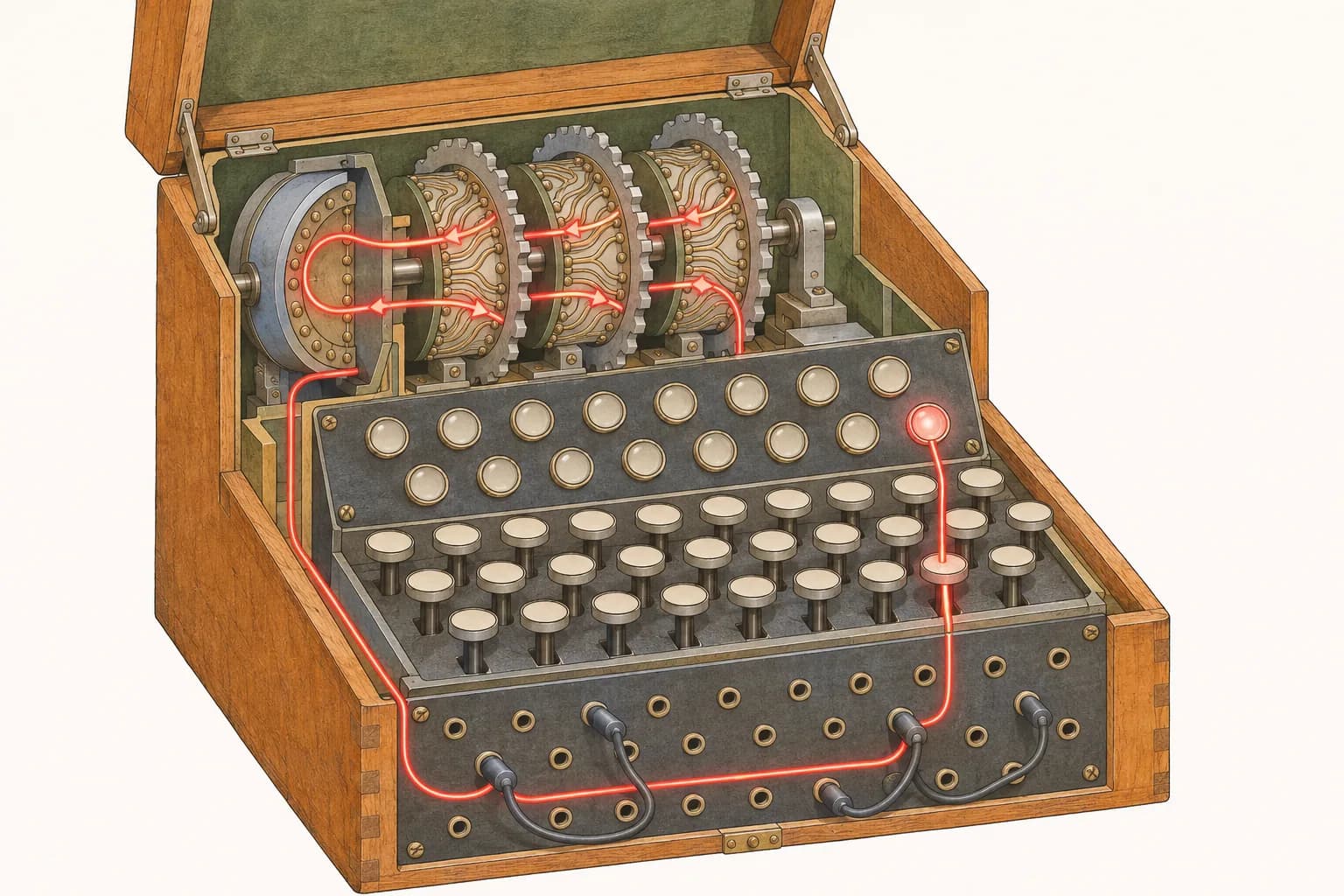
Enigma looked like a typewriter in a wooden box. The operator pressed a key, and a lamp lit up under a different letter on the panel above the keyboard. In between, the current ran through a plugboard that swapped letters in pairs, through three rotors and into a reflector that sent the signal back through the rotors.
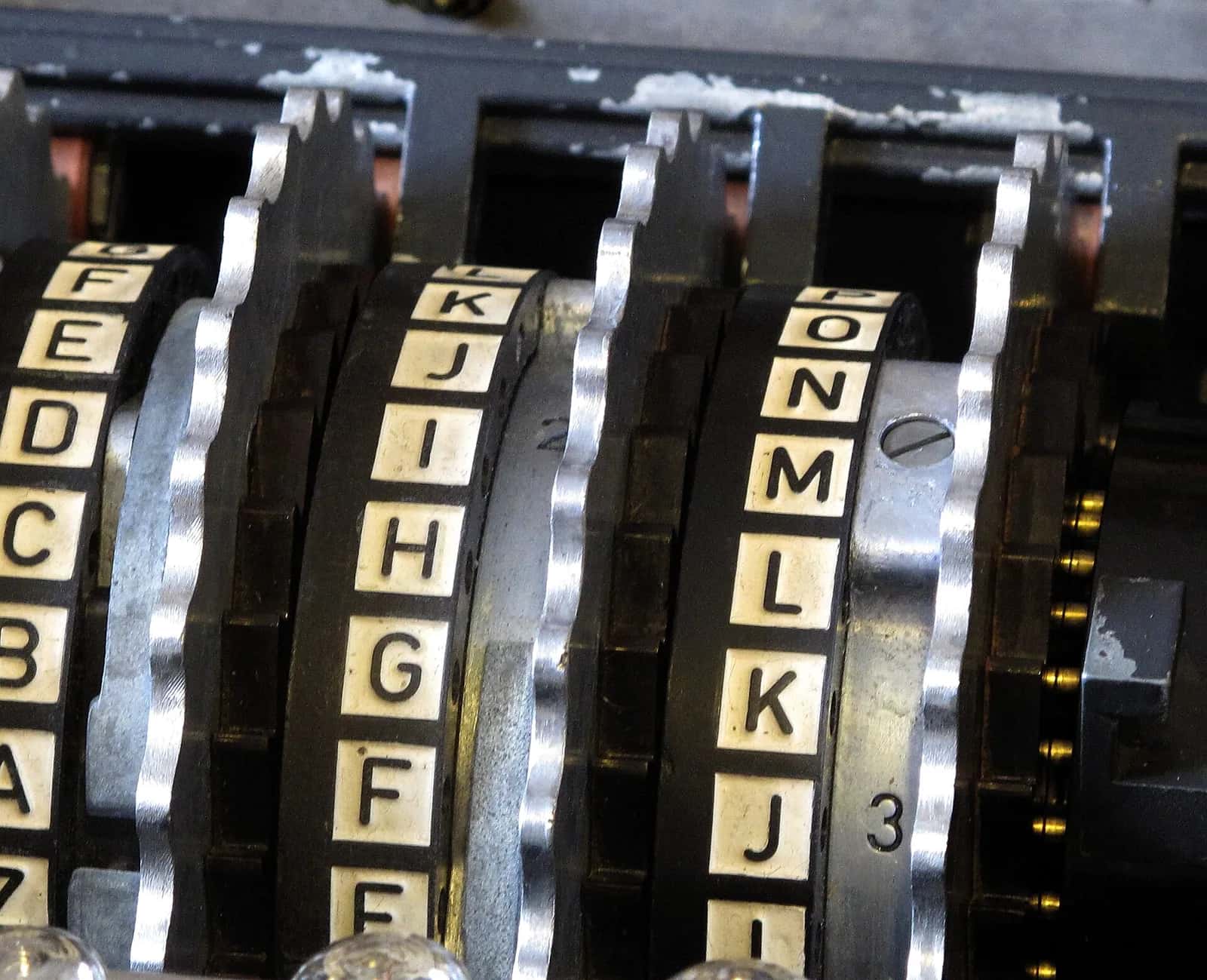
A rotor is a wheel almost 10 cm (4 in) across with 26 contacts on each side, joined inside by wires in a secret pattern. With every key press the right-hand rotor turned one step and from time to time nudged its neighbor. So the same letter typed twice in a row usually came out as two different cipher letters.
Three rotors have 26 × 26 × 26, or 17,576, starting positions. They could be placed in six different orders, which gives 105,456 combinations, and the plugboard, added to the military Enigma in 1930, multiplied that many times over. The Germans were sure nobody could get through all that without the key.
- Key: the operator types a letter of the plain text.
- Plugboard: swaps letters in selected pairs.
- Three rotors: each one substitutes the letter according to its wiring.
- Reflector: sends the signal back through the rotors and the plugboard.
- Lamp: the cipher letter lights up and the operator writes it down.
Was every Enigma a German military machine?
An Enigma in the Polish Arms Museum in Kołobrzeg carries the marking K574. It is a Model K dating from the 1930s. The Swiss military and diplomatic services both used this model. The Enigma Cipher Centre thinks this particular machine probably handled business correspondence. Its old catalogue card is missing, so the identity of the operator remains an open question.
The last leg of its journey is better documented. In September 1987 a museum employee took the overnight train to Toruń carrying the cash to buy the machine. In the morning he went to Desa, the state art and antiques dealer, and brought the Enigma back to Kołobrzeg. Thanks to a curator’s account, we know more about that train trip than about any message the machine once carried.
Who broke Enigma? Three mathematicians from Poznań
Early in 1929 the Polish Cipher Bureau ran a secret cryptology course at Poznań University for mathematics students who spoke German. Poznań was no accident: the city had belonged to Germany until the end of World War I, and young people there had gone to German schools.
The Bureau chose mathematicians because cipher machines had changed the rules: instead of a dictionary, the job now needed combinatorics and probability. Three students stood out: Marian Rejewski (born 1905 in Bydgoszcz), Henryk Zygalski (1908, Poznań) and Jerzy Różycki (1909).
From 1930 the best students worked part-time at a Cipher Bureau branch hidden in the basement of the Poznań garrison headquarters. In the summer of 1932 the branch was closed, and on September 1, 1932 Rejewski, Zygalski and Różycki started at the Bureau's head office in the Saxon Palace in Warsaw.
How did Rejewski break Enigma in 1932?
The weakness lay not in the machine but in the procedure. Each message was enciphered with its own key, three letters giving the rotor positions. The operator typed this key twice in a row and only then the message itself. So the first and fourth cipher letters, the second and fifth, and the third and sixth all hid the same letter.
By collecting many messages from a single day, Rejewski linked these pairs into chains, the cycles of a permutation, and from them derived equations describing the rotors. Intelligence helped. The French had a spy in Berlin, Hans-Thilo Schmidt, who supplied Enigma manuals and daily keys. Captain Gustave Bertrand of French intelligence passed them to the Poles, and in December 1932 they reached Rejewski.
By the end of 1932 the rotor wiring had been reconstructed. Rejewski later wrote that the intelligence material should be considered decisive; without it the method would have been slow and largely a matter of luck. The AVA radio works in Warsaw built copies of the military Enigma, and the Bureau began reading German messages.
Who built the Polish copies of Enigma?
At 25 Stępińska Street in Warsaw, a firm called AVA was making radios for the air force and navy before the codebreakers came to call. The brothers Leonard and Ludomir Danilewicz were amateur radio operators, as was Antoni Palluth, one of the directors. Once Rejewski had worked out how the rotor contacts were wired, AVA’s technicians built working copies of the machine. The Enigma Cipher Centre puts their prewar output at about fifty.
A later copy belongs to the Polish History Museum. During the war a factory outside Paris made its parts to a design by Palluth and Edward Fokczyński, and Cipher Bureau engineers assembled them. Look at the museum photograph and you can see the plugboard cables at the back. On a German Enigma they ran across the front. With matching settings the two machines still produced the same letters.
The cyclometer, Zygalski sheets and the bomba
Knowing the wiring was only half the job. Every day the Poles still had to find the daily key. Rejewski noticed that the number and length of the cycles in his permutations did not depend on the plugboard, so he only had to catalog them for all 105,456 rotor settings. For that he built the cyclometer, a device with two sets of rotors, around 1934–1935. The catalog took more than a year to compile, but afterwards a daily key could be found in 12–20 minutes.
On September 15, 1938 the Germans changed their procedure and the catalog stopped working. Zygalski answered with perforated sheets: 26 sheets for each rotor order, each with a 51 × 51 grid and about a thousand holes cut by hand with razor blades. Stacked and lit from below, they showed the one spot where light passed through every layer.
Rejewski designed the cryptologic bomb (bomba kryptologiczna): six Enigmas driven by an electric motor that worked through all 17,576 rotor positions in turn. By mid-November 1938 six bombs had been built, one for each rotor order. They found a key in about two hours and replaced the work of roughly a hundred people. As for the name, Rejewski said it was chosen for lack of a better idea; the story that it was named after an ice-cream dessert is considered a legend.
On December 15, 1938 the Germans added two new rotors, IV and V, and the number of possible rotor orders jumped from 6 to 60. The Poles quickly worked out the new wiring, but to keep finding keys they would have needed 60 bombs and 60 sets of sheets. That would have cost about fifteen times the Bureau's entire budget.
What happened at Pyry in July 1939?
From 1937 the Bureau's German section worked at a secret center in the Kabaty Woods near Pyry, on the southern edge of Warsaw. In late July 1939 (sources give dates between July 25 and 27) French and British officers came there, among them Alastair Denniston, head of the British codebreaking service, and Dillwyn Knox, one of London's best cryptanalysts.
The visitors learned that the Poles had been reading Enigma for seven years. Zygalski, who spoke English, explained the machine and the methods to Knox: the cyclometer, the bomba and the sheets. Each delegation was given a Polish copy of Enigma; in August both were shipped to Paris, and Bertrand personally carried one to London.
In return the British produced full sets of Zygalski sheets for all 60 rotor orders. In January 1940 Alan Turing brought them to PC Bruno, the French-run center near Paris where the evacuated Poles were working, and on January 17, 1940 the first wartime Enigma messages were read. Turing's own machine at Bletchley Park, the bombe, was named after the Polish bomba, although it worked on a different principle.
What did a buried chest reveal about the wartime codebreakers?
Major Edmund Piechowiak preserved a group of intelligence papers from the Polish unit known as Station 300. A commission was disposing of records in 1945, and some of the surviving files came into his care. In 1997 his son Alfred and Mariusz Borowiak found the papers in a buried chest. Documents from the find are available in the Enigma Cipher Centre’s media library.
One report looks back on Polish work on the cipher between 1930 and 1940. The centre considers Rejewski and Zygalski its likely authors. Other papers show how far the listening work of the Cadix centre in France reached. Its codebreakers received intercepted German traffic from units in North Africa as well as Europe.
What happened to the Polish codebreakers?
In September 1939 the codebreakers escaped through Romania to France. They worked at PC Bruno and, after France fell, at a secret center codenamed Cadix in the zone controlled by the Vichy government. On January 9, 1942 Jerzy Różycki died when the ship Lamoricière sank in the Mediterranean. Rejewski and Zygalski made their way through Spain, Portugal and Gibraltar to Britain.
Zygalski stayed in England and died there in 1978. Rejewski returned in 1946 to Bydgoszcz and worked for years as an office clerk. He described his part in breaking Enigma in 1967, in memoirs deposited with the Military Historical Institute. He died in Warsaw on February 13, 1980.
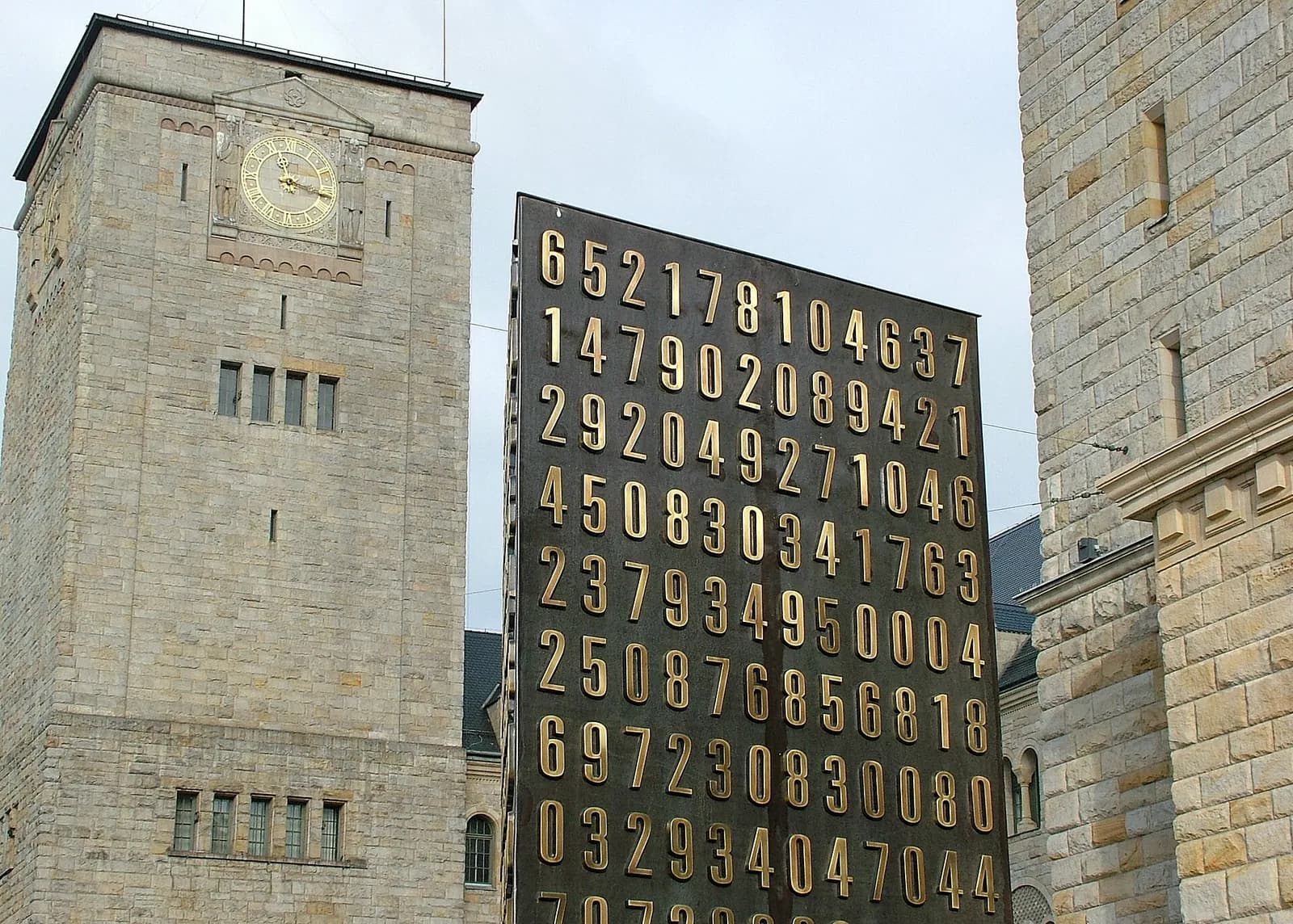
Today Poznań remembers them in two places. Outside the Imperial Castle, which housed university departments before the war and where the cryptology course was held, stands the codebreakers' monument: three tall blocks covered in digits, each bearing one of their names. Right next door, at Święty Marcin 78, the Enigma Cipher Centre has run a multimedia exhibition since September 2021.
Timeline
- 1929The Cipher Bureau runs a secret cryptology course for math students in Poznań.
- September 1, 1932Rejewski, Zygalski and Różycki start work at the Cipher Bureau in Warsaw.
- December 1932Rejewski reconstructs the wiring of the Enigma rotors.
- 1934–1935The cyclometer and the catalog of cycle patterns for finding daily keys.
- September 15, 1938The Germans change their procedure; the Poles respond with the sheets and the bomba.
- November 1938Six cryptologic bombs are ready.
- December 15, 1938Rotors IV and V arrive: rotor orders jump from 6 to 60.
- July 1939The Pyry meeting: the Poles hand their knowledge and Enigma copies to France and Britain.
- January 17, 1940First wartime Enigma messages read at PC Bruno near Paris.
Practical info
- Where
- Enigma Cipher Centre (Centrum Szyfrów Enigma), ul. Święty Marcin 78, Poznań, next to the Imperial Castle.
- Best time
- The exhibition is indoors, so any time of year. It is closed on Mondays; check current hours at csenigma.pl.
- Getting there
- The center is in downtown Poznań, within walking distance of Poznań Główny station and the Old Market Square.
- Tickets
- Tickets are sold online through the center’s website; check current prices on the official site.
- On site
- The codebreakers' monument outside the Imperial Castle; on the Old Market Square, the Greater Poland Military Museum holds items that belonged to Henryk Zygalski.
Questions and answers
Who broke the Enigma code first?
Polish mathematician Marian Rejewski of the Polish Cipher Bureau, at the end of 1932. He developed the methods for finding daily keys with Jerzy Różycki and Henryk Zygalski.
Did the Poles break Enigma before Alan Turing?
Yes. The Poles were reading Enigma from late 1932, and in July 1939 they shared their methods with the British. Turing and Bletchley Park built on that work during the war, and Turing’s bombe was named after the Polish bomba.
What was the Polish bomba?
An electromechanical device designed by Rejewski in 1938: six linked Enigmas driven by an electric motor. It worked through the rotor positions and found the daily key in about two hours.
How many settings did the Enigma machine have?
Three rotors gave 17,576 starting positions, and with six possible rotor orders 105,456. The plugboard, which swapped pairs of letters, multiplied that many times over.
What were Zygalski sheets?
Perforated paper sheets invented by Henryk Zygalski in 1938, 26 for each rotor order, with about a thousand holes each. Stacked on a light table, they revealed the rotor settings of the day.
Where can I learn about Enigma in Poland?
At the Enigma Cipher Centre in Poznań, at Święty Marcin 78, next to the Imperial Castle. The codebreakers' monument stands outside the castle.
Sources
- Wikipedia: Marian Rejewski (in Polish) (opens in a new tab)
- Wikipedia: Cryptanalysis of the Enigma (opens in a new tab)
- Enigma Cipher Centre, Poznań (in Polish) (opens in a new tab)
- Enigma Cipher Centre, the history of Model K574 (in Polish) (opens in a new tab)
- Enigma Cipher Centre, the Station 300 papers in the media library (in Polish) (opens in a new tab)
- Enigma Cipher Centre: the AVA radio factory in Warsaw (in Polish) (opens in a new tab)
- Enigma Cipher Centre: the replica in the Polish History Museum collection (in Polish) (opens in a new tab)
- Enigma Cipher Centre: technical drawings of the Polish Enigma and cyclometer (in Polish) (opens in a new tab)
- Wikipedia: Bomba (cryptography) (opens in a new tab)
- Wikipedia: Henryk Zygalski (in Polish) (opens in a new tab)
- Wikipedia: Enigma (in Polish) (opens in a new tab)