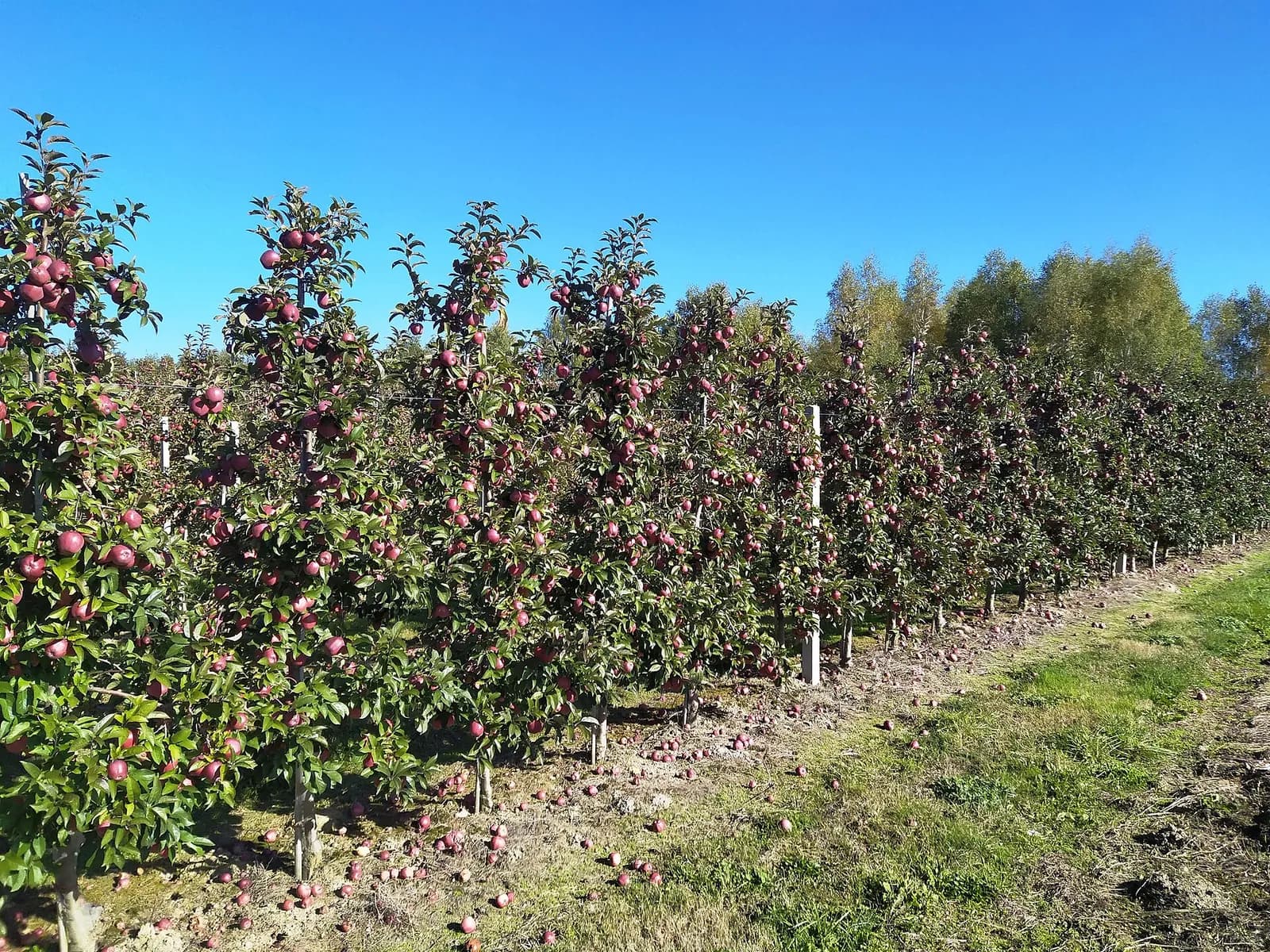
The croissant Poznań waits for all year
Show on mapOn November 11, St. Martin's Day, Poznań celebrates the name day of Święty Marcin Street. The star of the day is a croissant filled with white poppy seeds.
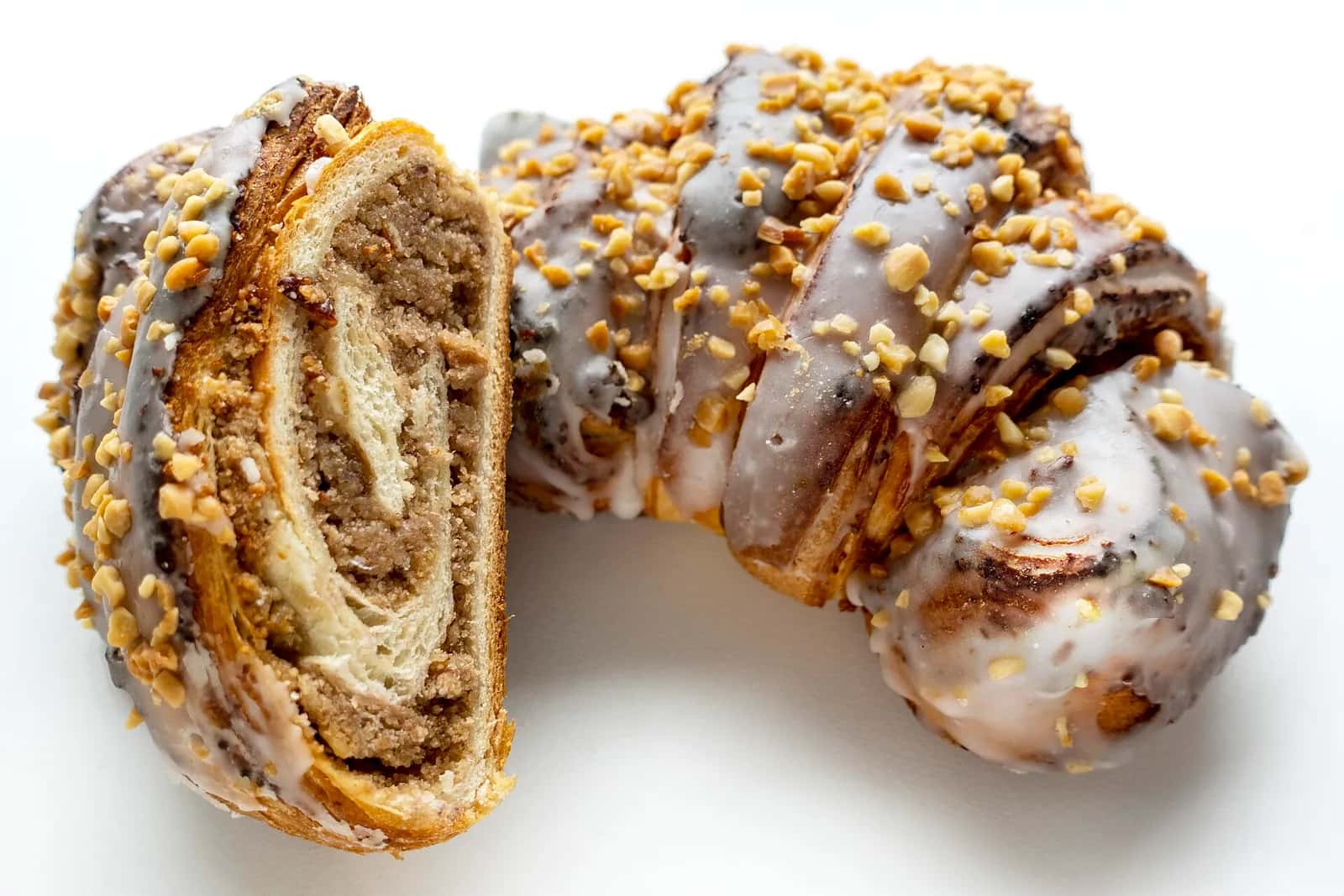
In a single day Poznań eats about 250 metric tons of croissants. That is how many, by the estimate of the Poznań Guild of Confectioners and Bakers, are sold on November 11, St. Martin's Day. Over a whole year it is about 500 tons, or roughly 2.5 million croissants.
The St. Martin's croissant (rogal świętomarciński) is a crescent of flaky yeast dough filled with white poppy seeds, raisins, nuts and candied fruit, glazed with icing and sprinkled with chopped nuts. It weighs 150–250 grams (about 5–9 oz). Since 2008 its name has been a Protected Geographical Indication in the European Union.
Everyone in Poznań knows the legend of the confectioner Józef Melzer, who baked croissants for the poor in 1891. Fewer know that Poznań confectioners were advertising St. Martin's croissants in the newspapers as early as 1852, almost forty years before.
What is in a St. Martin's croissant?
It starts with a yeast dough of high-gluten wheat flour (over 27% gluten), milk, eggs, sugar, yeast and fat. First comes a starter that rises for about an hour at around 30°C (86°F), then the rest of the ingredients. The specification names margarine as the fat, not butter.
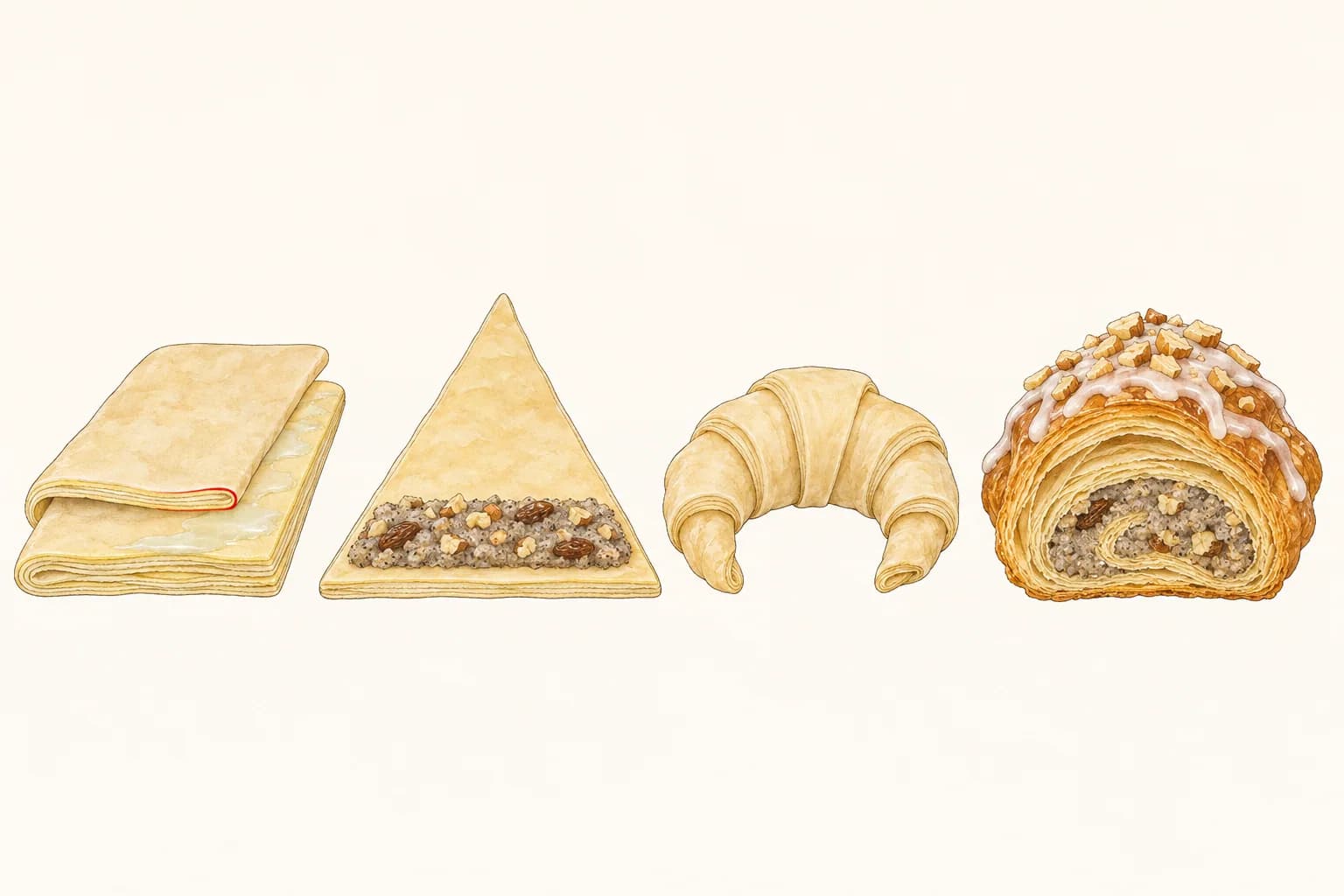
The yeast dough is then laminated, a little like a Danish pastry. A rolled rectangle is spread with fat over two thirds and folded in three, giving three layers of dough with two layers of fat between them. It is rolled and folded in three twice more, or in four once. The dough, rolled to 0.5–1 cm, is cut into triangles.
A portion of filling is piped onto the wide end of each triangle, the dough is rolled toward the tip and bent into a crescent. The croissants are brushed with egg, left to rise and baked at about 180°C (356°F); a 200 g croissant takes about 30 minutes. Finally comes the icing and a sprinkle of chopped nuts.
- white poppy seeds, scalded with hot water at about 1:1 and ground twice,
- cake crumbs and sugar, added at the second grinding,
- eggs, fat and almond flavoring,
- raisins, nuts and candied fruit or fruit in syrup, such as orange peel, pear or cherry.
How many croissants does Poznań eat on November 11?
According to the Poznań Guild of Confectioners and Bakers, about 250 tons of croissants are sold on St. Martin's Day alone and about 500 tons over the whole year. That is roughly 2.5 million croissants.
November 11 is a double holiday in Poznań. It is Poland's National Independence Day, marking the end of the First World War and the rebirth of the Polish state in 1918, and it is also the name day of Święty Marcin (St. Martin) Street, the city's main street. Since the mid-1990s the Zamek Culture Center has organized the street party. After Mass at St. Martin's Church a parade sets off with the saint on horseback, and outside the Zamek the mayor hands him the keys to the city gates. Croissant stalls line the route.
Why St. Martin? His church already stood on the left bank of the Warta River when Poznań received its town charter in 1253. A settlement called Święty Marcin grew around it and was absorbed into the city in the late 18th century. The feast of the parish and street patron gradually became the whole city's holiday.
Who invented the St. Martin's croissant? The legend and the 1852 ads
The best-known Poznań story says that in November 1891 the confectioner Józef Melzer, moved by a sermon from Father Jan Lewicki, the parish priest of St. Martin's, persuaded his employer to bake croissants and give them to the poor. Other bakers took up the idea, and a tradition was born.
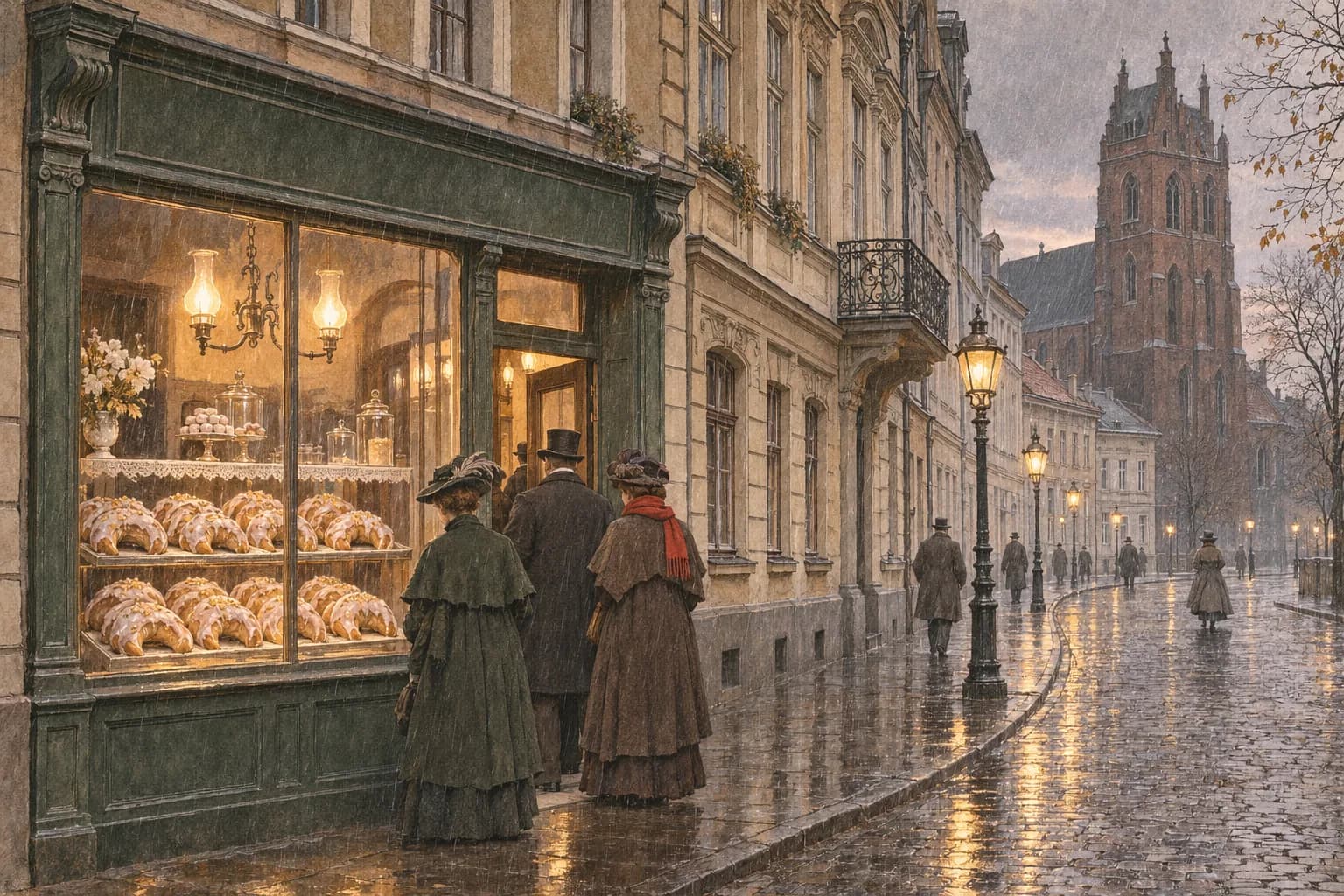
Old newspapers suggest the tradition is older. On November 10, 1852, the confectioner Antoni Pfitzner announced in the Gazette of the Grand Duchy of Poznań that he would have filled croissants at various prices the next day. On November 11, 1860, N.T. Hundt's confectionery on the Old Market Square advertised "St. Martin's croissants" with and without filling in the Poznań Daily. It is the oldest known use of the name.
By 1875 eight Poznań confectioners were advertising croissants for St. Martin's Day. In 1890 the firm of J.P. Beely sold them at prices from 10 pfennigs to 2 marks (Poznań was then part of Prussia), and in 1891 Paweł Siebert's shop on Święty Marcin Street advertised croissants "with poppy seeds and almonds".
The shape has several legends of its own. One says it recalls a horseshoe lost by St. Martin's horse. The writer Bronisław Gustawicz wrote in 1910 that it was a trace of ancient offerings shaped like ox horns. Another version links the crescent to Turkish banners captured at the Battle of Vienna in 1683.
When did white poppy seeds take the place of almonds?
In 1892 Antoni Pfitzner took orders for almond-filled croissants for November 11, with little marzipan geese to go with them. His advertisement ran in the local paper, Kuryer Poznański. Other confectioners were already using poppy seeds too. Anyone buying a St. Martin's croissant in Poznań then had a choice of fillings.
After the Second World War, almonds became hard to get. In their application to register the name, Poznań's confectioners describe how small bakeries turned to ground white poppy seeds with a little almond flavoring. You can still trace the shops through ads in Głos Wielkopolski, the regional daily. Knast's shop on Plac Wolności advertised its croissants in 1946, and three years later Ludwiżanka was selling them on Plac Wiosny Ludów.
What does the croissant certificate mean?
Since 2008 "rogal świętomarciński" has been a Protected Geographical Indication in the EU. A Commission regulation entered it in the register on October 30, 2008, after a campaign led by the Poznań Guild of Confectioners and Bakers.
Only bakeries in Poznań and 26 counties of Greater Poland that bake to the specification and pass inspections may use the name. A bakery that wants to sell certified croissants has to sign up by October 11, a month before the feast; latecomers can use the name only from the following year.
In 2024, 84 bakeries and confectioners held a certificate to bake traditional St. Martin's croissants. Inspections cover every stage, from making the dough to decorating, and every producer must be able to trace each batch of croissants back to its batch of ingredients.
Who delivered croissants to families in Poznań?
Wacława Małecka remembered her grandmother Antonina Jankowiak, the wife of a Poznań baker, working with the local Ladies of Charity of St. Vincent de Paul. For St. Martin’s Day the women made up parcels of croissants for poor and unemployed people in the neighborhood. The family’s account appeared in an exhibition catalog on the Jankowiaks. Behind the stories about generous bakers were people who knew which doors to knock on.
In 2023 Caritas in Poznań took croissant orders from schools, parishes and businesses. The proceeds were earmarked for four soup kitchens and a Christmas Eve supper for people in need at the Poznań International Fair grounds. The charity counted 12,500 of its croissants in its report for that year. Buying something sweet for a November morning could help pay for someone else’s meal in December.
What went with a St. Martin’s croissant a century ago?
In November 1925 the Poznań daily Dziennik Poznański reported the price of a goose at the city market. It cost between 7 and 12 złotys. The paper named both goose and croissant as feast-day foods that some households could scarcely afford that year. The following November the local press again reminded readers of the custom of eating both. To a reader in the 1920s, the pastry belonged to a meal that also called for a roast.
There was another occasion for a croissant, just with coffee, and it came nowhere near November. Poznań welcomed Ferdinand Foch, a marshal of both France and Poland, in May 1923. A master confectioner called Franciszek Rączyński supplied pastries for the reception, and St. Martin’s croissants were served with the coffee. The bakers included this detail in their application to register the name. Their pastry could stand for the city even six months before its feast day.
Where can you see the croissants being made?
The Croissant Museum of Poznań (Rogalowe Muzeum Poznania) is in a Renaissance townhouse on the Old Market Square, looking out on the town hall tower with its famous mechanical goats. It is not a museum of glass cases but a live show: the host makes the dough, tells the legends and the city's history, throws in words of Poznań dialect, and the show ends with a tasting.
Shows are mostly in Polish, with occasional English sessions. Individual tickets are sold online; groups book by phone or through a form. The best day to combine it with is November 11, when croissants are on every corner, but the museum runs all year.
Timeline
- 1253Poznań receives its town charter; St. Martin's Church already stands on the left bank of the Warta.
- 1852Antoni Pfitzner advertises filled croissants for St. Martin's Day.
- 1860Hundt's confectionery on the Old Market Square advertises "St. Martin's croissants", the first known use of the name.
- 1875Eight Poznań confectioners advertise croissants for St. Martin's Day.
- 1891According to legend, Józef Melzer bakes croissants for the poor.
- 2008The St. Martin's croissant becomes an EU Protected Geographical Indication.
- 202484 bakeries hold a certificate to bake the croissants.
Practical info
- Where
- Poznań and certified bakeries across Greater Poland. The Croissant Museum: Stary Rynek 41, entrance from Klasztorna Street 23.
- Best time
- November 11, the name day of Święty Marcin Street, with its parade and croissant stalls. Croissants are sold all year.
- Tickets
- Croissant Museum tickets are sold online; check current prices and show times on the official site.
- On site
- Ask the bakery about the certificate. A real one has icing, chopped nuts and a white poppy seed filling.
Questions and answers
Why does Poznań eat croissants on November 11?
It is St. Martin's Day, the feast of the patron of a Poznań parish and of the city's main street. Poznań confectioners have sold croissants for the day since at least 1852.
How much does a St. Martin's croissant weigh?
A certified croissant weighs 150–250 g (about 5–9 oz). In 2013 the minimum fell from 200 g to 150 g and the EU dropped the fixed dimensions. Every croissant still has to curve into a crescent.
What is the filling of a St. Martin's croissant?
White poppy seeds, cake crumbs, sugar, eggs, fat, raisins, nuts, candied fruit and almond flavoring.
Who invented the St. Martin's croissant?
Legend credits the Poznań confectioner Józef Melzer in 1891. Newspaper ads show that Poznań shops were selling croissants for St. Martin's Day as early as 1852.
Where can I buy a real St. Martin's croissant?
At certified bakeries and confectioners in Poznań and Greater Poland. In 2024, 84 businesses held the certificate.
Is the St. Martin's croissant made with butter?
The specification names margarine as the fat for both dough and filling. A butter version may taste good, but it does not follow the EU-protected recipe.
Sources
- Wikipedia: St. Martin's croissant (in Polish) (opens in a new tab)
- Product specification: Rogal świętomarciński (English translation) (opens in a new tab)
- Dziennik Poznański, November 12, 1925, in the Greater Poland Digital Library (in Polish) (opens in a new tab)
- Caritas Poznań, what the 2023 croissant sales funded (in Polish) (opens in a new tab)
- Caritas Poznań, figures for 2023 (in Polish) (opens in a new tab)
- European Commission, croissant weights and the history of the filling in the 2013 amended specification (opens in a new tab)
- Commission Regulation (EC) No 1070/2008 (Rogal świętomarciński PGI) (opens in a new tab)
- dzieje.pl: St. Martin's croissants, guild estimates (2023, in Polish) (opens in a new tab)
- RMF24: over 80 bakeries certified (2024, in Polish) (opens in a new tab)
- Croissant Museum of Poznań (opens in a new tab)
- Zamek Culture Center, Poznań (opens in a new tab)