One in three apples in the EU grows in Poland
Show on mapPoland is the largest apple producer in the European Union and one of the largest in the world.
One in three apples harvested in the European Union grew in Poland. In 2022 Polish orchards produced 34% of the EU crop, more than Italy and France combined. Worldwide, only China, Turkey and the United States harvest more.
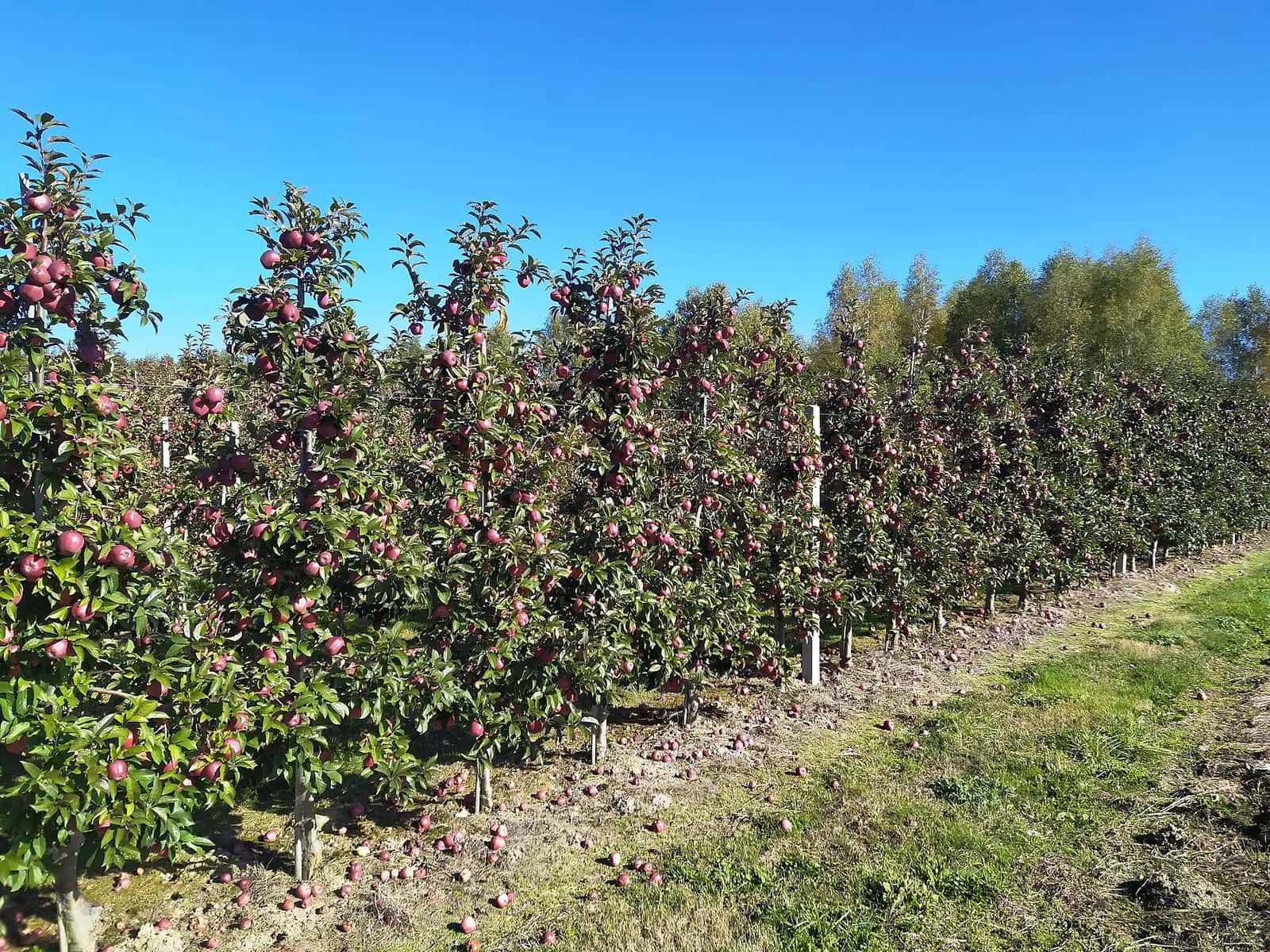
Those apples are not spread evenly across the country. The densest orchards lie south of Warsaw, around the towns of Grójec and Warka. Locals call the area "the largest orchard in Europe": in some municipalities orchards cover up to 70% of the cropland. In spring, when the trees blossom, the countryside turns white to the horizon.
This story runs from 19th-century manor orchards to a prewar grower who sold a kilo of apples for more than a kilo of sausage, and on to the summer of 2014, when Russia banned Polish fruit and Poles ate apples in protest.
How many apples does Poland grow?
Since 2013 the Polish apple harvest has topped 3 million metric tons every year. The one exception was 2017, when spring frosts cut it to 2.4 million tons. The record years were 2021 and 2022, both above 4 million tons.
Weather can take a big bite out of the crop. In 2024, after a bad spring, Statistics Poland (GUS) estimated the harvest at about 3.4 million tons, 13% less than a year earlier. Apples make up about 80% of all the tree fruit picked in Poland.
In EU terms Poland is still the clear leader. According to Eurostat, the EU harvested 12.6 million tons of apples in 2022: 34% came from Poland, 18% from Italy and 14% from France. In the weaker year of 2024 the EU crop fell to 11.6 million tons and Poland's share to 29%.
Why is Grójec called the largest orchard in Europe?
The Grójec apple region (jabłka grójeckie) covers the whole of Grójec County, with the towns of Grójec, Warka, Błędów, Belsk Duży and Mogielnica, plus neighboring municipalities in the Mazovia and Łódź provinces. Fruit growing occupies more than 40,000 hectares (about 100,000 acres) here.
In their application for EU registration the growers reported an average of 800,000–900,000 tons of apples a year, about 35% of national production. At the time 7,442 farms grew apples, averaging about 7 hectares each, of which 4.2 hectares were orchard.
The climate helps. From mid-September to late October the days can be warm and the nights cold, sometimes close to freezing. On cool nights the fruit burns less sugar, so more stays in the flesh and the skin blushes deeper. According to the official specification, Grójec apples have on average about 5% more blush and 5% more acidity than is typical for their variety.
You can see the orchards in the local heraldry and on the map. Apples appear on the coat of arms of Grójec County and several of its municipalities, and nearby villages are called Sadków and Sadkowice, from "sad", the Polish word for orchard. Since 2011 "jabłka grójeckie" has been a Protected Geographical Indication in the EU.
- it grows in the defined area: Grójec County and neighboring municipalities,
- it comes from organic farming, integrated production or a farm using the GlobalG.A.P. system,
- it is one of the several dozen varieties listed in the specification,
- for sale as a dessert apple, it meets the requirements for its variety and grades as Extra or Class I,
- the apples can be traced using a number issued to the grower by the Grójec Orchards Association. The grower can keep that number in the production records.
How did the orchards around Grójec begin?
Orchards here were already recorded in the 16th century, when Queen Bona Sforza, the Italian-born wife of King Sigismund I, managed the royal estates around Czersk and Warka. The real boom came later. Statistics from 1880 show 1,801 morgens (roughly 1,000 hectares) of manor orchards in Grójec County, three times more than in the runner-up, Warsaw County.
Around 1900 peasants began to plant fruit trees in the fields rather than next to their cottages, with the market in mind. Two clusters formed: one along the Vistula, the other west of Grójec around Belsk and Błędów. In the village of Podgórzyce near Warka, Jan Cieślak noticed the high price of fruit at a Warsaw market and planted his own orchard. In 1918 he built a fruit storehouse, one of the first growers in Poland to do so.
It paid off. In 1938, when a kilo of sausage cost 2 złoty, Cieślak was selling a kilo of apples for 3.50 złoty. The 1921 census counted 2,694 hectares of orchards in the county. After the Second World War came research stations, horticultural schools and cooperatives, and in 1951 the Institute of Pomology opened in nearby Skierniewice.
The 1958 harvest was so large that apples were left lying in roadside ditches. A year later a local official, Wacław Przytocki, organized the first Apple Blossom Days in the village of Potycz. The festival moved from town to town for years before settling in Grójec.
Why plant a crab apple in an orchard of dessert apples?
Two partners help a Cortland tree set fruit. One is a tree of a compatible variety that flowers at the same time. The other is an insect that carries pollen between them. Gala can supply pollen for Cortland, but so can a flowering crab apple called Evereste. Its little apples will never go into the crates of Cortlands. It earns its place in the orchard in spring.
Researchers at Skierniewice publish tables of varieties that make good partners. A tree whose fruit is simply a different-colored mutation of the main variety can be too closely related to do the job. Even a well-matched pair needs insects on the move while both trees are in bloom. Honeybees and red mason bees both visit apple blossom. A grower chooses the trees years ahead, then depends on what happens in those few days of spring.
How do you save an apple when nobody remembers its name?
At Bolestraszyce, near Przemyśl in southeastern Poland, the first job was to find the trees. Jerzy Piórecki gathered material on field trips for a collection begun in the late 1980s. Some apples in village gardens were known only to the families who grew them, sometimes by a local nickname. Matching a fruit to a description in an old orchard manual could wait. Taking a cutting while the tree was still standing could not.
Staff grafted shoots onto Antonówka rootstocks in the arboretum nursery. The roots belonged to one variety, while the branches would bear fruit of the variety they had gone out to save. In 2009 the orchard behind the fort received 90 trees from surveys across the Podkarpackie region. Two years later another orchard took material collected in western Ukraine with the botanical garden of Lviv University. Visitors can taste some of these apples at the arboretum’s fruit exhibitions.
Which apple varieties grow in Poland?
Nineteenth-century peasant orchards grew easy varieties with Polish names such as Papierówka (a summer apple), Oliwka, Różanka, Mnich and Rzepka. Summer and autumn apples dominated, and winter keepers were rare. Today old varieties, above all the tart Antonówka, are associated with szarlotka, the Polish apple cake, and with backyard trees.
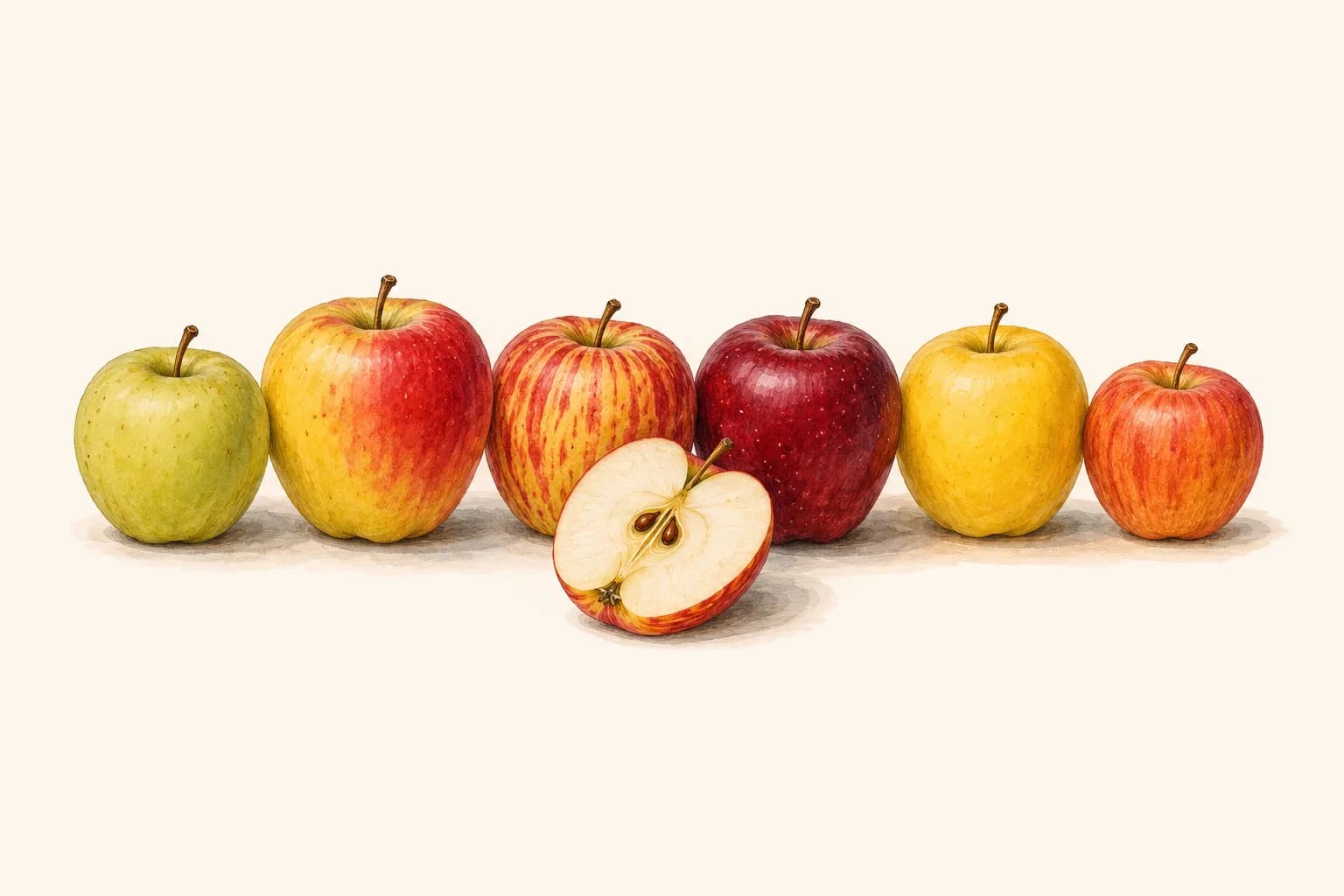
A modern orchard looks nothing like that: dense rows of short trees. The Grójec specification lists several dozen varieties, including Idared, Szampion, Jonagold and Jonagored, Gala, Golden Delicious, Gloster, Elstar, Fuji and Braeburn.
One Polish-bred variety is on the list too: Ligol. It was bred in 1972 at the Research Institute of Pomology and Floriculture in Skierniewice by A. Przybyła and S.W. Zagaja, by crossing Linda with Golden Delicious. It is a large, red-blushed late-winter apple.
How do growers know when to pick an apple for winter storage?
A grower can tell a lot by slicing a sample apple across the middle, through the star of seeds. A little iodine solution stains the flesh deep blue wherever it still holds starch. As the apple ripens, the starch breaks down, so less of the flesh turns blue each time the grower tests a fresh sample. Comparing the pattern with a chart and checking how firm the flesh feels under a probe helps the grower decide when to pick fruit that needs to keep for months.
Around Grójec it can take much of the winter for an apple to reach the shop. The Grójec apple specification gives 1–3°C (34–37°F) as the ideal temperature for several months in storage. When the cold room opens, the fruit is sorted. Even after months in the cold, a winter apple like Ligol still has to be firm enough to carry the protected name. Growers can look up the minimum firmness for their variety in the grading table.
Where do Polish apples go?
Between 20% and 30% of fresh apples are exported. The main buyers in the EU are Germany and Romania, and outside it Egypt and Kazakhstan. In years with a big harvest up to 70% of the crop goes to processing, mostly for juice.
Polish apple juice concentrate is an export product: up to 85% of it is sold abroad, to Germany, the United Kingdom, the Netherlands and the United States. An apple from Grójec may well end up in a juice carton on the other side of the Atlantic.
The market looked different before 2014, when Russia was a major customer. In the summer of 2014, in response to EU sanctions over Ukraine, Russia banned imports of Polish fruit and vegetables. Poles answered online with the #jedzjabłka ("eat apples") campaign, posting photos of themselves biting into apples. Growers had to look for new markets; today Egypt and Kazakhstan are among the main buyers outside the EU.
Which Polish apples have EU protection?
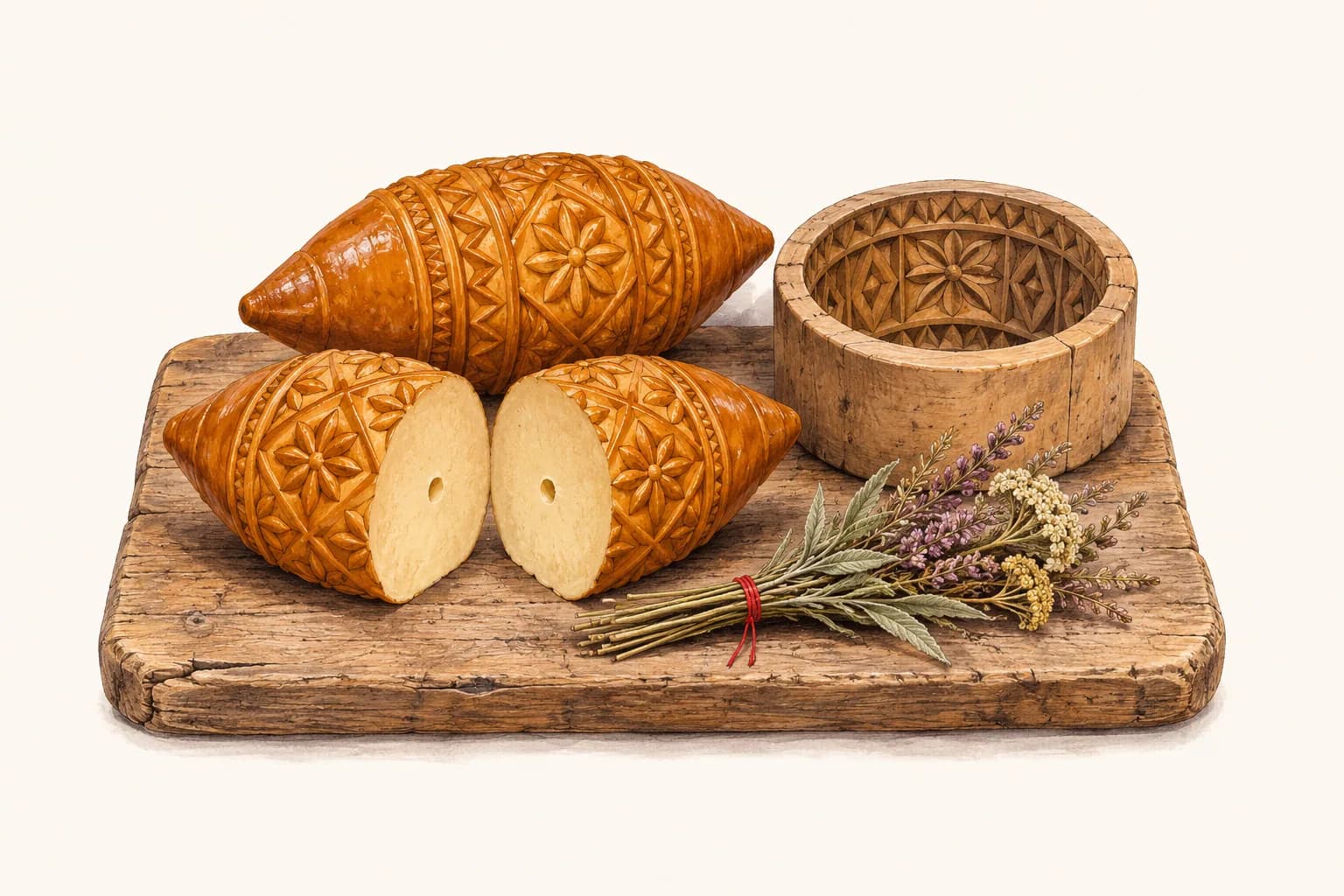
Four of the Polish names protected in the EU are apples. Besides Grójec apples there are Łącko apples from the Beskid Sądecki mountains in the south, Krajna apples from the Krajna region on the northern edge of Greater Poland, and the smoked Sechna apple from Małopolska, dried in smoke like the local plums.
Each describes a different landscape: mountain orchards in the Dunajec valley, the flat orchards of Mazovia, the hills of Krajna and an old tradition of smoking fruit in drying sheds. The rule is the same for all four: an apple from anywhere else cannot carry the name.
Timeline
- 1880Manor orchards in Grójec County cover three times more land than in Warsaw County.
- 1918Jan Cieślak builds a fruit storehouse in Podgórzyce near Warka.
- 1938A kilo of his apples costs 3.50 złoty, a kilo of sausage 2 złoty.
- 1951The Institute of Pomology opens in Skierniewice.
- 1959The first Apple Blossom Days take place in Potycz.
- 1972The Ligol apple is bred in Skierniewice.
- 2011Grójec apples become an EU Protected Geographical Indication.
- 2014Russia bans Polish fruit; Poles launch the #jedzjabłka campaign.
- 2022Poland grows 34% of the EU apple harvest.
Practical info
- Where
- The area around Grójec, Warka, Błędów and Belsk Duży, about 40 km (25 miles) south of Warsaw.
- Best time
- Spring, when the orchards bloom, and September to October, during the harvest.
- Getting there
- From Warsaw take the S7 expressway toward Kraków and exit at Grójec.
- On site
- The Apple Blossom Festival in Grójec, and roadside stands selling apples straight from the orchard in season.
Questions and answers
How many apples does Poland produce?
Usually more than 3 million metric tons a year since 2013, and over 4 million tons in the record years of 2021 and 2022. In 2024, after a bad spring, about 3.4 million tons.
Is Poland the largest apple producer in Europe?
Yes. According to Eurostat, Poland grew 34% of the EU apple harvest in 2022 and 29% in 2024. Worldwide, China, Turkey and the US harvest more.
Where is the largest orchard in Europe?
That is the popular name for the area around Grójec and Warka, south of Warsaw, where fruit orchards cover more than 40,000 hectares.
What are Grójec apples?
Apples from Grójec County and neighboring municipalities, protected in the EU since 2011. Growers can use organic farming, integrated production or the GlobalG.A.P. system. The apples must also meet the standards for their variety.
Where does Poland export its apples?
Fresh apples go mainly to Germany, Romania, Egypt and Kazakhstan. Apple juice concentrate goes mainly to Germany, the UK, the Netherlands and the US.
What is a Ligol apple?
A Polish variety bred in 1972 in Skierniewice by crossing Linda with Golden Delicious. It is a large, red-blushed late-winter apple.
Sources
- FAOSTAT: Crop production (opens in a new tab)
- Wikipedia: Grójec apples (in Polish) (opens in a new tab)
- Eurostat: EU fruit production in 2022 (opens in a new tab)
- Bolestraszyce Arboretum, how the heritage apple orchards were planted (in Polish) (opens in a new tab)
- Integrated apple production guidelines, table of compatible varieties (in Polish) (opens in a new tab)
- Eurostat: EU fruit and vegetable harvest in 2024 (opens in a new tab)
- Polish Ministry of Agriculture: fruit and vegetables (in Polish) (opens in a new tab)
- Product specification: Jabłka grójeckie (English translation) (opens in a new tab)
- National Institute of Horticultural Research, how to judge picking maturity (in Polish) (opens in a new tab)
- Official Journal of the EU, Grójec apple varieties, grading and cold storage (opens in a new tab)
- EU regulation approving the 2023 changes for Grójec apples (opens in a new tab)
- Commission Implementing Regulation (EU) No 981/2011 (opens in a new tab)
- Polish Ministry of Agriculture: registered Polish names (in Polish) (opens in a new tab)
- Plant catalog: Ligol apple (in Polish) (opens in a new tab)
- Euronews: Russia fruit ban causes Polish apple excess (2014) (opens in a new tab)