Oscypek, a cheese made of sheep's milk and smoke
Show on mapThis smoked cheese from Podhale, the highland region below the Tatras, is protected by the EU. Genuine oscypek is made only while the sheep are out grazing.
The oldest trace of this mountain cheese is not a recipe but a tax. In 1416 a man named Dawid Wołoch (David the Vlach) was granted the right to found the village of Ochotnica in the Gorce Mountains, and villagers who kept sheep had to pay a tribute in sheep and cheese around St. Martin's Day. A hard, smoked cheese kept for a long time, so it worked as money.
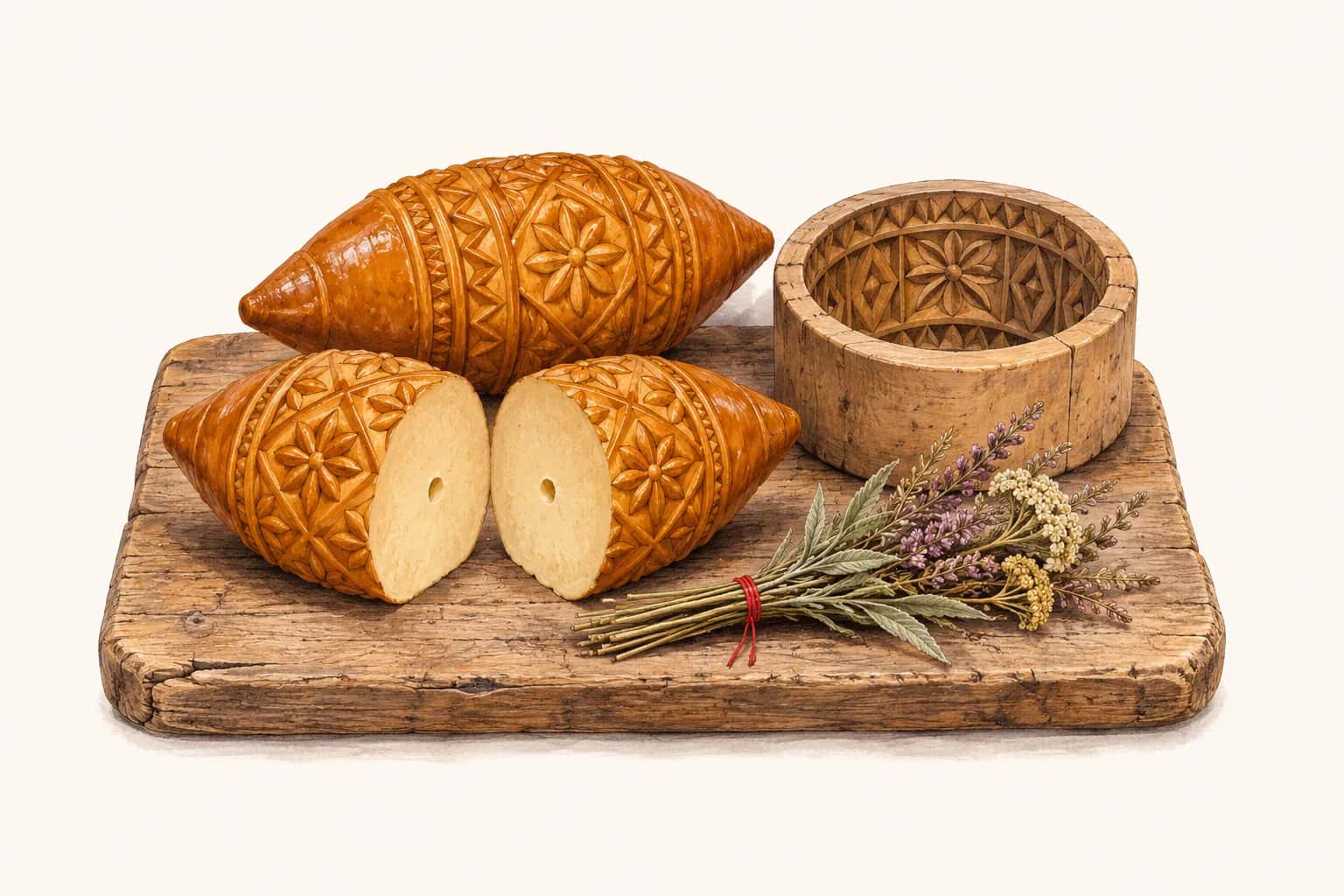
Today's oscypek (say "os-tsih-pek") is shaped like a spindle, 17–23 cm (7–9 inches) long, and weighs 0.6–0.8 kg (1.3–1.8 lb). Around its middle runs a band of patterns pressed in by a carved wooden mold, the oscypiorka. Every baca, the head shepherd who runs a hut, has his own patterns, so each cheese is also his signature.
Since February 2008 oscypek has been a Protected Designation of Origin in the European Union. It is made by hand, only from May to September, from the milk of the Polish Mountain Sheep, with no more than 40% added milk from Polish Red cows. A "smoked sheep cheese" bought in Zakopane in January is almost certainly not oscypek.
What is oscypek, and how is it different from gołka?
Oscypek is a hard, smoked cheese made mostly from sheep's milk. It is shaped like a double cone, and its cylindrical middle is decorated with raised and sunken patterns in three bands. The rind is straw-colored to light brown with a soft shine. Cut it open and the inside is cream-colored, sometimes with a single large hole in the center: the trace of the skewer it was shaped on.
The specification also sets its composition: no more than 44% water and at least 38% fat in the dry matter. The taste is distinctly smoky and slightly salty. The longer the cheese hangs in the smoke, the darker its color, from creamy yellow to orange-brown.
Gołka looks similar but is a different cheese. It is cylindrical, made from cow's milk and sold all year, so in winter it is what most market stalls actually offer. Oscypek's close relatives include bundz, a fresh cheese from a single milking, bryndza, a crumbly salted sheep's cheese, and redykołka, small smoked cheeses shaped like animals, birds and hearts.
How is oscypek made? Step by step in a shepherd's hut
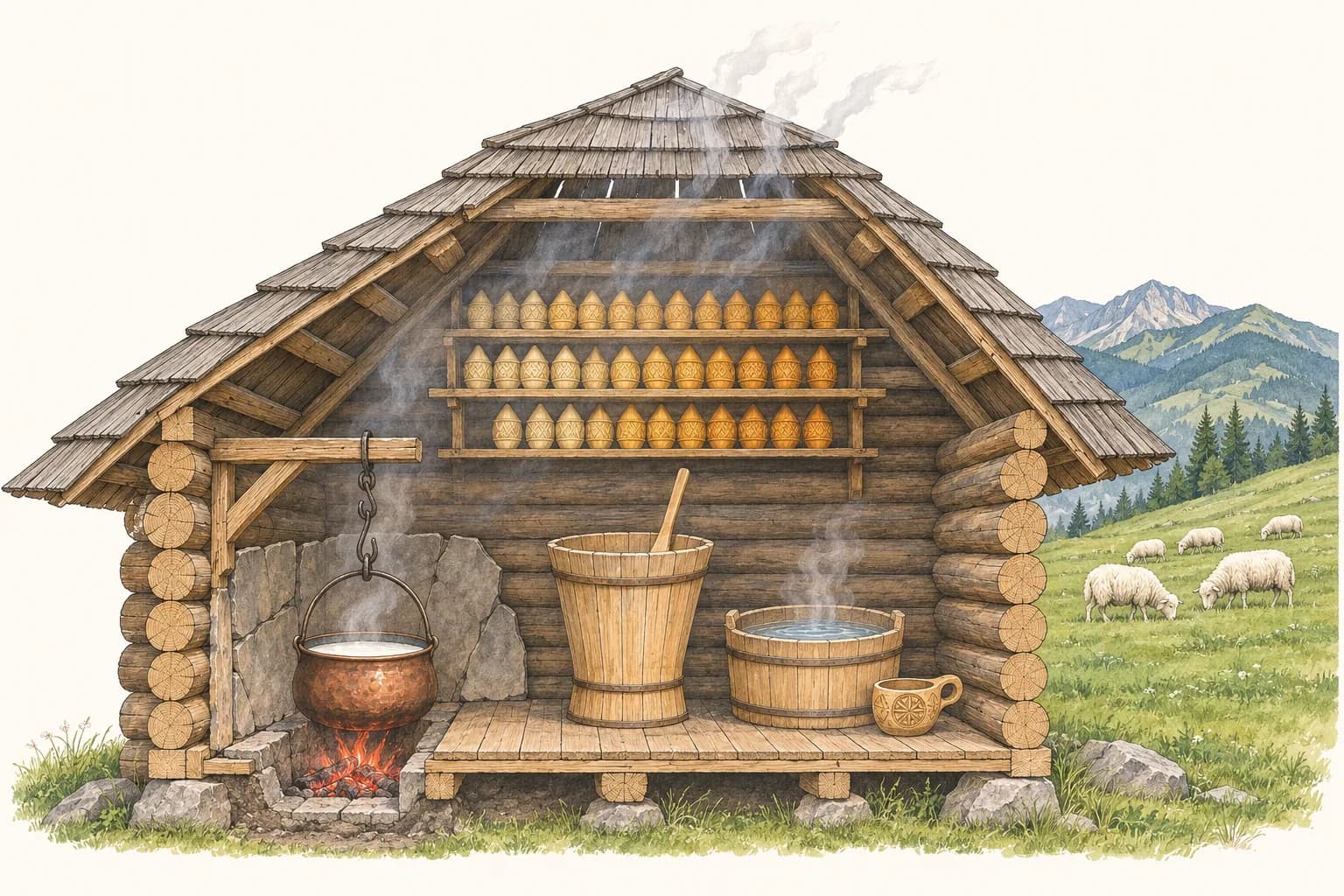
Everything happens in a bacówka, a wooden shepherd's hut on a mountain pasture. A traditional one is 4–5 meters wide and 8–9 meters long, with no windows. In a corner of the main room a fire burns all season in a pit sunk 40–100 cm into the floor. The smoke escapes through gaps in the roof, curing the cheeses stacked under the eaves on its way out.
The sheep are milked two or three times a day: around 5 a.m., between noon and 2 p.m., and around 9 p.m. From September only twice. Every step is done by hand, and the baca judges water temperature and scalding time by feel, depending on the milk and the weather.
The cheeses are cold-smoked on wooden shelves called komorniki and turned at least once a day for an even color. Larch gives a darker rind, alder a lighter one; ash and spruce are used too.
- Fresh milk is mixed with a little soured milk (no more than 8% of the total) and warmed in a copper kettle to about 40°C (104°F).
- In a puciera, a tall wooden barrel, rennet is added; a curd forms in 10–30 minutes.
- The curd is broken with a ferula, a wooden stirrer, into grains the size of cereal grains.
- Up to half the whey is drained off; the rest becomes żentyca, the shepherds' sour whey drink.
- The curd is kneaded into a ball measured with a wooden cup and scalded 2–5 times in water up to 66°C (151°F) to press out the whey.
- The ball is pushed onto a skewer, shaped into a double cone and clamped in the carved oscypiorka, which presses in the pattern.
- The cheese soaks in brine for up to 24 hours, dries for 12–24 hours and is cold-smoked for 3–7 days.
Why would a shepherd give someone a pair of cheese birds?
After shaping an oscypek, the shepherd might have a little curd left over, too little for another spindle. There was enough for a redykołka, perhaps a little duck or a deer. Brine and smoke gave it much the same flavor as the large cheese. Its purpose became clear when the flocks came down from the mountains. An owner collecting the cheese owed for the milk might also receive a small gift from the shepherd.
In the application to register redykołka, the shepherds describe a custom of giving the figures in pairs. Two little birds could thank someone for a favor. Cheese doves and roosters also decorated ceremonial branches at weddings and crowned harvest wreaths. The animals you see on a market stall as souvenirs once had a place in a wedding procession or in the hands of a family calling for its sheep.
Where does oscypek come from? Vlachs, tributes and the first recipe
Oscypek came to the Polish mountains with the Vlachs, pastoral people who moved along the arc of the Carpathians between the 14th and 16th centuries. They brought Zackel sheep, the ancestor of today's Polish Mountain Sheep, the system of summer grazing on high pastures, the shepherd's hut and rennet cheeses. Documents of the time mention "Wallachian cheeses".
A royal survey of 1564 shows how much cheese mattered in the economy of Podhale, the highland region below the Tatras. In the village of Klikuszowa the sheep tribute was calculated on 920 sheep, and a cheese tax was among the dues. In Szaflary both sheep and cow cheese were taxed.
The first detailed description of cheese-making in mountain huts comes from instructions written in 1748 for the Ślemień estate near Żywiec and recopied in 1773. The name itself appears later: in 1830 the writer Ambroży Grabowski noted that highlanders made "oszczypki" and bryndza from sheep's milk. In 1870 Walery Eljasz's guidebook to the Tatras priced an oscypek at 20–25 cents, depending on its size.
Oscypek or oštiepok? The dispute with Slovakia
On the other side of the Tatras, Slovaks make a similar cheese: oštiepok. When Poland applied to protect oscypek, Slovakia objected, which delayed registration. In the end the two countries agreed that the cheeses are now made quite differently and that both names can coexist.
Oscypek entered the EU register in February 2008 as a Protected Designation of Origin. In September of the same year Slovakia registered "Slovenský oštiepok" as a Protected Geographical Indication. The differences are clear: the Slovak cheese may be made in a dairy, may or may not be scalded and may or may not be smoked, while Polish oscypek is made only by hand, in a hut, during the grazing season.
How to tell a real oscypek
The simplest test is the calendar. Sheep give milk from about late April to early October, so oscypek is made from May to September. In winter, vendors usually sell "oscypek-style" smoked cheese or gołka.
Oscypek producers are registered, declare how many sheep and cows they graze and where, and keep production records. Compliance is checked by Poland's Agricultural and Food Quality Inspection (IJHARS), which issues certificates. It is fair to ask the baca or the seller to show one.
- a spindle shape, 17–23 cm long, weighing 0.6–0.8 kg,
- a band of carved patterns around the widest part,
- a straw-colored to light brown rind with a slight shine,
- a creamy inside, sometimes with one hole left by the skewer,
- a smoky smell and a mildly salty taste,
- bought between May and September, ideally at a certified hut.
What does oscypek have to do with spring crocuses?
On Hala Długa, a meadow below Mount Turbacz in the Gorce Mountains, crocuses flower in spring and the shepherds make cheese in summer. The link is the flock. People cleared these slopes to graze their animals and cut hay for winter. When grazing and mowing stop, bilberries and raspberries spread across some of the clearings, and eventually the forest returns.
Jan Loch of Gorce National Park counted flowering crocuses after the snow melted each spring from 2008 to 2012. On one rich meadow, the plots open to sheep had twice as many flowering crocuses per square meter at the end of the study as at the start. In the fenced plots the number fell to a third. Loch suggested that a thick mat of old grass made it hard for flowers to push through. The type of grassland mattered too. On poorer ground dominated by matgrass, crocuses declined even where sheep grazed.
How do you eat oscypek?
In the highlands oscypek is eaten cold, sliced, or warm. The favorite version is grilled oscypek with cranberry sauce: the rind crisps and the inside softens. At the hut it comes with żentyca, the tangy whey left over from the cheese.
Oscypek is also recommended by the international Slow Food movement. In 2003 four bacas made it in front of an audience at the Salone del Gusto in Turin, Italy, and according to the registration application the demonstration drew considerable interest.
Timeline
- 1416Ochotnica's founding charter: a tribute in sheep and cheese, paid around St. Martin's Day.
- 1564A royal survey records cheese taxes in Klikuszowa and Szaflary.
- 1748Instructions for the Ślemień estate describe how to make cheese in mountain huts.
- 1830Ambroży Grabowski writes about highland "oszczypki", the oldest known use of the name.
- 1870Walery Eljasz's guidebook prices an oscypek at 20–25 cents.
- 2003Shepherds make oscypek at the Slow Food fair in Turin.
- 2007Bryndza podhalańska becomes the first Polish food protected in the EU.
- 2008Oscypek becomes an EU PDO; in September Slovakia registers oštiepok.
Practical info
- Where
- Shepherds' huts on the pastures of the Tatras, Podhale, the Gorce and the Beskids. In Podhale, the Oscypek Trail (Szlak Oscypkowy) links selected huts.
- Best time
- May to September, while the sheep are grazing and the huts are working.
- On site
- Ask the baca for the certificate and to see the carved mold. Many huts also offer żentyca and bundz.
- Buying in town
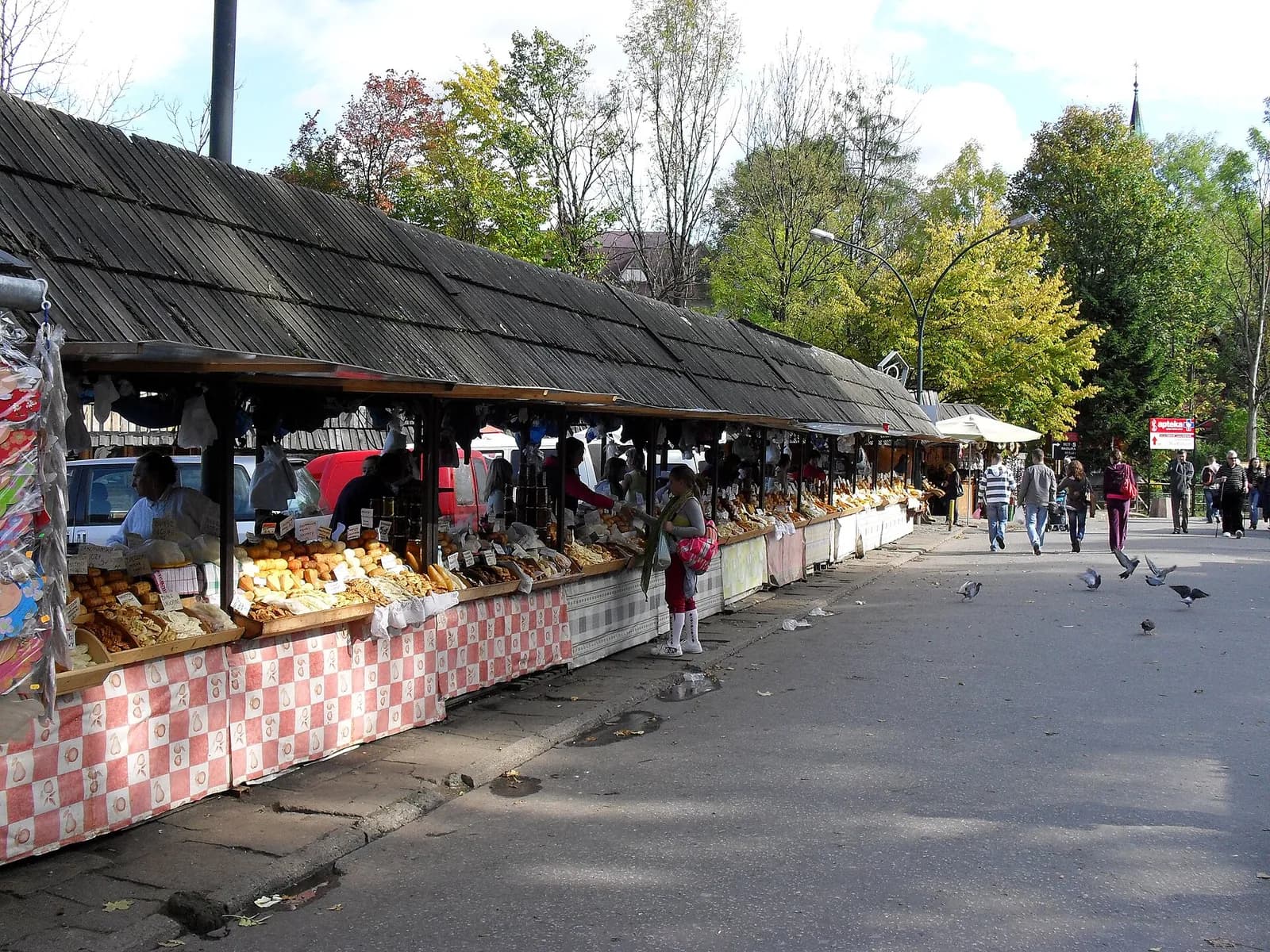
- Zakopane markets sell smoked cheese all year, but out of season it will not be oscypek.
Questions and answers
When is oscypek season?
From May to September, while the sheep graze on the mountain pastures and the huts make cheese from fresh milk.
What milk is oscypek made from?
Milk from Polish Mountain Sheep. Milk from Polish Red cows may be added, but no more than 40%, so at least 60% has to be sheep's milk.
What is the difference between oscypek and gołka?
Oscypek is spindle-shaped, made mainly from sheep's milk and only in season. Gołka is cylindrical, made from cow's milk all year and is not covered by the oscypek protection.
How much does an oscypek weigh?
Between 0.6 and 0.8 kg (1.3–1.8 lb). It is 17–23 cm long and 6–10 cm across at its widest point.
Is oscypek bought in winter real?
Probably not. Genuine oscypek is made only from May to September, so in winter stalls usually sell smoked cheese in its style, or gołka.
What is the difference between oscypek and Slovak oštiepok?
Oštiepok may be made in a dairy and does not have to be smoked. Oscypek is made by hand in a mountain hut during the grazing season. Both names have been protected in the EU since 2008.
Sources
- Wikipedia: Oscypek (in Polish) (opens in a new tab)
- Product specification: Oscypek (English translation) (opens in a new tab)
- Etnozagroda, Podhale shepherds and their tally sticks (in Polish) (opens in a new tab)
- Ministry of Agriculture, cheese figures at weddings and harvest festivals (in Polish) (opens in a new tab)
- Commission Regulation (EC) No 127/2008 (Oscypek PDO) (opens in a new tab)
- IJHARS Kraków: oscypek protected by EU law (in Polish) (opens in a new tab)
- Commission Regulation (EC) No 943/2008 (Slovenský oštiepok PGI) (opens in a new tab)
- Commission Regulation (EC) No 642/2007 (Bryndza podhalańska PDO) (opens in a new tab)
- Product specification: Redykołka (English translation) (opens in a new tab)
- Gorce National Park, the shepherds’ hut on Hala Długa (in Polish) (opens in a new tab)
- Jan Loch, study of grazing and crocuses on Hala Długa (2012), pp. 26–34 (in Polish with English summary) (opens in a new tab)
- National Geographic Traveler: the Oscypek Trail (in Polish) (opens in a new tab)