Krzyżtopór, a palace in a fortress and its legends
Show on mapKrzysztof Ossoliński set his palace inside a pentagon of bastions and had a cross and an axe carved on the gate. A century later it stood empty. Did it really have 365 windows?
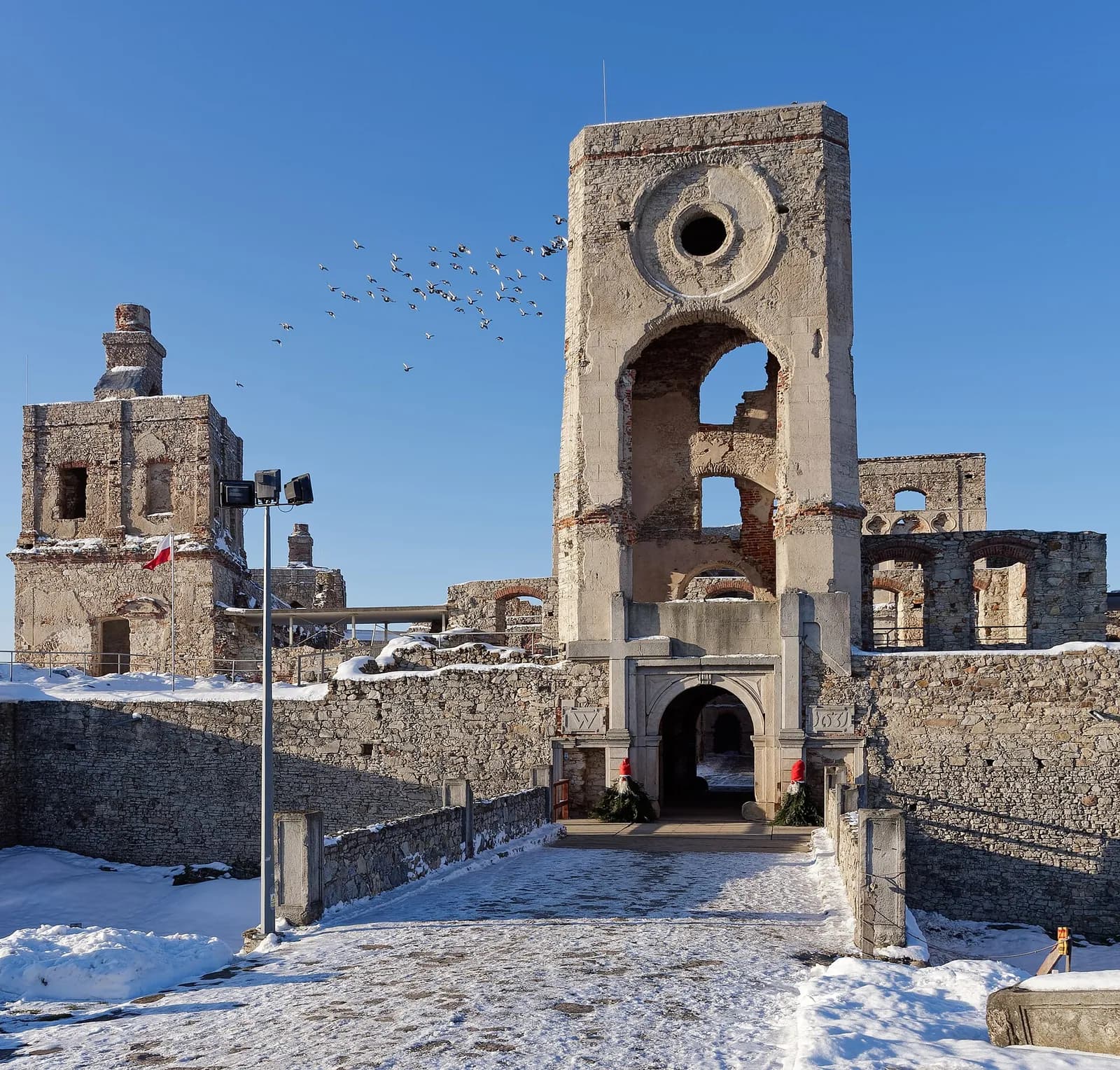
Two signs are carved in stone on the gate at Ujazd: a cross and an axe. The cross stood for the founder’s piety. The axe was his family’s coat of arms, and Poland’s National Heritage Board describes it bluntly as a symbol of aristocratic pride. Krzysztof Ossoliński, governor of the Sandomierz province, built a residence here in the first half of the 17th century that the board now ranks among the largest ruins of fortified noble residences in Europe.
Krzyżtopór was lived in for little more than a century. Its founder died in 1645, soon after the building was finished. Swedish troops carted off its furnishings, library and archive, and much of it was wrecked in fighting during the Bar Confederation, a noble revolt of 1768–1772. It has stood empty since the late 18th century and has gathered more legends than any other castle in Poland.
Below: who built Krzyżtopór and when, how a palace came to sit inside a five-sided ring of bastions, which stories about its windows and aquarium hold up, how it fell into ruin, and how to visit.
Who built Krzyżtopór, and when?
Krzysztof Ossoliński was granted the estate of Iwaniska, which included Ujazd, in 1619. The high point of his career was the governorship of Sandomierz. The castle’s official website says it went up in three phases between 1621 and 1644, beginning with the main building and fortifications in 1621–1627. An inscription dates the enlargement of the gate tower, the clock tower, to 1631.
Not every source agrees. The National Heritage Board record, compiled in 2014, gives 1631–1644, based on inscriptions on the entrance gate and the parapet. The end date is not in doubt: in 1644 the founder’s son was married here, with King Władysław IV among the guests.
Nor is it clear who designed the castle. The official site names the Italian architect Lorenzo Senes, known in Polish as Wawrzyniec, from Graubünden in present-day Switzerland. Kraków city records list him as builder in 1633. The heritage board thinks Senes ran the building work and the design more probably came from an unknown, more important architect.
Where does the name come from, and what do the gate carvings mean?
According to the castle’s website, the older name was Krzysztopór, joining the founder’s first name, Krzysztof, to the name of the family arms, Topór, meaning axe. The form Krzyżtopór, from krzyż, a cross, came later.
The main gate carried a large cross and an axe. A lost inscription once read, roughly, “The cross our defense, the cross our support, for the children of our Axe”.
Over the smaller gates is a carved letter W with a cross above it and the date 1631. It is the Dębno coat of arms of the founder’s mother, Jadwiga Sienieńska.
How is a palace built inside a fortress?
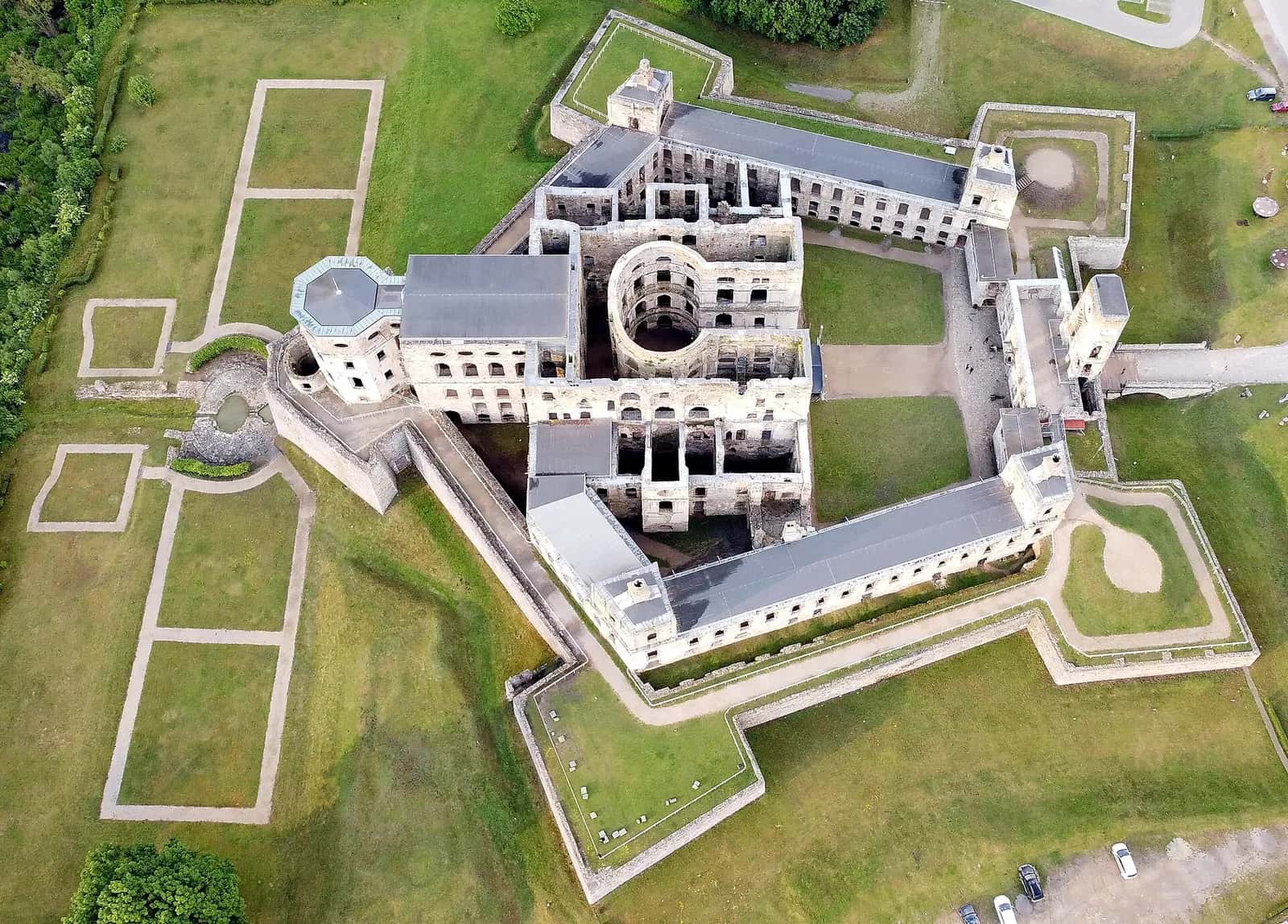
Art historians call this type palazzo in fortezza, a palace in a fortress. The residence sits inside a pentagon of bastion fortifications, with a bastion at each corner.
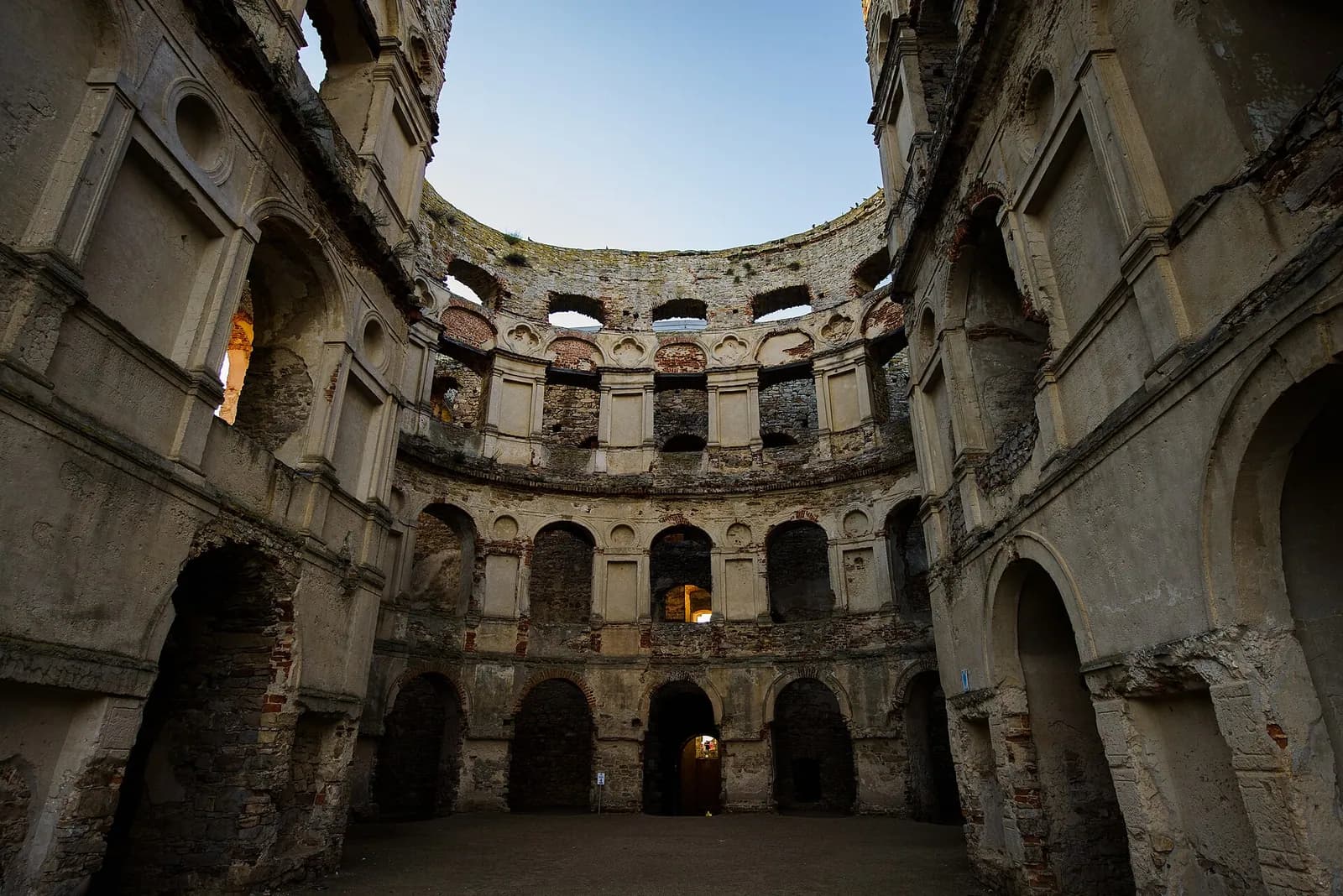
Inside, the palace is laid out along an axis. Beyond the gate lies a trapezoid main courtyard. A narrow passage leads to an oval inner courtyard, and an octagonal tower closes the axis. The castle’s website compares the plan with Caprarola, the pentagonal Farnese villa near Rome.
The official figures: 70,000 m³ of buildings, 1.3 hectares for the castle itself and about 1.6 more for the gardens. The north–south axis is 120 meters long and the east–west axis 95 meters. The builders used 11,000 tons of quartzitic sandstone and 200,000 bricks. A 2018 presidential decree calls Krzyżtopór a leading achievement of 17th-century Polish architecture.
Did Krzyżtopór have a window for every day of the year?
The best-known story says the castle was built like a calendar: four towers for the seasons, 12 halls for the months, 52 rooms for the weeks and 365 windows for the days. The heritage board repeats it with an “allegedly”. Some tourism sites give the numbers as fact. We found no source that has checked them, and the castle’s own history page does not mention them.
The stables are a similar case. Horses are said to have stood at marble mangers below crystal mirrors. The 2014 heritage record states this without qualification, but none of the accounts cites a 17th-century source. The castle website says only that the stables have excellent acoustics.
The aquarium gets the most careful treatment. The dining hall in the tower “reportedly” had a glass ceiling with exotic fish swimming above it. Both the castle and the heritage board use that hedge. Be wary also of the line that it was the largest palace in Europe before Versailles. It turns up in popular articles, while scholarly writing calls it one of the largest palaces of its time.
How did the palace become a ruin?
The founder died in February 1645. His son, Krzysztof Baldwin, was killed by an arrow at the Battle of Zborów on the night of August 15–16, 1649, leaving no heir to live at Ujazd.
On October 30, 1655, during the Swedish invasion of Poland known as the Deluge, troops under General Douglas took the castle by trickery without firing a shot. According to the castle, they took the furnishings, library and archive but left the walls standing. Over 1655–1657 the castle was looted and damaged.
Ownership then passed through several families, among them the Denhoffs, Kalinowskis, Morsztyns and Pacs. Jan Michał Pac repaired part of the building around 1760 and lived here until the Bar Confederation. In 1768–1770 confederates held out in the right wing, and much of the castle was destroyed in the fighting. After the revolt failed, Pac left for France. Nobody has lived at Krzyżtopór since the end of the 18th century.
What happened to the ruin after the war?
After the Second World War the castle passed to the state. In the 1970s a team under Professor Alfred Majewski, who had earlier led the restoration of Wawel, decided it should remain a permanent ruin: the walls would be secured, not rebuilt. The same approach was taken at Ogrodzieniec on the Trail of the Eagles’ Nests. Visitors have followed marked routes through the ruin since 1991.
The municipality of Iwaniska has looked after the castle since 2007. In 2010–2014 more than 12 million zł, mostly from EU funds, paid for roofs over some halls and towers, repairs to the walls and a cinema and exhibition room in one of the bastions. According to the Polish Press Agency, about 90% of the walls and 10% of the vaults survive.
On April 20, 2018, Krzyżtopór became a Monument of History, Poland’s top heritage designation; it is one of 12 castles or castle complexes on the list. In 2024 the municipality began a further phase of almost 8 million zł, 7 million of it from a government heritage program, to strengthen the clock tower and glaze the east wing for an exhibition. Radio Kielce reported that the work should finish in the second half of 2026.
How to visit Krzyżtopór
Ujazd is in the Świętokrzyskie province of central southern Poland, in the municipality of Iwaniska. Regional roads lead there from Opatów, Klimontów and Staszów, and there are two free car parks with room for about 100 cars.
The castle is open all year, with shorter winter hours: 8:00 to 16:00 from November to February and 8:00 to 20:00 from April to August. In 2026 a standard ticket costs 22 zł and a reduced one 19 zł (as of November 2026). It is closed on January 1, Easter Sunday, November 1 and December 24–25.
Check the notices on krzyztopor.org.pl before you go, as parts of the castle can be closed during conservation work. To see a lived-in royal residence from the same era, head to Wawel Royal Castle in Kraków, where Renaissance and early Baroque rooms survive.
Timeline
- 1619Krzysztof Ossoliński is granted Iwaniska and Ujazd.
- 1621Building begins, according to the castle; the heritage board dates it to 1631–1644.
- 1631The date carved on the gate beside the arms of the founder’s mother.
- 1644The castle is finished; King Władysław IV attends the wedding of the founder’s son.
- 1645Krzysztof Ossoliński dies.
- 1649His son, Krzysztof Baldwin, is killed at Zborów.
- October 30, 1655Swedish troops take the castle by trickery, without a shot.
- 1768–1770Bar confederates hold out in the castle; the fighting destroys much of it.
- 1991The ruin opens to visitors along marked routes.
- April 20, 2018Krzyżtopór becomes a Monument of History.
Practical info
- Where
- Ujazd 73, municipality of Iwaniska, Świętokrzyskie province. Regional roads lead there from Opatów, Klimontów and Staszów.
- Best time
- April to October, when opening hours are longest. In winter the castle closes at 16:00.
- Tickets
- In 2026: standard 22 zł, reduced 19 zł (as of November 2026; price list at krzyztopor.org.pl).
- Parking
- Two free car parks by the castle, about 100 spaces in all.
- Note
- Conservation work is under way and parts of the castle may be closed. Check the castle website.
Questions and answers
Who built Krzyżtopór Castle?
Krzysztof Ossoliński, governor of Sandomierz. The Italian architect Lorenzo (Wawrzyniec) Senes ran the building work; the designer is unknown. It was finished in 1644.
Did Krzyżtopór really have 365 windows?
That is the legend: four towers, 12 halls, 52 rooms and 365 windows, like a calendar. Poland’s National Heritage Board repeats it with an “allegedly”, and no source confirms the numbers.
Who destroyed Krzyżtopór?
Swedish troops looted it in 1655–1657, but most of the damage came in the Bar Confederation fighting of 1768–1770. It has been empty since the late 18th century.
How much does it cost to visit Krzyżtopór?
In 2026 a standard ticket costs 22 zł and a reduced one 19 zł (as of November 2026). Check krzyztopor.org.pl for the current price list.
Was there an aquarium at Krzyżtopór?
A story says the tower dining hall had a glass ceiling with exotic fish above it. Both the castle and the heritage board present it as hearsay.
Sources
- Krzyżtopór Castle: history (in Polish) (opens in a new tab)
- National Heritage Board of Poland: Krzyżtopór Castle (opens in a new tab)
- Krzyżtopór Castle: opening hours (in Polish) (opens in a new tab)
- Krzyżtopór Castle: prices (in Polish) (opens in a new tab)
- National Heritage Board of Poland: Monument of History, Krzyżtopór (in Polish) (opens in a new tab)
- Presidential decree of April 20, 2018 (in Polish) (opens in a new tab)
- National Heritage Board: list of Monuments of History (in Polish) (opens in a new tab)
- Dzieje.pl (PAP): work on the castle in 2012 (in Polish) (opens in a new tab)
- Radio Kielce: the next phase of work at Krzyżtopór (in Polish) (opens in a new tab)
- Radio Kielce: visitor numbers in 2024 (in Polish) (opens in a new tab)
- Radio Kielce: getting there and parking (in Polish) (opens in a new tab)