A bell that takes twelve people to swing
Show on mapThe Sigismund Bell at Wawel weighs nearly 13 metric tons. It rings only on the most important holidays and at key moments for the country.
The first clapper of the Sigismund Bell struck its bronze about 12 million times. It lasted 479 years, three cracks in the 19th century and two world wars, until at Christmas 2000 the bell ringers found a fourth crack. Since April 14, 2001, a new steel clapper has done the job, and the old iron one lies at the entrance to the tower, so anyone can see what metal fatigue looks like.
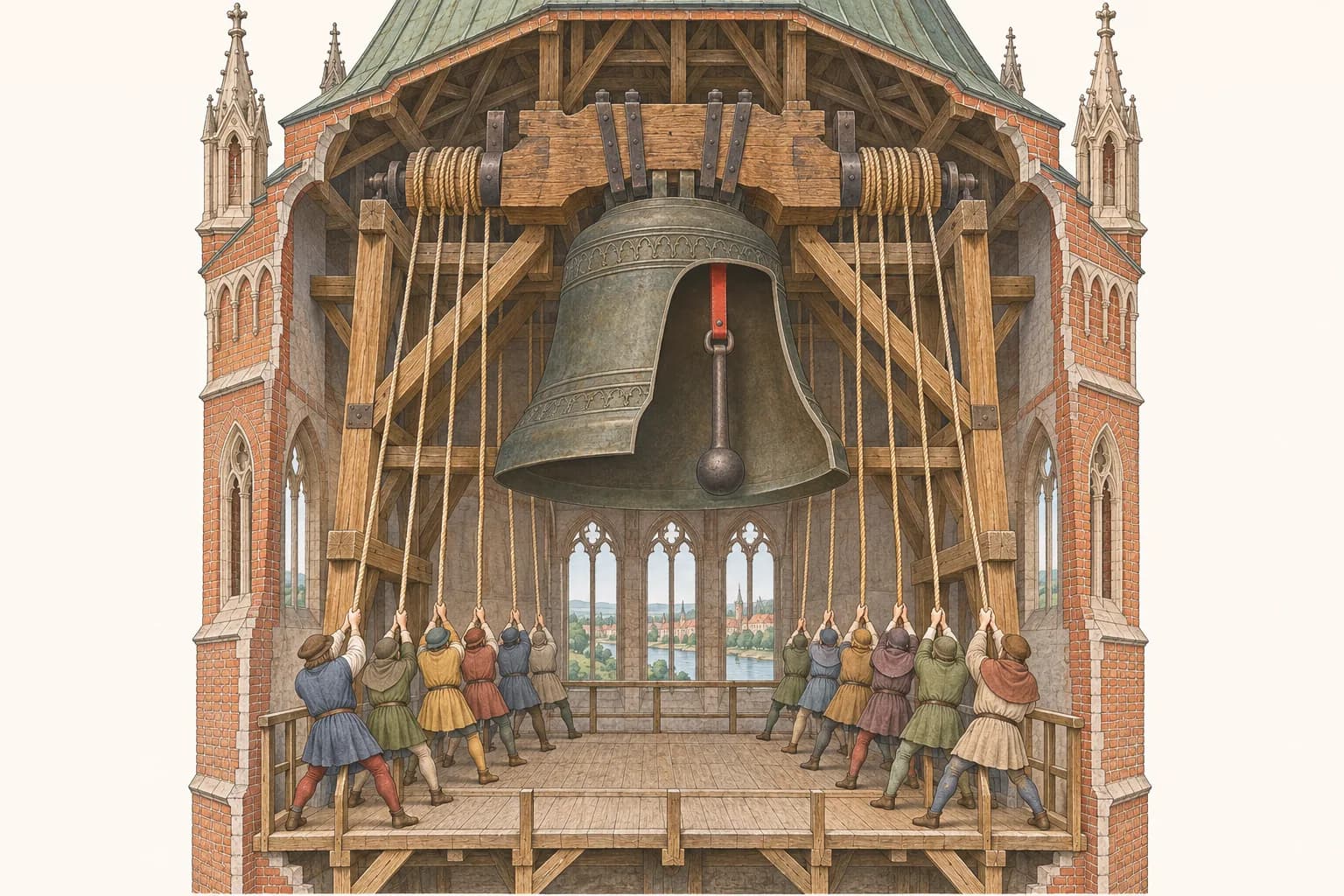
With all its fittings the bell, known in Polish simply as Zygmunt, weighs 12,600 kg (nearly 28,000 lb), and it has no motor. Twelve bell ringers swing it by pulling on ropes, six on each side. A peal usually lasts 6 minutes, and the sound carries up to 30 km (19 miles) from Wawel Hill.
Hans Behem of Nuremberg cast the bell in Kraków in 1520 for King Sigismund I the Old. The city first heard it on July 13, 1521. Since then it has rung on the greatest religious and national holidays and at moments the whole country remembers.
How much does the Sigismund Bell weigh?
The bronze bell alone weighs 9,650 kg. Add the oak yoke with its iron fittings (2,160 kg), the clapper with its strap (365 kg) and other parts (425 kg), and the total comes to 12,600 kg, close to 13 metric tons.
The bell is 242 cm (7 ft 11 in) across at the mouth and 241 cm tall with its crown. With the yoke and clapper, the whole assembly stands 4.5 m high, and the oak yoke spans 307 cm. The bronze walls range from 7 cm to more than 20 cm thick, thickest where the clapper strikes.
Zygmunt is Poland's most famous bell, but no longer its largest. It held that title until 2000, when a bell nearly 3 metric tons heavier was hung at the shrine in Licheń in central Poland. The Wawel giant remains special in another way: it is still moved by nothing but human muscle.
- bronze bell: 9,650 kg
- oak yoke with fittings: 2,160 kg
- clapper with strap: 365 kg
- other parts: 425 kg
Who cast the Sigismund Bell, and when?
King Sigismund I the Old commissioned the bell, and Hans Behem, a bell founder from Nuremberg working in Kraków since 1518, cast it in the second half of 1520. The cathedral tower, once a defensive tower of the castle, was built higher especially for it. The bell set off in June 1521, was hauled into the tower on July 9 and rang for the first time on July 13, the feast of St. Margaret.
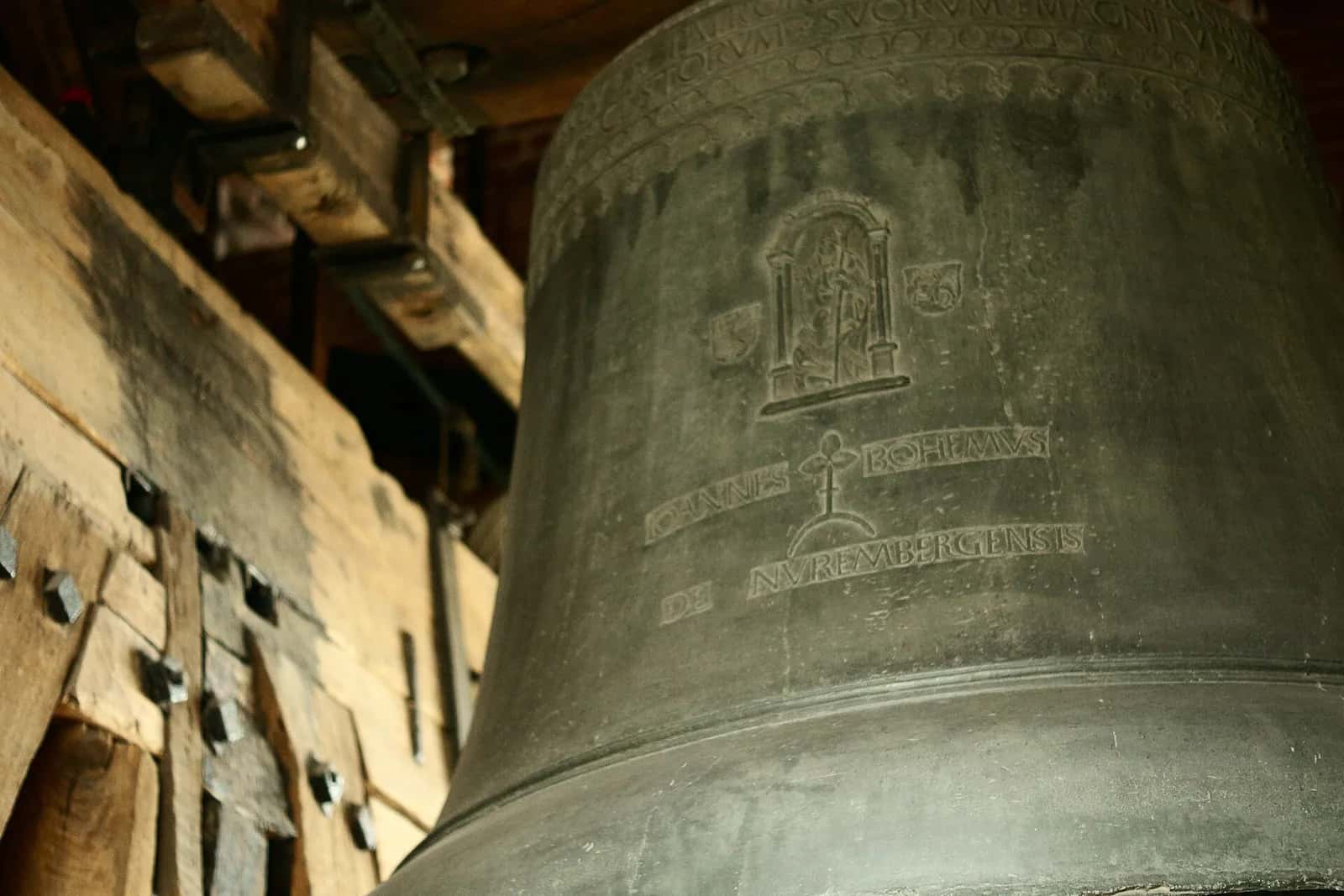
A Latin inscription runs around the top. In the cathedral's translation it says that Sigismund, King of Poland, had the bell made, worthy of the greatness of his mind and deeds, to God, the Virgin Mother of God and his patron saints, in the year of salvation 1520. Below are two reliefs, of St. Stanislaus and of St. Sigismund, King of Burgundy, with the crowned eagle of Poland and the mounted knight of Lithuania.
Recent research brought two surprises. Behem's signatures on the bell were not cast with it but engraved later, no one knows when. And the whole inside of the bell is covered with round dimples 17–22 mm across, a Renaissance decoration not found on any other bell.
Legends grew around the bronze. One says it was cast from cannons captured at the Battle of Obertyn, but that battle took place in 1531, ten years after the bell was hung. Another version names cannons from the Battle of Orsha in 1514.
How do bell ringers swing a 12-ton bell?
The bell has been rung by hand since its first day. To swing more than 12 metric tons properly, twelve ringers have to pull together. They stand on the north and south sides, and the ropes fly up and down at speed, so the work takes strength and constant attention.
In the 16th century the cathedral sextons rang it, then for several centuries the Kraków carpenters' guild, and later Wawel staff. Since the mid-20th century the ringers have been volunteers from all walks of life. Today there are about thirty of them, the oldest ringing for more than fifty years, and the role usually passes from father to son. Each receives a "Sigismund Bell Ringer" badge after training. The only solid-gold honorary badge belonged to Pope John Paul II.
In 1924 the bell was fitted with ball bearings from a company in Gothenburg, Sweden, which made the work much easier. It hangs in a free-standing oak frame that does not touch the tower walls, so the swinging does not shake the masonry apart. This timber frame survives in its original state. Four other large cathedral bells hang in the same tower.
Why did the Sigismund Bell's clapper crack?
The clapper is an iron pendulum hanging inside the bell. It has an eye, a shaft and a ball that hits the thickest part of the wall, with a counterweight below the ball to control its speed. It originally hung from an oxhide strap twelve layers thick at its thickest point.
The first clapper was forged from iron, 218.5 cm long and 323 kg in weight. It cracked three times in the 19th century, in 1859, 1865 and 1876, and was repaired each time. During one of those breaks a broken piece struck the neighboring Cardinal bell and left a visible mark on it.
The fourth crack was found at Christmas 2000, caused by metal fatigue after 479 years of work. A new clapper modeled on the old one was forged in the workshops of a Kraków steelworks, and it has struck the bell since April 14, 2001. With its strap it weighs 365 kg.
When does the Sigismund Bell ring?
As early as 1525 a decree limited ringing to 120 times a year. Today it rings far less often, on fixed holidays and on exceptional occasions. A peal usually lasts 6 minutes, longer during processions. Wawel Cathedral publishes the current schedule.
Its list of exceptional moments reads like a short history of Poland. It rang for coronations, for the victories at Kircholm in 1605 and Vienna in 1683, for the papal elections of 1978, 2005, 2013 and 2025, after the Smolensk air crash in 2010, and in 2022 in support of Ukraine. In July 2021 it marked its own 500th anniversary.
Its voice blends many tones: the lowest is F sharp, and the strike note is G. Tradition holds that a young woman who touches the clapper will soon be lucky in love, which is why visitors have reached out to it for centuries.
- New Year's Day and Epiphany (January 6)
- Easter, with the Resurrection procession
- Constitution Day (May 3) and Independence Day (November 11)
- the St. Stanislaus procession to Skałka in May
- Corpus Christi and August 15
- Midnight Mass on Christmas Eve
Which Wawel bell strikes the hour?
If you hear the hours and quarters on Wawel Hill, you are hearing two gongs in the cathedral’s Clock Tower. Its first clock went up in 1519, before Sigismund was even cast. A single hand traveled around a 24-hour dial, and a new day began in the evening. A 12-hour dial followed in 1602. In 1681 the clock gained a second gong to strike the quarters.
Even the Sigismund Tower has several voices. For centuries the bell heard most often there was Urban, which originally hung in a church in the nearby town of Niepołomice. It cracked three times and was recast each time, most recently in 1757. Three other bells share the tower with Urban and Sigismund. Their names are Wacław, Kardynał and Stanisław.
Wawel: the royal hill above the Vistula
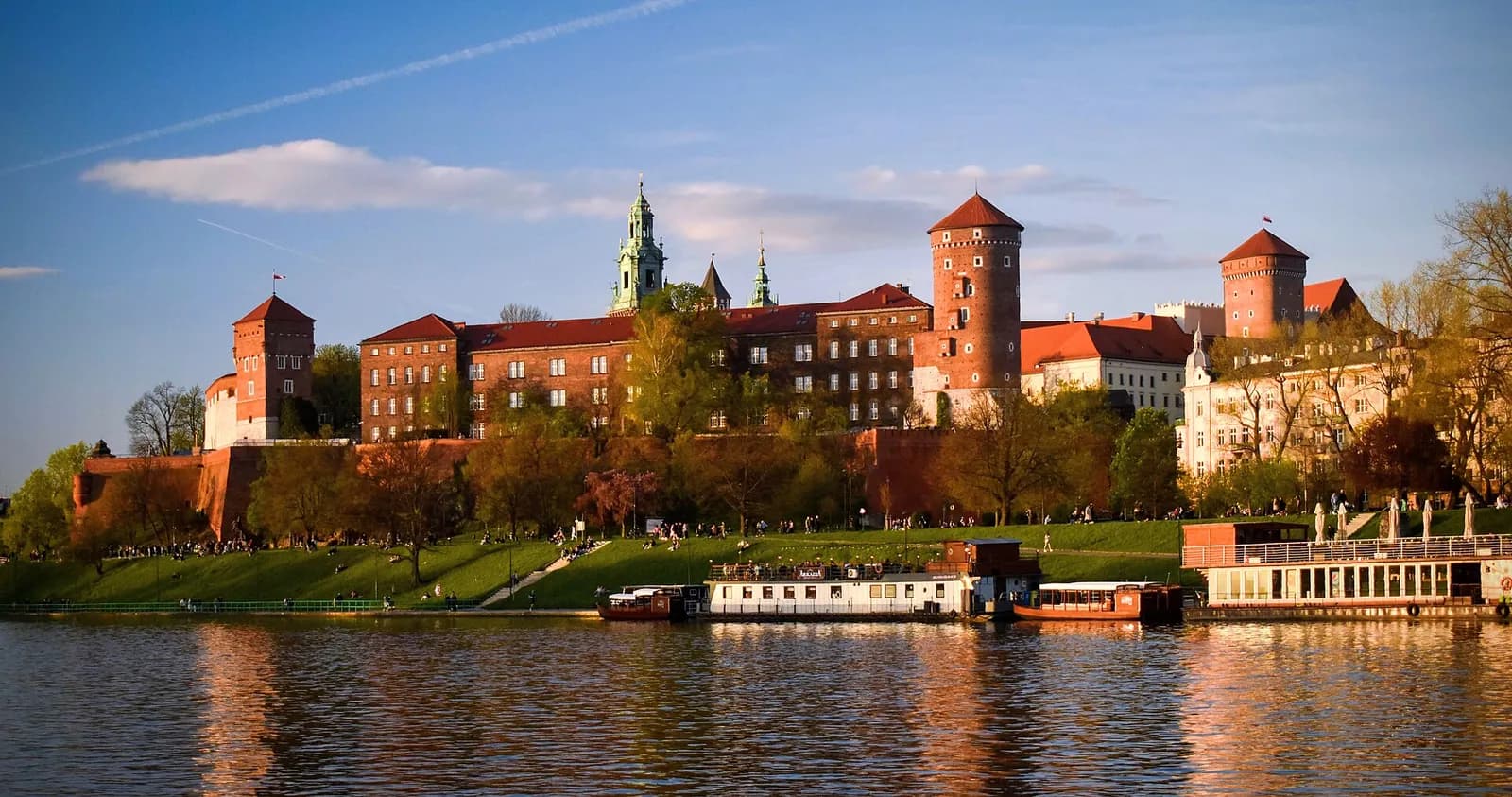
For four hundred years Wawel Cathedral was the church of the kings of Poland. From the coronation of Władysław I the Elbow-high on January 20, 1320, every Polish king was crowned here except Stanisław Leszczyński and Stanisław August Poniatowski. Many of them are buried in its chapels and crypts.
Wawel was the seat of the royal court until around 1600, when the king moved to Warsaw. The hill and its castle remained the symbol of the state, and in 1978 Kraków's Old Town together with Wawel was on the very first UNESCO World Heritage List.
The hill itself is older than any castle. It is made of Late Jurassic limestone, reef structures built by sponges and microbes on the floor of a shallow sea. It is the same rock on which the castles of the Trail of the Eagles' Nests stand, a trail that starts in Kraków.
Where is the bell hanging in Matejko’s painting?
It is still on the ground. In the painting known as The Hanging of the Sigismund Bell, the cathedral is in the distance. In the foreground, by Kraków’s former Vistula Gate, the bellfounder directs the workers lifting the bell out of its mold. Jan Chojeński is there to bless it, while King Sigismund I, Queen Bona and their children look on from beneath a canopy.
On the painted clapper you can make out Matejko’s signature and the date, 1874. Several faces in the Renaissance crowd belong to the artist’s own time. Bona has the features of his wife Teodora, and the royal children resemble his children. Look a few steps below the royal family for his self-portrait. Matejko gave his own face to Stańczyk, the court jester.
How did Kraków make the bell visible from the city?
On the evening of July 13, 2021, five hundred years after Sigismund first rang, the winning pieces from an electroacoustic music competition were heard at the foot of the tower. Each took a single bell stroke as its starting point. After the concert, light appeared above Kraków. In a performance called Latarnia, or Beacon, the sound of the bell triggered beams of laser light.
The competition took its title, Study for a Single Bell Stroke, from a 1959 work in which Włodzimierz Kotoński used a single stroke on a cymbal. For another anniversary project, Bells of Distance, artists from Nuremberg set up microphones in different places. In a single piece they could bring together the ringing of the cathedral bells, a passing conversation and the rumble of traffic.
Timeline
- 1320The coronation of Władysław the Elbow-high opens the era of coronations at Wawel.
- 1520Hans Behem casts the great royal bell in Kraków.
- July 13, 1521The Sigismund Bell rings for the first time.
- 1525A decree limits ringing to 120 times a year.
- 1924The bell is fitted with Swedish ball bearings.
- 1978Wawel and the Old Town on UNESCO's first World Heritage List.
- 2000At Christmas the original clapper cracks for the fourth time.
- April 14, 2001The new clapper strikes for the first time.
- 2021500 years since the first ringing.
Practical info
- Where
- The Sigismund Tower of Wawel Cathedral, Kraków. Entry is through the cathedral.
- Tickets
- The bell is included in the cathedral ticket, together with the Royal Tombs and the Cathedral Museum. Check current prices and hours on the Wawel Cathedral website.
- When to hear it
- The cathedral publishes the ringing schedule. The bell usually rings on New Year's Day, Easter, May 3, Corpus Christi, August 15, November 11 and at Christmas Midnight Mass.
- On site
- Steep wooden stairs lead up the tower. The old cracked clapper is on display at the entrance.
- Closed
- The cathedral is closed to visitors on Good Friday, Holy Saturday, Easter Sunday, Christmas Eve and Christmas Day.
Questions and answers
How much does the Sigismund Bell weigh?
The bronze bell alone weighs 9,650 kg. With its clapper, oak yoke and fittings, the total is 12,600 kg, nearly 13 metric tons.
How many people does it take to ring the Sigismund Bell?
Twelve bell ringers pulling ropes, six on each side. About thirty people hold the right to ring it.
When does the Sigismund Bell ring?
On the most important religious and national holidays, such as New Year's Day, Easter, May 3 and November 11, and at exceptional moments for the country. Wawel Cathedral publishes the schedule.
Can you see the Sigismund Bell?
Yes. The climb up the Sigismund Tower is included in the Wawel Cathedral ticket, and the old cracked clapper is on display at the entrance.
Is the Sigismund Bell the largest bell in Poland?
It was until 2000. A heavier bell now hangs at the shrine in Licheń, but Zygmunt is still the most famous Polish bell and is swung by hand.
How far can you hear the Sigismund Bell?
According to Wawel Cathedral, the bell can be heard up to 30 km (19 miles) away.
Sources
- Wikipedia: Sigismund Bell (in Polish) (opens in a new tab)
- UNESCO: Historic Centre of Kraków (opens in a new tab)
- National Museum in Warsaw: Matejko’s painting and signature (in Polish) (opens in a new tab)
- National Museum in Warsaw: faces from Matejko’s family (in Polish) (opens in a new tab)
- Nuremberg House: the anniversary performances in Kraków (opens in a new tab)
- Wawel Cathedral: the clock and gongs of the Clock Tower (opens in a new tab)
- Wawel Royal Castle: the arcaded courtyard (PDF, in Polish) (opens in a new tab)
- Wawel Cathedral: the Royal Sigismund Bell (in Polish) (opens in a new tab)
- Wawel Cathedral: the Sigismund Bell ringers (in Polish) (opens in a new tab)
- Wawel Cathedral: the Sigismund Tower (in Polish) (opens in a new tab)
- Wawel Cathedral: the royal cathedral (in Polish) (opens in a new tab)
- Wawel Cathedral: plan your visit (in Polish) (opens in a new tab)
- Wikipedia: Sigismund Bell (opens in a new tab)
- Radio Kraków: the Sigismund Bell is 501 years old (in Polish) (opens in a new tab)
- Radio Kraków: the Sigismund Bell rings in the New Year (in Polish) (opens in a new tab)
- Radio Kielce: 500 years of the Sigismund Bell (in Polish) (opens in a new tab)
- Jagiellonian University repository: Oxfordian limestones of Wawel Hill (in Polish) (opens in a new tab)