Książ Castle, seven centuries above a bend in the river
Show on mapA Baroque facade faces the gate. Two early 20th-century wings overlook the gorge. Between them, the castle’s oldest walls enclose the Black Courtyard.
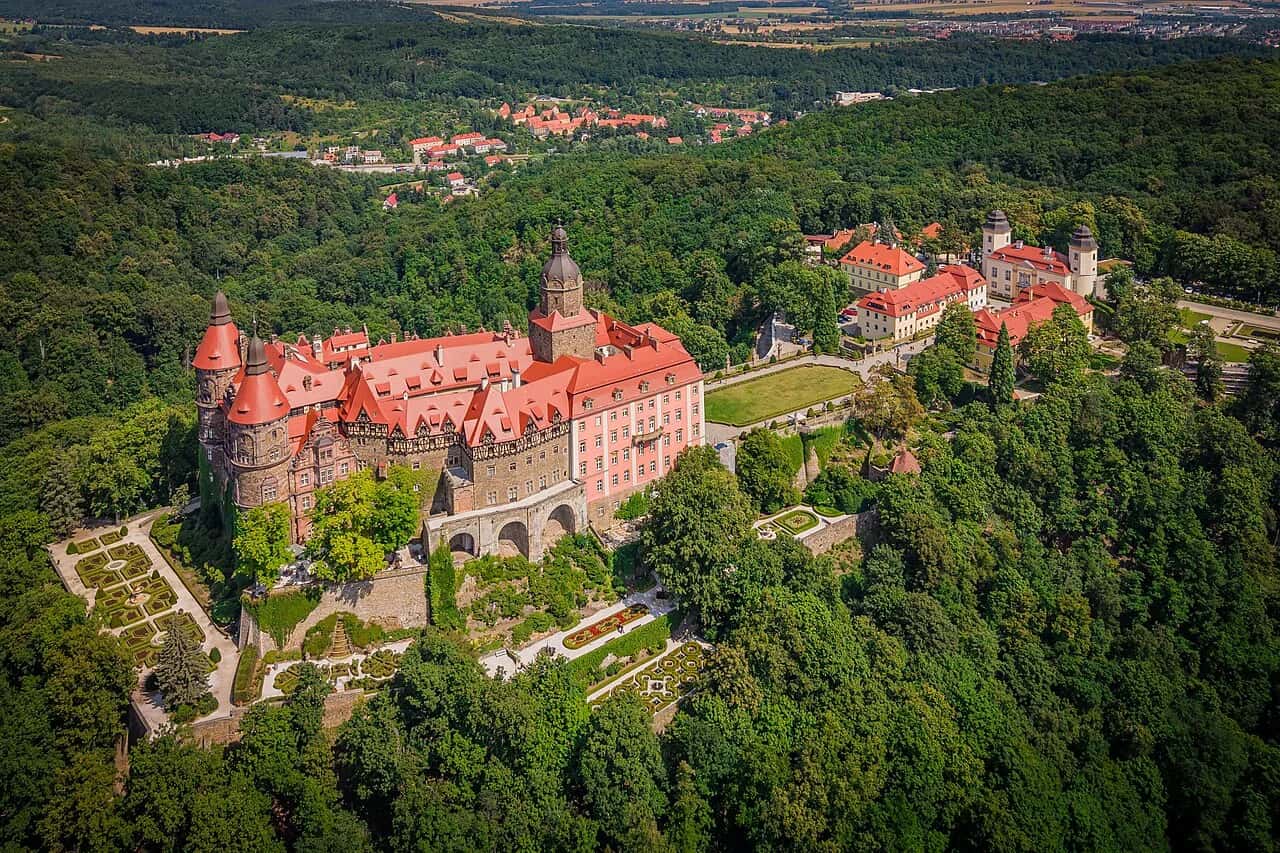
It is easy to walk past the oldest part of Książ. From the gate you see a Baroque palace. Overlooking the Pełcznica gorge are two wings added in the early 20th century. To find what survives of the medieval stronghold, head into the heart of the residence, to the Black Courtyard.
Książ stands within the city limits of Wałbrzych in Lower Silesia. The Hochbergs also owned a second castle on the opposite side of the gorge. This was Old Książ, which they had commissioned to look like a medieval ruin.
Where is the medieval castle inside the palace?
The Pełcznica makes such a tight bend below Książ that the gorge shelters the rocky spur on three sides. The castle is traditionally attributed to Bolko I the Strict, Duke of Świdnica and Jawor, who ruled in the late 13th century. His grandson Bolko II is credited with enlarging it. Traces of medieval defenses also survive across the river, and the early history of the two sites is still uncertain.
The oldest wings, including a building known as the Long House, surround the Black Courtyard. Their walls took shape between the 14th and 16th centuries. Inside, both the Knights’ Hall and the Crooked Hall owe much of their present appearance to 20th-century alterations. Step out into the courtyard and the short distance from one wall to the next gives a sense of the early castle’s scale.
How did a guest reach Maximilian Hall?
The Hochbergs took control of Książ in 1509. It became their hereditary property in 1605. In the early 18th century Count Konrad Ernst Maximilian von Hochberg commissioned a new approach to the residence. Arriving from the northeast, guests passed between two parallel estate buildings and crossed the old moat on a stone bridge. They entered a formal courtyard where the middle castle had once stood. Beyond it rose the new Baroque wing.
A guest’s rank determined which rooms they entered. The room now called the Chinese Salon was a waiting room for visitors of lower rank. In the principal reception room, then known as the Marble Hall, look up. A ceiling painting from 1732 shows Athena visiting the nine Muses on Mount Helicon. The patron who chose this setting also expanded the library and kept a cabinet of coins, natural specimens and works of art.
Why build a ruin across the river?
Late in the 18th century Hans Heinrich VI von Hochberg asked Christian Wilhelm Tischbein to design Old Książ. Between 1794 and 1797 builders worked the remains of a medieval stronghold into a Romantic ruin. It gave a walk through the gorge a destination. Visitors could look out from the tower above the chapel or examine family keepsakes in the vaulted rooms.
Before the Second World War, visitors could end their walk with a meal at the restaurant at Old Książ or stay the night in one of four guest rooms. The ruins you see today preserve traces of two periods. On the remains of the medieval stronghold stand the walls of the castle the Hochbergs built to entertain their guests.
What changed in Princess Daisy’s time?
Early in the 20th century, under Hans Heinrich XV, two large new wings rose on the west and north sides. The architect drew on Renaissance forms and gave the tower a new cap. The ballroom, the largest room in the castle, was octagonal with a larch ceiling. Wartime alterations erased its distinctive shape, but the walls of the Renaissance Revival wings survive and still dominate the castle skyline.
Below the castle windows, the gardens took shape on the site of the old defenses. In 1646 the removal of walls and ramparts gave the gardeners more room. Steps connected terraces on different levels. Gardeners brought over from Britain worked here in Daisy’s day. Much of the layout you see from the steps today dates from an expansion that ran from 1913 to 1927.
Why is there rock from Mount Etna in the Palm House?
In the early 20th century Hans Heinrich XV commissioned the Palm House in nearby Lubiechów for his wife Daisy. To build the garden under glass, he had seven wagonloads of volcanic rock brought from Mount Etna in Sicily. Workers broke the rock into pieces and set them into the walls, leaving pockets for plants. They used the same material to make grottoes and waterfalls.
The glasshouse belonged to a larger working garden. There were plots for fruit and vegetables, a Japanese garden and a rose garden. Plants were propagated at Lubiechów for the terraces at the castle. Visiting the two sites lets you see both ends of the gardeners’ work, from raising young plants to arranging the beds below the windows of the residence.
Who dug the tunnels, and what is measured in them today?
In May 1944 the Germans established the Fürstenstein subcamp on a hill near the castle. It belonged to the Riese network of subcamps within the Gross-Rosen concentration camp system. Jewish prisoners from Poland, Hungary and Greece were forced to dig tunnels beneath Książ and move building materials. In mid-February 1945 the prisoners were forced to march to Trutnov. From there they were taken by train to Flossenbürg concentration camp.
Part of the underground complex now houses a geodynamics laboratory run by the Polish Academy of Sciences. Since 1974 researchers there have tracked tiny changes in the direction a plumb line points. When an earthquake struck off Sumatra on December 26, 2004, instruments beneath the castle recorded the resulting ground vibrations at Książ for about six hours.
Timeline
- 1509Książ passes into Hochberg hands.
- 1732The ceiling painting in Maximilian Hall is completed.
- 1794–1797Old Książ takes shape as a Romantic ruin across the gorge.
- 1944In May the Germans establish the Fürstenstein subcamp.
- 1974Continuous monitoring of changes in the direction of the plumb line begins underground.
Questions and answers
Are Książ Castle and Old Książ the same place?
They are separate sites on opposite sides of the Pełcznica River. Old Książ was laid out as a Romantic ruin on the remains of a medieval stronghold.
Where can I see the oldest part of Książ?
Look around the Black Courtyard, beside the Long House. The formal courtyard by the main entrance took shape much later.
Is the Palm House inside the castle?
The Palm House is a separate building in the Lubiechów district of Wałbrzych. Its gardeners grew plants for the terraces at the main residence.
Sources
- National Institute of Cultural Heritage: Książ Castle and its grounds (in Polish) (opens in a new tab)
- Książ Castle in Wałbrzych: history of the residence (opens in a new tab)
- National Institute of Cultural Heritage: Książ and Old Książ (in Polish) (opens in a new tab)
- Książ Castle: an archive of interiors, paintings and photographs (in Polish) (opens in a new tab)
- Książ Castle: the history of the Palm House (opens in a new tab)
- Książ Castle: the gardens on the terraces (opens in a new tab)
- Gross-Rosen Museum: Riese and the Fürstenstein subcamp (opens in a new tab)
- Space Research Centre of the Polish Academy of Sciences: the underground laboratory (in Polish) (opens in a new tab)