Malbork, the largest brick fortress in the world
Show on mapThe Teutonic Knights spent more than a century building it. In 1457 Poland bought it instead of storming it.
In 1457 Poland did not conquer Malbork. It bought it. King Casimir IV Jagiellon paid 190,000 florins, about 660 kg of gold, to Bohemian mercenaries whom the Teutonic Order had stopped paying. The mercenaries held the castle as a pledge, and on June 7, 1457, the king rode in without a shot fired. Nearly fifty years earlier, after the Battle of Grunwald, a Polish-Lithuanian army had besieged the same fortress for 55 days and gone home empty-handed.
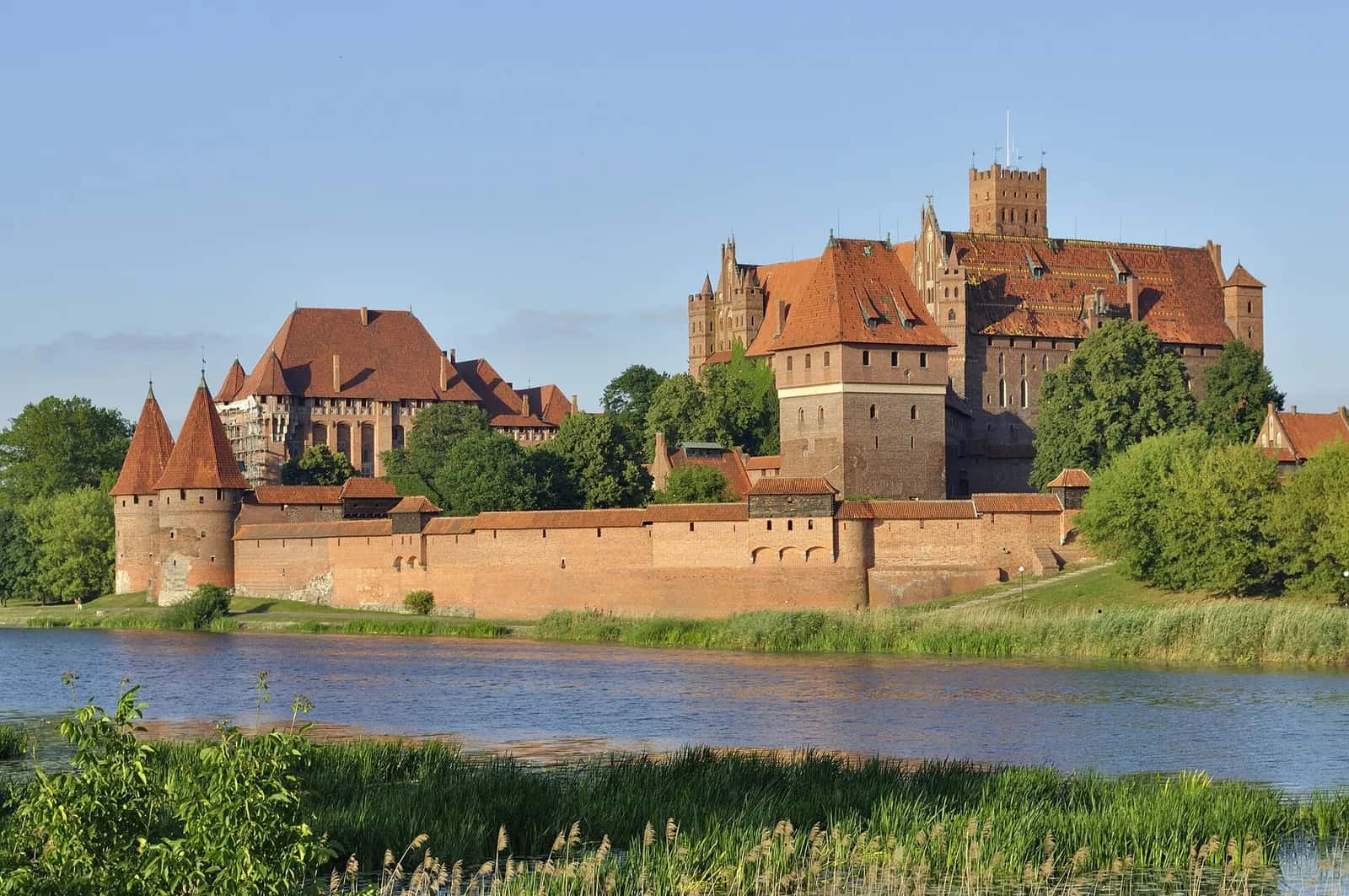
The castle on the Nogat River in northern Poland is the largest brick fortress in the world. Its walls, towers and moats enclose about 21 hectares (52 acres), and inside stand three castles one behind the other: the High, the Middle and the Low Castle, or Outer Bailey. From 1309 it was the capital of a crusader state that ruled the southern Baltic coast.
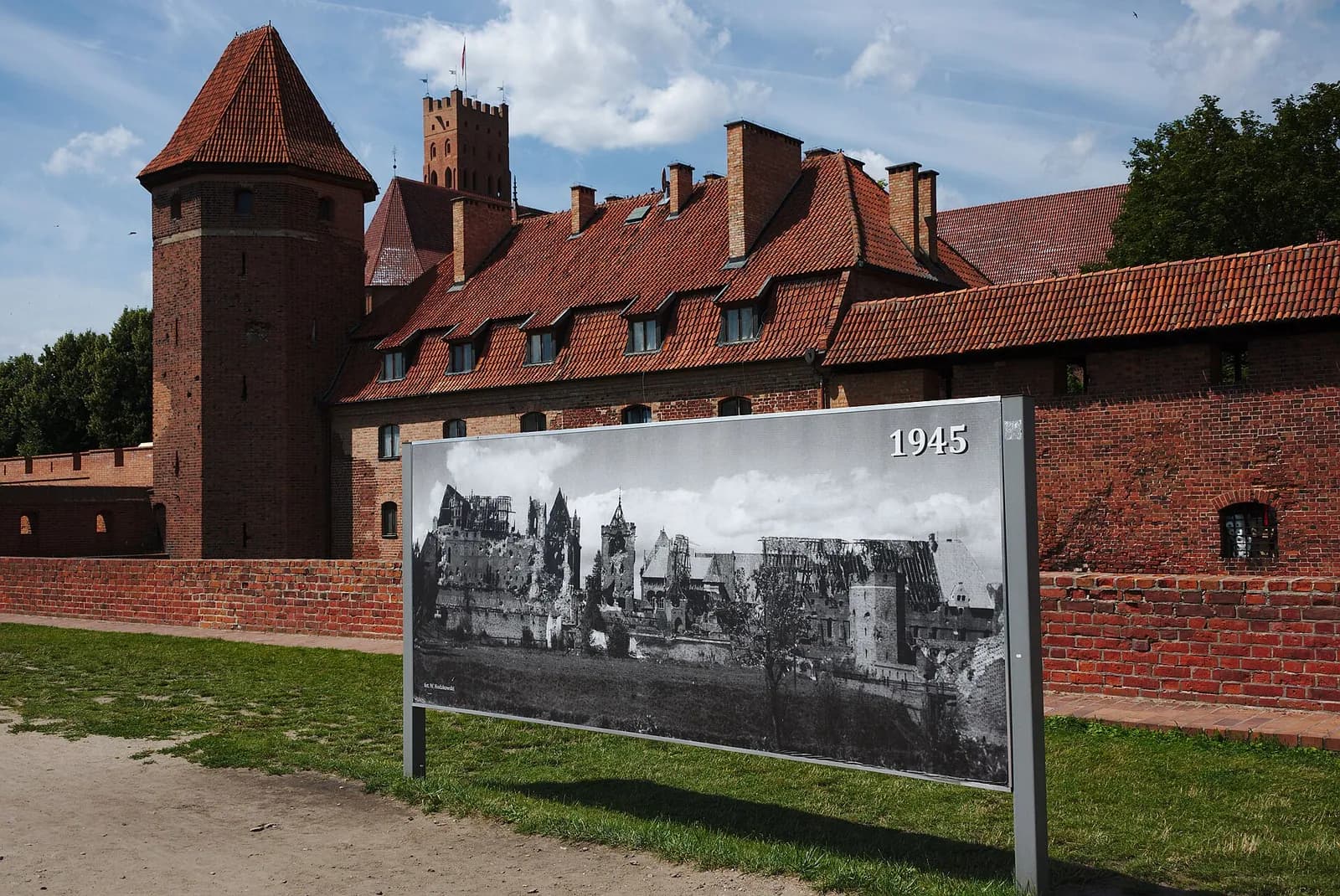
By 1945 more than half of the castle lay in ruins. Rebuilding took decades, and in 1997 Malbork joined the UNESCO World Heritage List, partly as the place where modern methods of restoring historic buildings were born.
Why is Malbork the world's largest brick castle?
The record comes down to scale. The castle complex covers about 21 hectares, roughly thirty soccer fields. It is not one building but three linked fortresses, each with its own courtyards, gates and moats, extended over more than a century.
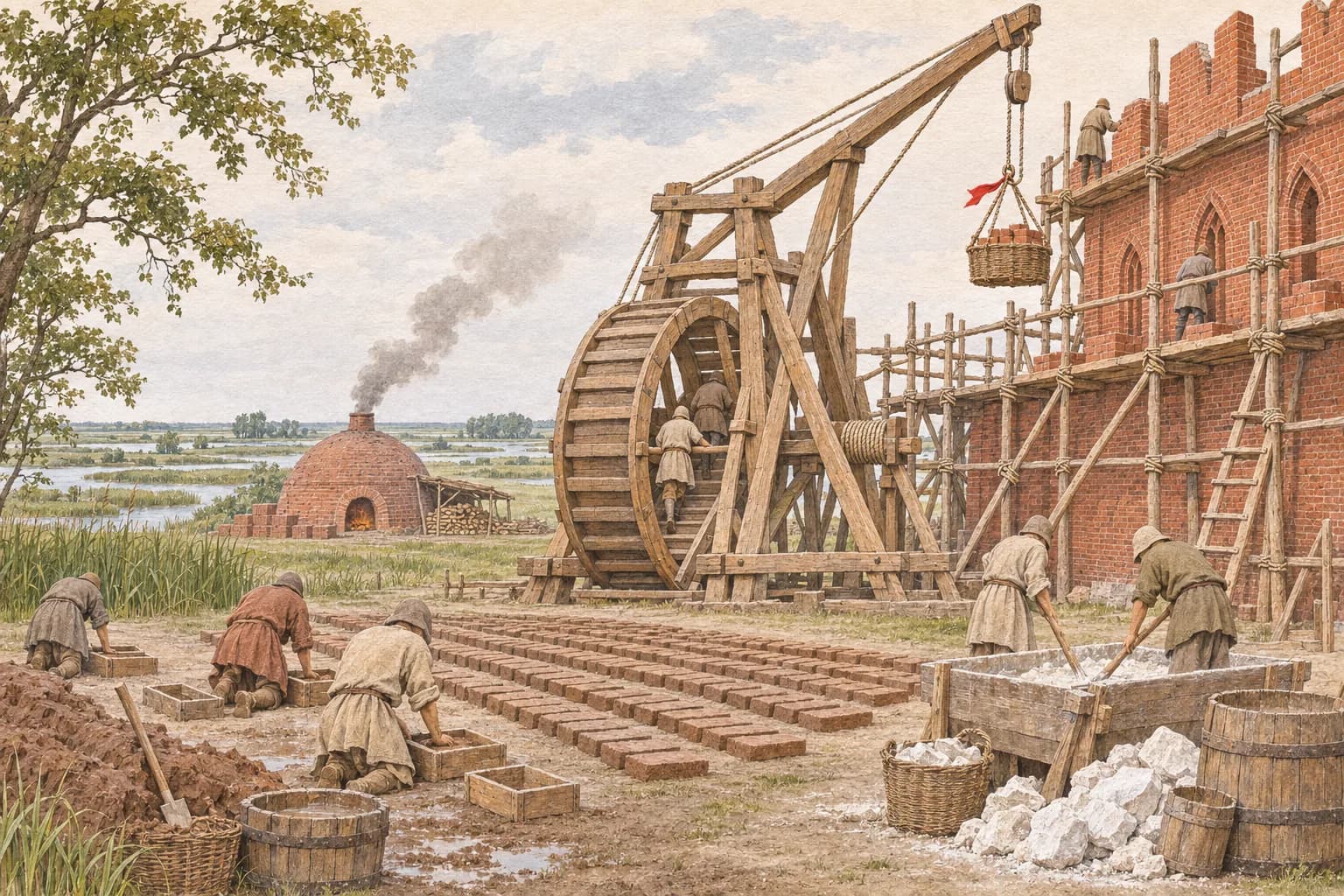
Brick was not an aesthetic choice. The Vistula delta and Prussia had little good building stone but plenty of clay. So the Teutonic Knights, like the Hanseatic towns, built in fired brick bound with lime mortar. Stone was brought in only where it was essential, for example for the granite columns that carry the vault of the Great Refectory.
Out of that necessity grew a style of its own, Brick Gothic, found across northern Europe and especially around the Baltic Sea. UNESCO calls Malbork the most complete and elaborate example of a Gothic brick castle in the Teutonic Order's style, a model for many later buildings across northeastern Europe.
How did Malbork become the capital of the Teutonic Knights?
The Teutonic Knights, a German crusading order of military monks, began preparing the site around 1278 by clearing forest and hauling in materials. Construction started in 1280 at the earliest. At first the castle was the seat of a commander who ran one district, a compact square with a church and cloisters.
Everything changed on September 14, 1309. Grand Master Siegfried von Feuchtwangen moved his seat here from Venice, and Malbork, then called Marienburg, became the capital of one of the most powerful states on the southern Baltic. For nearly forty years the old convent was rebuilt into the High Castle: the Church of the Virgin Mary gained a new chancel, with St. Anne's Chapel beneath it, the burial place of the grand masters.
On the former outer bailey rose the Middle Castle, designed to host knightly guests from Western Europe, and beyond it the Low Castle with workshops, an arsenal called the Karwan and St. Lawrence's Chapel. Building went on through the whole 14th century and the first half of the 15th.
What is inside the Grand Masters' Palace?
The castle's showpiece was built around 1380–1396 in the Middle Castle, facing the river. Its heart is the Summer Refectory, a square hall about 14 m (46 ft) on each side and 9.7 m high, lit by large windows on three sides. The star vault rests on a single slender column, which to medieval visitors must have looked like a trick.
That column is the subject of Malbork's best-known legend. During the siege after the Battle of Grunwald, a traitor supposedly hung out a red marker to show the besiegers where to aim. A cannonball of about 80 kg missed the column, by a few centimeters according to later calculations. A fragment of it is still lodged in the wall above the refectory's fireplace.
Next to the palace is the Great Refectory, built around 1320–1337: a hall of 30.3 by 15.3 m, the largest secular interior in the Teutonic state. Its palm vault springs from three granite columns. The main halls were heated with hot air from furnaces beneath the floor, a system known as a hypocaust.
- Summer Refectory: about 14 × 14 m, vault on a single column
- Great Refectory: 30.3 × 15.3 m, palm vault on three columns
- Heating: furnaces under the floor sending warm air into the halls
Why were there 36 holes in the floor of the Great Refectory?
Each hole had a lid. All the lids stayed shut while wood burned in the cellar below. The fire heated stones laid on a brick grate, and the smoke escaped up the chimney. Once the wood had burned down and the smoke had cleared, the attendants closed the flue and lifted the lids in the dining hall. Air warmed by the stones rose through the floor. Opening more vents let more heat into the room.
A trial on April 3, 1822 gives an idea of how long a guest might have waited to feel warm. Heating the furnace took most of the time. It burned through 60 spruce logs in nearly five hours. Once the lids came off, the refectory reached 18°C in just 20 minutes. Outside it was 2.5°C.
Why did Poland buy Malbork instead of storming it?
The first attempt failed. After their victory at Grunwald in 1410, the armies of King Władysław II Jagiełło and Grand Duke Vytautas of Lithuania besieged Malbork from July 26 to September 19, 1410. Heinrich von Plauen led the defense, the Order kept its capital, and the Peace of Thorn in 1411 cost it only minor territory.
The Thirteen Years' War (1454–1466) settled it. The Order could not pay its mercenaries, who took the castle as a pledge for their back pay. Their Bohemian commander, Oldřich Červenka (Ulryk Czerwonka in Polish), sold it to King Casimir IV Jagiellon for 190,000 florins. The king entered Malbork on June 7, 1457, and the grand master had to move his seat to Königsberg.
For more than three hundred years the castle was the seat of Polish authorities in Royal Prussia. A royal governor ran it with a burgrave under him, the High Castle stored pitch, salt, beer and hops, and the Outer Bailey held cannons and gunpowder. In the early 17th century part of the Grand Masters' Palace was turned into royal apartments. The era ended in September 1772, when Prussian troops took over after the First Partition of Poland.
What happened to Malbork Castle in 1945, and how was it rebuilt?
Before the war the castle went through two extremes. From 1773 to 1804 the Prussian army used it as barracks and warehouses and tore down Gothic vaults. Then came the romance of the Middle Ages: from 1817 a romantic restoration began, and from 1882 to 1922 Conrad Steinbrecht led a methodical rebuilding based on research and measurement. His documentation later proved priceless.
Fighting in 1945 lasted until March 9. Damage is estimated at 50–60%: the eastern parts suffered most, including the chancel of the Church of the Virgin Mary, the main tower, the east wing of the Middle Castle and the Outer Bailey. The town around the castle was nearly 80% destroyed.
First came mine clearing and patching roofs, and a fire in 1959 caused more damage. The Castle Museum was founded in 1961, and systematic rebuilding has continued ever since. In April 2016 the castle church was completed, along with the 8-meter mosaic statue of the Virgin Mary that had been shattered in 1945. UNESCO stresses that each generation of conservators here worked from the records of the last.
How much of the mosaic Madonna is medieval?
The Madonna installed in a niche at the east end of the castle church around 1340 originally had a painted surface. The builders cast the figure in sections on site, using mortar mixed with gravel, and anchored the pieces to the wall with metal rods. The paint weathered badly. Around 1380 a craftsman from the Venice area covered the figure in glass mosaic, fitting small pieces to the curves of the face and the folds of the robes.
After the wall fell in 1945, pieces of the statue were recovered from the rubble. Some spent years in the cellars of the Grand Masters’ Palace. Conservators could use them to rebuild the figure, though they had to work out the mosaic pattern from old images. The Madonna unveiled in 2016 has red and blue glass from Italy and gold pieces made in Gdańsk. Beneath the new surface are parts of the statue that stood here in the Middle Ages.
What did a chipped corner reveal about an amber casket?
A casket in the museum’s collection stands 40 cm tall, about the height of a small stool. Amber panels cover the sides and the Judgment of Paris plays out in miniature on the lid. Its maker, Christoph Maucher of Gdańsk, worked with both clear honey-colored amber and opaque pieces in yellow and white. Light passes through parts of this late 17th-century casket, picking out the figures against their background.
The museum acquired the casket through a Paris auction house in 1968. Decades later, conservators took a tiny sample from a chipped corner. From its infrared spectrum the conservators identified the material as succinite, or Baltic amber. An X-ray revealed wood beneath the amber and a broad drawer that runs the full depth of the base. Its edges are glued shut.
Timeline
- 1280Earliest possible start of construction of a commandery castle on the Nogat.
- 1309The grand master moves his seat from Venice to Malbork.
- 1410After Grunwald the castle survives a 55-day siege.
- 1457Casimir IV Jagiellon buys the castle from mercenaries and enters on June 7.
- 1772After the First Partition, Prussia takes the castle and turns it into barracks.
- 1882Conrad Steinbrecht begins forty years of research-based restoration.
- 1945Fighting destroys 50–60% of the castle.
- 1961The Malbork Castle Museum is founded.
- 1997Inscribed on the UNESCO World Heritage List.
Practical info
- Where
- Malbork, Pomeranian province, on the east bank of the Nogat, southeast of Gdańsk.
- Getting there
- By train: Malbork is on the line from Gdańsk to Warsaw, and the castle is within walking distance of the station.
- Tickets
- Check current prices and opening hours on the Castle Museum website (zamek.malbork.pl), as they change with the season. In summer the museum also runs night tours.
- On site
- Allow at least half a day: the route leads through all three castles. The best view of the whole fortress is from the west bank of the Nogat.
- Best time
- Spring to fall, on a warm evening when the low sun lights the brick walls from the river side.
Questions and answers
How big is Malbork Castle?
Malbork Castle's walls, towers and moats enclose about 21 hectares (52 acres), making it the largest brick fortress in the world.
Who built Malbork Castle?
The Teutonic Knights, a German crusading order. Construction began around 1280, and from 1309 Malbork, then called Marienburg, was the capital of their state.
How much did Poland pay for Malbork Castle?
In 1457 King Casimir IV Jagiellon paid 190,000 florins, about 660 kg of gold, to Bohemian mercenaries who held the castle as security for their unpaid wages.
Was Malbork Castle destroyed in World War II?
Yes. The fighting of early 1945 destroyed 50–60% of the castle. It has been rebuilt since 1961 by the Castle Museum, using the records of prewar conservators.
When did Malbork Castle become a UNESCO World Heritage Site?
The Castle of the Teutonic Order in Malbork was inscribed on the UNESCO World Heritage List in 1997.
Is Malbork Castle worth visiting?
Yes, if you like history on a big scale: it is the world's largest brick castle, with three castles in one and Gothic halls such as the Summer Refectory. Plan at least half a day.
Sources
- UNESCO: Castle of the Teutonic Order in Malbork (opens in a new tab)
- Malbork Castle Museum (in Polish) (opens in a new tab)
- Malbork Castle Museum: reconstructing the Madonna (opens in a new tab)
- Malbork Castle Museum: investigating the Maucher casket (in Polish) (opens in a new tab)
- Malbork Castle Museum: the furnace beneath the Great Refectory (in Polish) (opens in a new tab)
- Malbork Castle Museum: the heating trial of 1822 (in Polish) (opens in a new tab)
- Malbork Castle Museum: the convent kitchen (in Polish) (opens in a new tab)
- Malbork Castle Museum: history 1280–1457 (in Polish) (opens in a new tab)
- Malbork Castle Museum: history 1457–1772 (in Polish) (opens in a new tab)
- Malbork Castle Museum: history 1772–1945 (in Polish) (opens in a new tab)
- Malbork Castle Museum: history since 1945 (in Polish) (opens in a new tab)
- Wikipedia: Malbork Castle (in Polish) (opens in a new tab)
- Wikipedia: Malbork Castle (opens in a new tab)
- Wikipedia: Siege of Marienburg (1410) (opens in a new tab)
- Wikipedia: Brick Gothic (opens in a new tab)