The tunnel under the Świna that joined two islands
Show on mapSince June 30, 2023, cars have crossed between the islands of Usedom and Wolin in about two minutes. The tunnel under the Świna is Poland’s longest underwater crossing, bored by the largest tunnel boring machine ever used in the country.
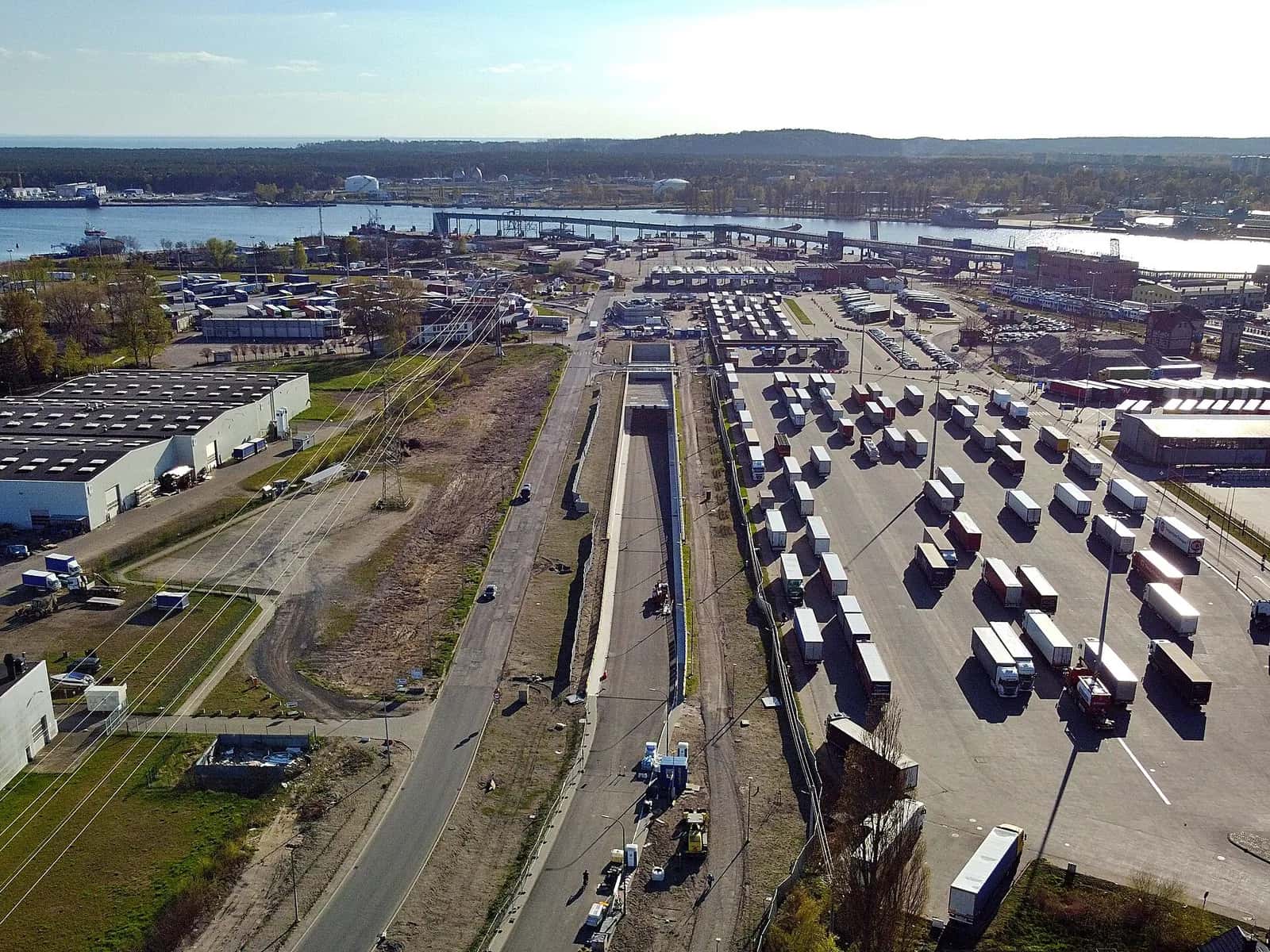
For most of Świnoujście’s history, a driver who wanted to get from Usedom to Wolin had to board a ferry. In summer the queues grew so long that Poland’s national roads agency described waiting times measured in hours. The ferries also depended on the weather.
On June 30, 2023, the tunnel under the Świna opened. The underwater section takes about two minutes to drive. It is the first fixed link between the islands in the city’s history and the longest underwater crossing in Poland.
How long is the Świnoujście tunnel?
It depends what you count. The boring machine dug 1,484 meters of tunnel. With the entry sections, built by the cut-and-cover method, the tunnel is 1,780 meters long. The whole new road, with approaches and junctions, is about 3.2 kilometers.
Older documents give other figures. The 2018 contract spoke of 1.44 kilometers of single-tube tunnel and 3.4 kilometers for the whole project, and the European Commission still quoted 1.44 kilometers at the opening. The final figures from the contractor’s documentation are 1,484 meters bored and 1,780 meters for the whole tunnel.
- section bored by the TBM: 1,484 m
- whole tunnel with entry sections: 1,780 m
- whole road with approaches: about 3.2 km
- roadway: 11 m wide, two 3.5 m lanes and two 2 m emergency lanes
Why did Świnoujście need a tunnel?
The city lies on several islands, and the Świna strait separates Usedom from Wolin. According to the European Commission, Świnoujście receives about 2.5 million visitors a year.
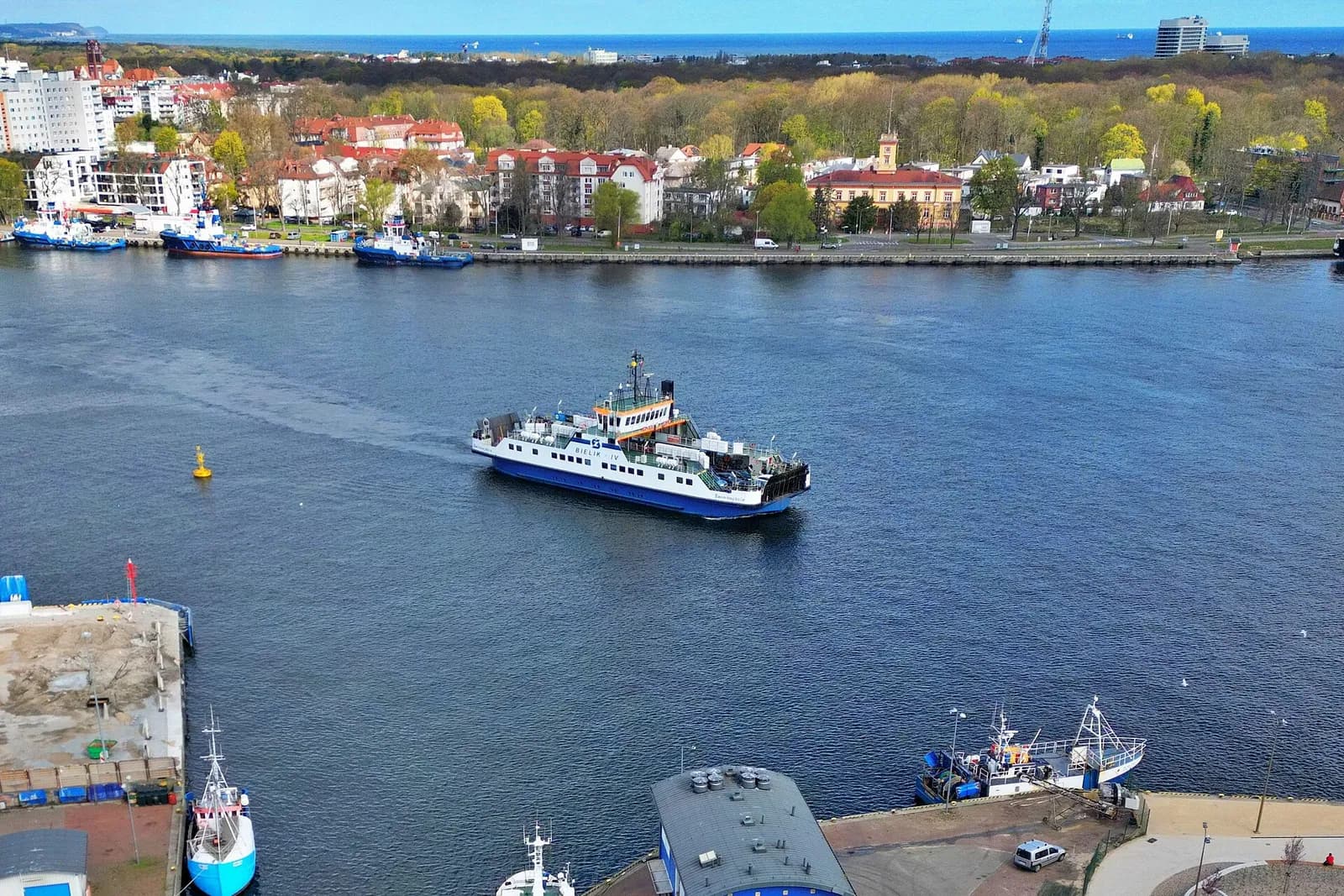
Before the tunnel, ferries carried the cars. Once it opened, the big Karsibór ferries stopped taking trucks and cars from outside the city, and the smaller Bielik ferries on the Warszów crossing now carry mainly pedestrians and cyclists. Karsibór ferries remain for vehicles carrying dangerous goods, which are not allowed in the tunnel.
Part of the fleet became surplus. In September 2026 the city put the ferry Bielik III up for sale. Built in 1998 at the Gryfia shipyard in Szczecin, it is 49.9 meters long, and the asking price was 5.04 million złoty before tax.
How deep under the Świna does the tunnel run?
In the design, the roof of the tunnel lies about 23.5 to 25 meters below sea level, under 8.5 to 9.4 meters of soil on the bed of the strait. Reports from the opening also give 34 meters below the water surface at the deepest point. The design gives the position of the tunnel roof, while press reports give the deepest point below the water surface.
The machine reached the tunnel’s lowest point roughly halfway through. The ground varied: fine sea sand, silty clay, sand, and sandy clay mixed with gravel and chalk.
Wyspiarka: the largest tunnel boring machine in Polish history
The tunnel was dug by a tunnel boring machine that locals named Wyspiarka. Its shield was 13.46 meters across, and the whole machine was about 100 meters long and weighed 2,740 tonnes. According to the contractor, it was the largest machine of its kind ever used to build a tunnel in Poland.
It worked with bentonite slurry. At the front it mixed the soil with slurry, and the spoil was pumped through pipes to a separator in the launch shaft, where the slurry was recovered. Boring went on around the clock. Behind the shield the machine assembled rings of concrete segments, eight per ring. All 6,280 segments were cast in a plant on the building site.
Wyspiarka set off from Usedom in March 2021. On July 13 it was halfway, after 742 meters and 417 rings. By August 12 it had covered 1,000 meters and was under Wolin. On September 16, 2021, after six months, it reached the receiving chamber on Wolin. The chamber was flooded to balance the pressure, and taking the machine apart took about two months.
Each ring weighed 75 to 100 tonnes. Two of the emergency exits called for a different technique from the tunnel itself: they were built using ground freezing, which turns waterlogged sand into a solid mass while the work goes on.
Is it the longest underwater tunnel in Poland?
Yes: the contractor and the trade journal Nowoczesne Budownictwo Inżynieryjne call it the longest underwater crossing in Poland. It is not, however, Poland’s first road tunnel bored with a TBM. That distinction belongs to Gdańsk.
The tunnel under the Martwa Wisła, a branch of the Vistula, opened there in 2016. Its machine, Damroka, had a 12.56-meter shield, weighed 2,200 tonnes and was 91 meters long. The tunnel has two tubes, the bored section is 1,072 meters, and the whole tunnel 1,377.5 meters long. It cost 885 million złoty and runs nearly 35 meters below the water. Świnoujście has a single tube with two-way traffic, but a longer stretch under water and a bigger machine.
At the opening, the European Commission called it the longest EU-funded underwater tunnel in Europe. That is not the same as the longest underwater tunnel in Europe.
What did it cost, and who built it?
The tender was announced on April 15, 2016. The Astaldi and Ghella consortium won with a bid of 727.1 million złoty, but in August 2018 it refused to sign the contract, citing rising prices. The city kept its 10 million złoty bid bond. The contract went to the next bidder, a PORR-led consortium, and was signed on September 17, 2018, for about 793 million złoty.
In the end the design-and-build project cost 913.8 million złoty. Up to 775 million, or 85 percent, came from the European Union’s Infrastructure and Environment program. The investor was the city of Świnoujście, with the national roads agency GDDKiA managing the project. The builders were PORR SA, PORR Bau GmbH and the Turkish firm Gülermak. The bored tunnel was designed by Europrojekt Gdańsk and Systra SWS.
The European Commission gives the figures in euros: 162.3 million from the Cohesion Fund and the European Regional Development Fund, out of a total of 191.5 million. The funding was approved in June 2018. Construction was supervised by Sweco, for 21.6 million złoty.
The 2018 plan aimed to finish in September 2022. Construction started in autumn 2019, and the tunnel opened on June 30, 2023, about nine months later than planned.
Who can use the tunnel, and how is it kept safe?
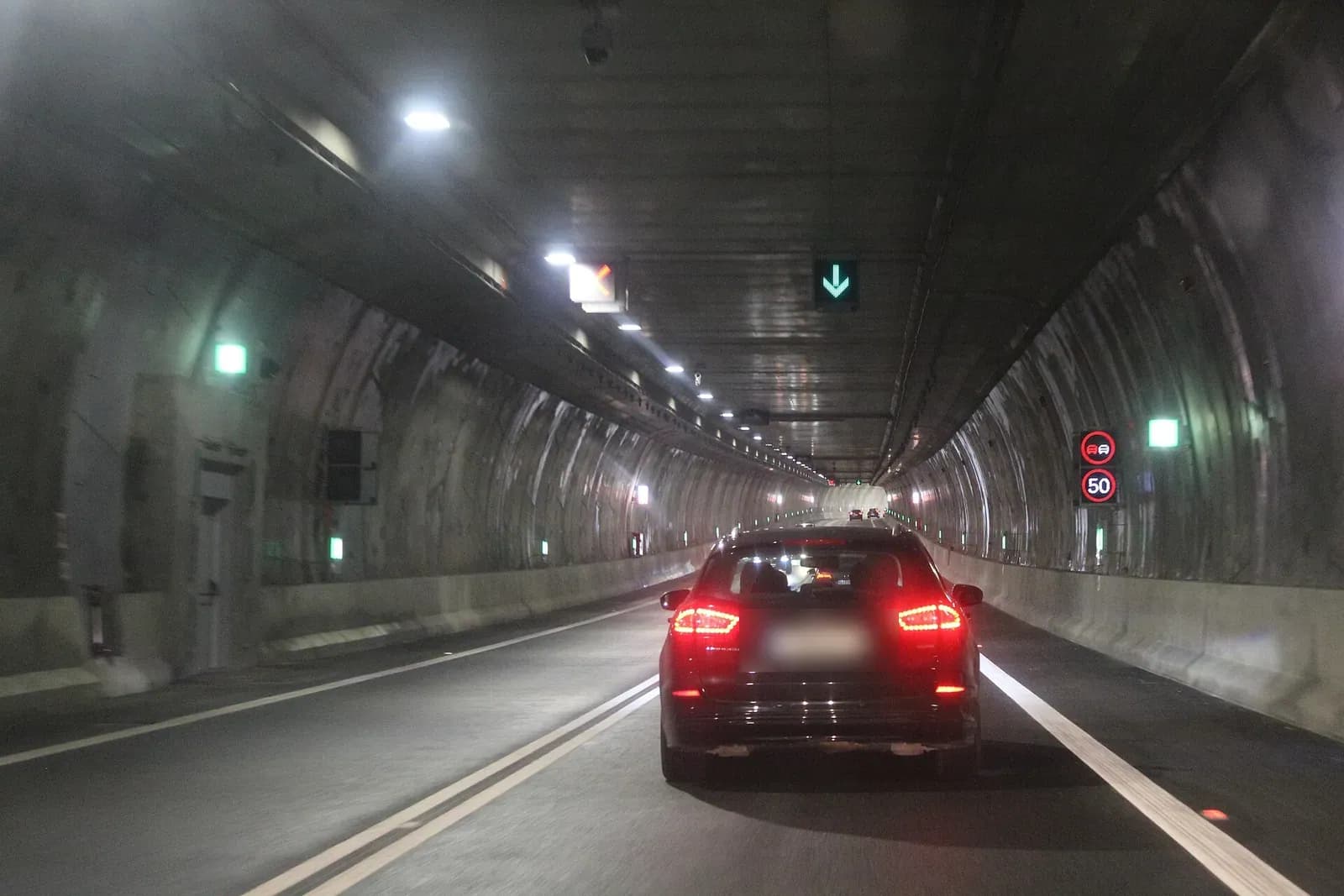
The tunnel has a single tube with one lane in each direction. The limit is 50 km/h, overtaking is banned, and average speed cameras check the whole section. Pedestrians, cyclists and vehicles carrying dangerous goods are not allowed; they use the ferries. The city’s 2023 transport plan added bus routes 5T and 7T through the tunnel. In 2021 the mayor of Świnoujście announced that driving through the tunnel would be free. As early as 2017 the city explained that a toll could put the EU funding at risk and applied for free passage for at least five years.
An evacuation gallery runs under the roadway. Two stairways lead down to it, about 600 to 700 meters from the portals and 500 meters apart, and the gallery ends at staircases by both portals. SOS niches hold fire extinguishers and phones to the tunnel control center. There are two ventilation systems, one for the roadway and one for the escape routes, which smoke cannot enter.
In its first year 4,643,554 vehicles used the tunnel, up to 16,000 a day on average. When the tunnel closes, as on the night of July 23 to 24, 2026, the ferries take over.
Timeline
- 2010Environmental decision for a bored tunnel in the northern corridor.
- April 15, 2016The tender is announced.
- August 2018The winning bidder, Astaldi, refuses to sign.
- September 17, 2018Contract signed with the PORR and Gülermak consortium.
- Autumn 2019Construction begins.
- March 2021Wyspiarka starts boring under the Świna.
- September 16, 2021The machine reaches Wolin.
- June 30, 2023The tunnel opens to traffic.
- September 2026The city puts the ferry Bielik III up for sale.
Practical info
- Where
- Świnoujście, northwestern Poland, between the islands of Usedom and Wolin.
- Who can drive through
- Cars and buses. Pedestrians, cyclists and vehicles with dangerous goods take the ferries.
- Rules
- 50 km/h, no overtaking, average speed cameras.
Questions and answers
How long is the Świnoujście tunnel?
The tunnel is 1,780 meters long, 1,484 meters of it bored by a TBM. The whole new road is about 3.2 kilometers.
How deep is the tunnel under the Świna?
In the design, the tunnel roof lies about 23.5 to 25 meters below sea level, under 8.5 to 9.4 meters of soil on the bed of the strait.
Can you walk or cycle through the Świnoujście tunnel?
No. Pedestrians and cyclists cross on the Bielik ferries at the Warszów crossing.
Is there a toll for the Świnoujście tunnel?
The city announced that the crossing would be free. In 2017 it spoke of at least five years without a toll, because charging could put the EU funding at risk.
How much did the Świnoujście tunnel cost?
913.8 million złoty. Up to 775 million, or 85 percent, came from the European Union.
When did the Świnoujście tunnel open?
On June 30, 2023, about nine months after the original deadline.
What was the tunnel boring machine called?
Wyspiarka, “the island woman”. Its shield was 13.46 meters across, the largest TBM ever used in Poland.
How many cars use the Świnoujście tunnel?
4,643,554 vehicles in its first year, up to 16,000 a day on average in both directions.
Is it Poland’s first underwater road tunnel?
No. The first road tunnel bored with a TBM was the tunnel under the Martwa Wisła in Gdańsk, opened in 2016. The Świnoujście tunnel is longer under water.
Sources
- PORR: opening of the Świnoujście tunnel (opens in a new tab)
- GDDKiA: the boring machine reaches Wolin (in Polish) (opens in a new tab)
- Nowoczesne Budownictwo Inżynieryjne 4/2023: the tunnel opens (PDF in Polish) (opens in a new tab)
- Nowoczesne Budownictwo Inżynieryjne 6/2018: tender and design (PDF in Polish) (opens in a new tab)
- Polish Ministry of Infrastructure: contract signed (2018, in Polish) (opens in a new tab)
- GDDKiA: boring reaches the halfway point (in Polish) (opens in a new tab)
- GDDKiA: 1,000 meters bored (in Polish) (opens in a new tab)
- European Commission: inauguration of the tunnel (opens in a new tab)
- Sika: boring technology and ground conditions (PDF in Polish) (opens in a new tab)
- City of Świnoujście: what to do in a tunnel emergency (in Polish) (opens in a new tab)
- tu.swinoujscie.pl: city transport after the tunnel opens (in Polish) (opens in a new tab)
- Interia: the tunnel under the Świna opens (in Polish) (opens in a new tab)
- RMF24: the ferries after the tunnel opens (in Polish) (opens in a new tab)
- money.pl: the tunnel’s first year of traffic (in Polish) (opens in a new tab)
- Interia: overnight closure in July 2026 (in Polish) (opens in a new tab)
- Interia Geekweek: the ferry Bielik III for sale (2026, in Polish) (opens in a new tab)
- Inżynier Budownictwa: the Martwa Wisła tunnel in numbers (in Polish) (opens in a new tab)
- Inżynier Budownictwa: Poland’s first TBM-bored tunnel (in Polish) (opens in a new tab)
- Swinoujskie.info: the mayor on a free crossing (2021, in Polish) (opens in a new tab)
- iSwinoujscie.pl: five toll-free years and EU funding (2017, in Polish) (opens in a new tab)
- European Commission in Poland: the tunnel opens (in Polish) (opens in a new tab)