Ships that sail across grass
Show on mapOn the Elbląg Canal a boat sails onto a cradle car, rolls out of the water and glides on rails across a meadow. It is all powered by water, just as in 1860.
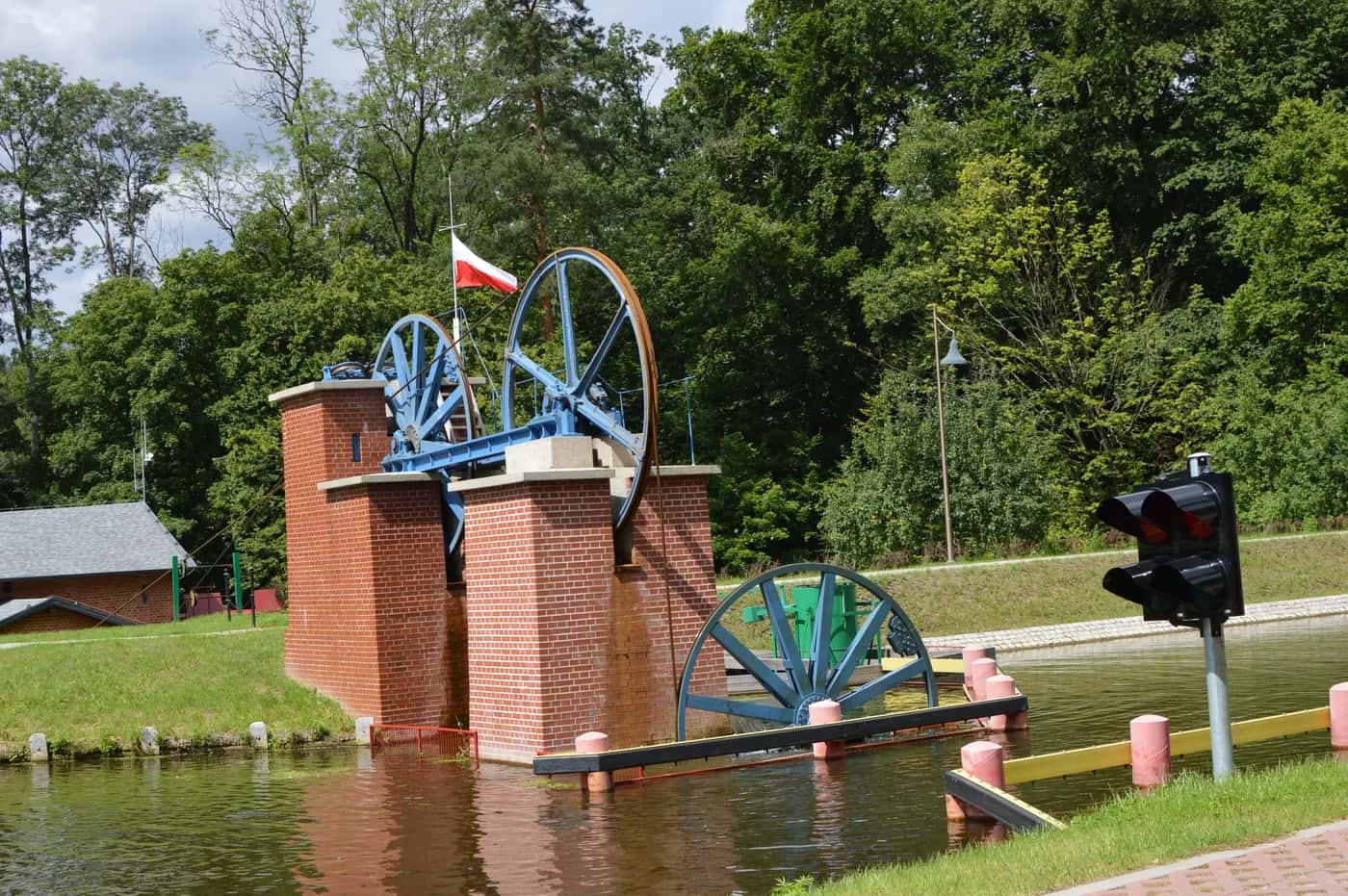
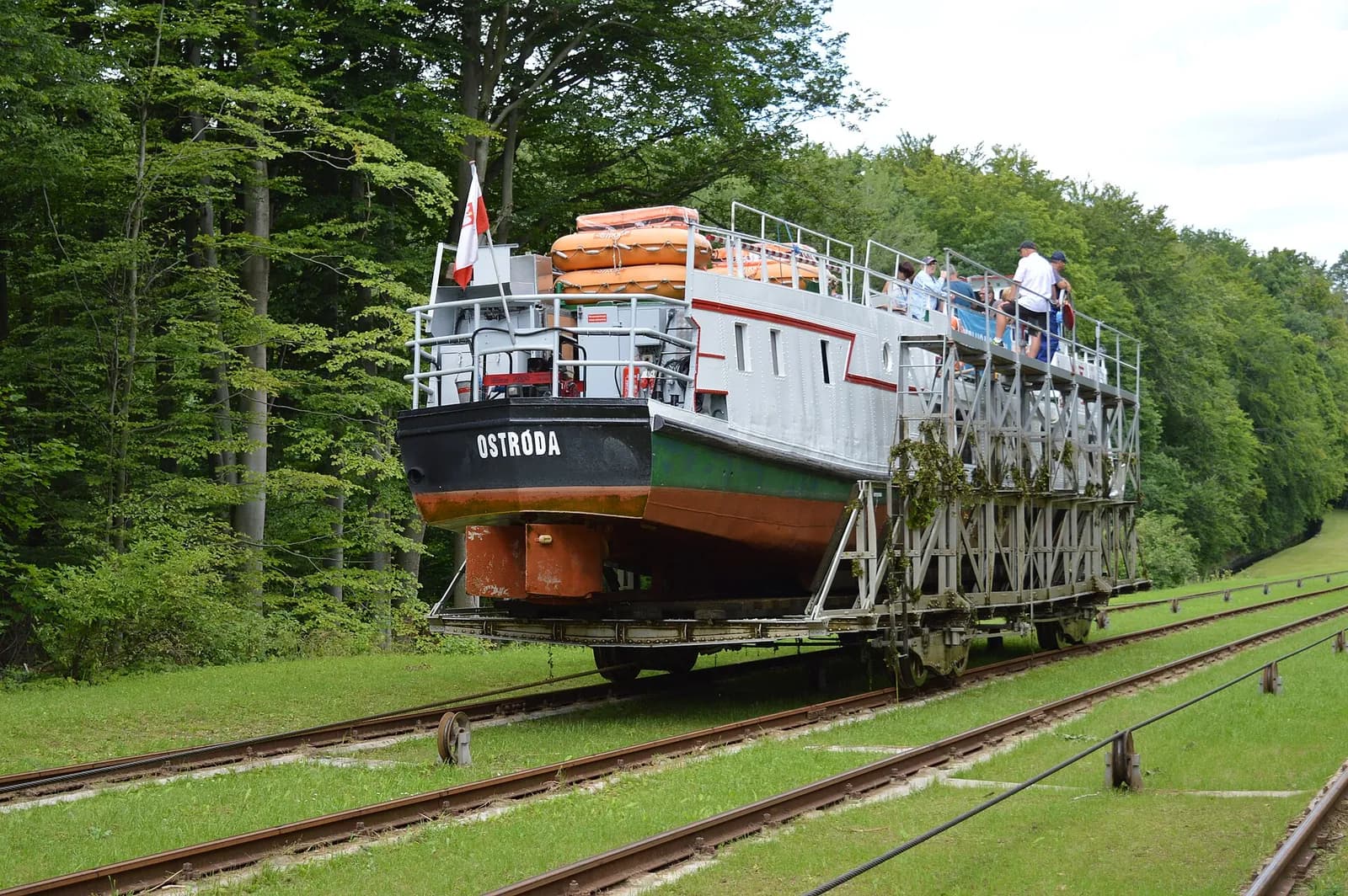
A boat glides down a narrow canal through the woods, slows, and then stops floating. A steel cradle rises from the water beneath its hull, lifts it clear and carries it onto rails. For the next quarter of an hour the passengers sit on the deck of a boat that is climbing a grassy hill. On the Elbląg Canal (Kanał Elbląski) in northern Poland, this has been routine for more than 160 years.
The most surprising part is the power source. Nobody burns coal or starts an engine: a cable pulls the cradle, a drum winds the cable, and the drum is turned by a waterwheel fed by water falling from the higher stretch of the canal. Electricity is used only for the lights. The same idea has worked since the days when this region belonged to Prussia.
The canal links Lake Drużno near the city of Elbląg with the lakes of the Iława Lake District, and through the Elbląg River and the Vistula Lagoon with the Baltic Sea. Its most famous part is a stretch of just under 10 km between Buczyniec and Całuny, where five inclined planes lower boats by a total of 99.5 meters.
How does an inclined plane on the Elbląg Canal work?
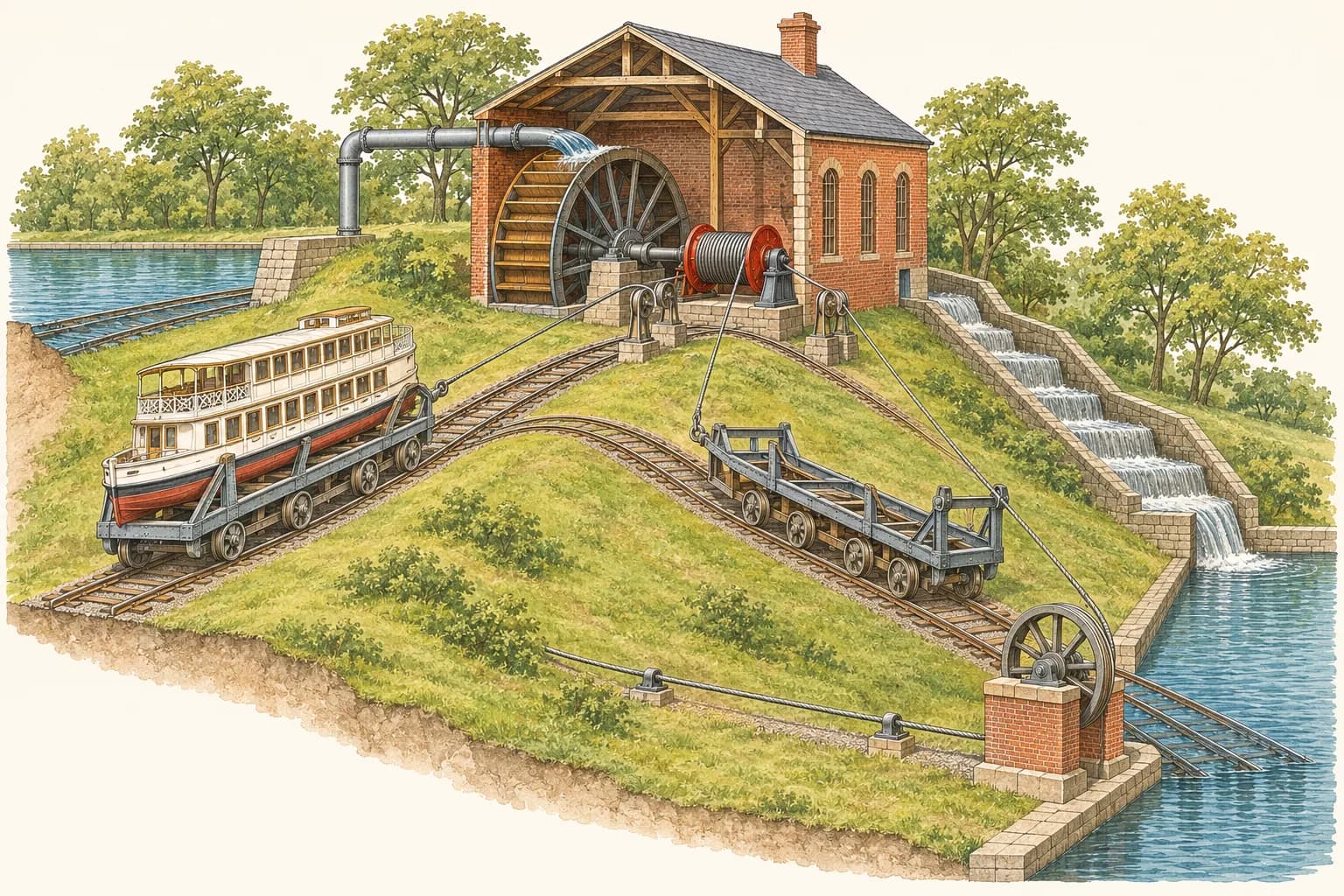
An inclined plane (pochylnia, often called a boat lift or slipway in English) is a railroad laid over a hill between two sections of canal. The rails begin underwater in the upper basin, climb to the crest and disappear underwater again in the lower one. Each plane has two parallel tracks with two cradle cars: as one goes up, the other comes down, so their weights partly balance out.
A cradle weighs 24 metric tons and can carry a boat of up to 50 tons. When both cradles carry boats at the same time, each takes up to 38 tons. The moment of submersion is cleverly solved: near the stations the rails split, the front and rear wheels run onto different tracks, and the cradle levels out underwater so a boat can float onto it as if entering a dock.
Water supplies the power. A steel pipe carries it from the upper canal onto a waterwheel inside the engine house. The wheel turns a drum that winds two cables: one hauls a cradle uphill while the other unwinds and lowers the second cradle. A third cable connects both cradles from below through a return wheel at the bottom station. Water leaving the wheel runs down a stepped stone channel to the lower level.
Crossing one plane takes about 23 minutes on average. The lowest plane, Całuny, uses a Francis turbine instead of a wheel, but the cradles and cables work the same way.
From water to rails and back
- Boarding the cradle The boat floats over the submerged cradle. As the cradle starts uphill, it takes the weight of the hull and lifts it clear of the water.
- Riding the rails Water powers a drum that winds in a cable. The cable hauls the cradle and its boat along the rails and over the crest.
- Floating free The cradle dips underwater on the far side. The water lifts the hull off the cradle and the boat sails into the upper canal.
Why build inclined planes instead of locks?
The problem was the drop. Between Lake Drużno and Lake Piniewo the land rises almost 100 meters over about 10 km. The first plan called for 32 wooden locks. Every lock cycle uses a full chamber of water from the higher stretch, and on such a steep route there would not have been enough water, while boats would have waited for hours in line.
From 1837 the project was led by Georg Jacob Steenke, born in 1801 in Königsberg (now Kaliningrad) and working as the dike and embankment inspector in Elbląg. Construction began in 1844, but Steenke kept looking for something better. He found it in the inclined planes of the Morris Canal in the United States, and in 1850 the plan for inclined planes on the Elbląg Canal was born.
He chose “dry” planes: the boat does not float in a water-filled chamber but rides on a cradle over land. Water is needed only to turn the wheel. According to Polish Waters, the state water authority, this cuts water use to a fifth of what locks would need.
The landscape was rebuilt along the way. The levels of Lakes Sambród and Piniewo were lowered by about 5 meters and Lake Ruda Woda by 1.7 meters. Across Lake Karnickie, which lies 2 meters lower than the rest of the route, the canal runs on a 484-meter embankment, like an aqueduct.
How high is each of the five inclined planes?
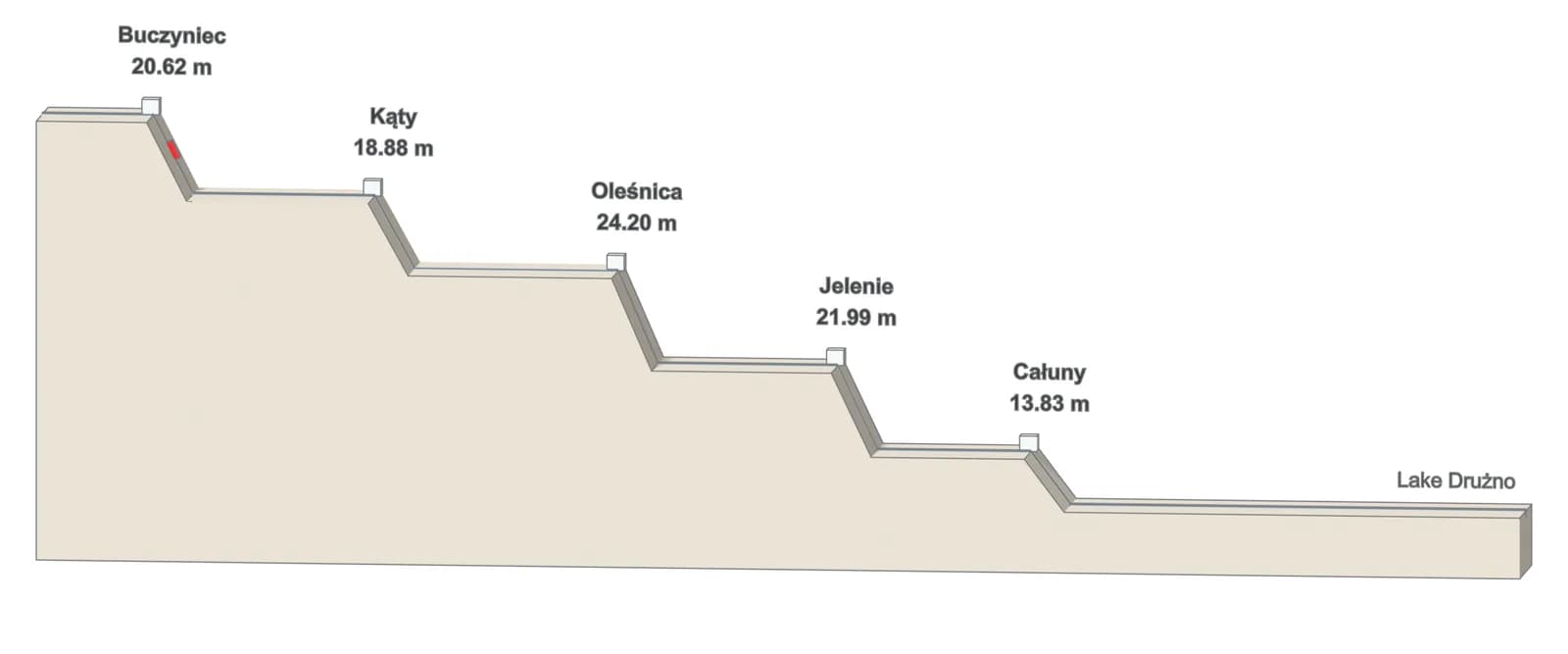
Coming from Ostróda, a boat meets Buczyniec first, then Kąty, Oleśnica, Jelenie and Całuny. The highest drop is at Oleśnica; the lowest and shortest plane is Całuny. The tracks are between 352 and just over 490 meters long.
The first four planes opened in 1860 and 1861. Work on Całuny, nearest to Lake Drużno, only began in 1874. Five wooden locks stood there before and turned out to be the bottleneck of the whole route once the canal opened, so they too were replaced by an inclined plane.
- Buczyniec: 20.62 m drop, 490 m of track.
- Kąty: 18.88 m, 404 m of track.
- Oleśnica: 24.20 m, 479 m of track.
- Jelenie: 21.99 m, 433 m of track.
- Całuny: 13.83 m, 352 m of track, driven by a turbine instead of a waterwheel.
Where do boats still pass through locks on the Elbląg Canal?
Follow the waterway from Miłomłyn through Ostróda toward Lake Szeląg Wielki and you pass the locks at Miłomłyn, Zielona, Ostróda and Mała Ruś, in that order. At the last one, a boat coming from Lake Pauzeńskie enters the lock chamber. The gates close behind the stern and the water rises, lifting the hull by as much as 1.64 meters. Once the water in the chamber is level with Lake Szeląg Wielki, the upper gates can open.
At Miłomłyn, look for the weir beside the lock. Water from Lake Jeziorak can flow through this weir into Lake Drwęckie, then on through the weir at Samborowo to the Drwęca River. There is a second way to reach the same river, through a weir in Iława and down the Iławka. The canal keepers can divide the flow between the two routes according to conditions in the Drwęca valley. Even when no boats are passing through the lock, the weir still has a job to do.
From grain and timber to tourist cruises
The canal was built for freight. The lake district shipped mainly grain and timber through it to the ports of Elbląg and Gdańsk, including prized local pine for ship masts. The first boat sailed part of the route on August 31, 1860, freight traffic opened in the fall of 1861, and the canal officially went into service in the spring of 1862.
Its golden age was short. In 1872 a railroad reached Ostróda and cargo began moving to the tracks. By the 1930s the canal carried mostly tourists. The first pleasure cruise ran in 1912 on the motorboat Seerose, and regular passenger service started in 1927.
Steenke worked on the canal until he retired in 1875. While he was still alive, in 1872, an obelisk honoring him was put up next to the Buczyniec plane. He died in 1884 in Königsberg, and the towns of Elbląg and Miłomłyn made him an honorary citizen.
How were the inclined planes restored in 2011–2015?
After a century and a half of service, the machinery needed a full overhaul. From August 2011 to May 2015 the canal was restored at a cost of about 115 million zloty (PLN), partly paid for by EU funds. The waterway was dredged, the banks reinforced, and on all five planes the mechanical and hydraulic parts were replaced: waterwheels, the turbine, tracks, cables, piers and engine houses.
Boats could not cross the planes for two seasons. The canal reopened on May 29, 2015, at Buczyniec, where the Elbląg Canal History Room (Izba Historii Kanału Elbląskiego) was also created. It displays casting molds for parts of the planes and documents bearing Steenke’s original signature.
The canal is well protected today: part of it has been a listed technical monument since 1978, and the canal has been a Monument of History since 2011. In a 2007 poll by the daily Rzeczpospolita it was voted one of the Seven Wonders of Poland.
Why are there safety gates on both sides of Lake Karnickie?
On the branch from Miłomłyn to Iława, boats cross Lake Karnickie about two meters above its surface. The builders raised an embankment 46 meters wide across the lake and cut a ten-meter-wide navigation channel along its top. Lake water passes underneath the bank between the two parts of the lake. A boat follows the higher waterway from one shore to the other.
That difference in height explains the gates at Ligowo and Zagadka. If the bank gave way, water could run in from either end of the canal and spill onto lower ground. Closing the Ligowo gate cuts off the supply from the Ruda Woda chain of lakes. The Zagadka gate does the same on the Lake Jeziorak side. On an ordinary trip a boat passes through the open gates without changing level.
Why do boats keep to a narrow channel on Lake Drużno?
North of the inclined planes the canal reaches Lake Drużno. From the deck it can still look like a channel cut through greenery. The lake averages only about 1.2 meters deep. Water lilies grow in the shallows and reeds fringe the shores. Polish Waters publishes the navigable depth of the marked channel together with a water-gauge reading. The average depth of the whole lake tells a skipper little about how much water there is under the keel.
The lake and adjoining wetlands have been a nature reserve since 1966, protecting nesting grounds for birds including the great crested grebe and marsh harrier. For a different view, the walking trail described by the municipality of Markusy leads to an observation tower. From there you can pick out the route the boats follow through the reed beds. High water sometimes floods the path.
Elbląg Canal cruise: which route to choose?
The most popular trip runs between Elbląg and Buczyniec: about 4.5 hours, over all five inclined planes and across Lake Drużno, with the return by bus. Shorter options include the stretch from Jelenie to Elbląg, about 2.5 hours, or a round trip from Buczyniec to Jelenie. In the 2026 season the operator also brought back a few full-day cruises along the whole route from Ostróda to Elbląg, lasting about 11 hours.
You can also watch the planes from land. At Buczyniec a path runs along the tracks, and you can get close to the cable wheels at the top station and the engine house. The best spot is by the bottom station, watching a cradle rise from the water with a boat on it.
Timeline
- 1837Georg Jacob Steenke starts work on the canal design.
- 1844Construction of the Elbląg Canal begins on October 28.
- 1850The plan to use inclined planes instead of locks is born.
- 1860On August 31 the first boat sails part of the route; the first planes start working.
- 1862In spring the canal officially enters service.
- 1874Work begins on the Całuny plane, replacing five locks.
- 1912The first pleasure cruise, on the motorboat Seerose.
- 2011The canal becomes a Monument of History; restoration begins.
- 2015On May 29 the restored canal reopens at Buczyniec.
Practical info
- Where
- Warmian-Masurian Province in northern Poland, between Elbląg and Ostróda. The inclined planes are on the stretch from Buczyniec to Całuny.
- Best time
- During the sailing season, from spring to fall. In summer, cruise tickets sell out fast, so book ahead.
- Getting there
- Cruises leave from Elbląg and Ostróda; Buczyniec is reachable by car. On one-way routes the operator arranges a bus back to the start.
- Tickets
- Cruises are run by Żegluga Ostródzko-Elbląska. Check current prices and timetables on its official website.
- On site
- Buczyniec has the Elbląg Canal History Room, with an exhibition on how the inclined planes were built.
Questions and answers
Where is the Elbląg Canal?
In the Warmian-Masurian Province of northern Poland. It links Lake Drużno near Elbląg with Ostróda and Iława, and the inclined planes are on the stretch between Buczyniec and Całuny.
How do boats travel over land on the Elbląg Canal?
They sail onto a submerged rail cradle that a cable pulls over the hill to the next level of the canal. The cable is wound by a drum driven by a waterwheel, so the system runs without fuel.
How many inclined planes are on the Elbląg Canal?
Five: Buczyniec, Kąty, Oleśnica, Jelenie and Całuny. Together they overcome a height difference of 99.5 m.
How long is the Elbląg Canal boat trip?
The cruise from Elbląg to Buczyniec over all the inclined planes takes about 4.5 hours. The full route from Ostróda to Elbląg takes about 11 hours and runs only on selected days.
When can you take a cruise on the Elbląg Canal?
During the sailing season, from spring to fall. The operator, Żegluga Ostródzko-Elbląska, publishes the exact timetable each year.
Can you see the inclined planes without taking a cruise?
Yes. You can drive to the planes, for example at Buczyniec, and watch boats cross from the bank. Buczyniec also has a small museum about the canal’s history.
Sources
- Wikipedia: Elbląg Canal (in Polish) (opens in a new tab)
- Iława Lake District landscape parks, the Karnickie aqueduct (in Polish) (opens in a new tab)
- National Institute of Cultural Heritage, the canal and its structures (in Polish) (opens in a new tab)
- Polish Waters, the Ligowo and Zagadka safety gates (PDF in Polish) (opens in a new tab)
- Municipality of Markusy, the trail and tower at Lake Drużno (in Polish) (opens in a new tab)
- Polish Waters in Gdańsk, notices to mariners and channel depths (in Polish) (opens in a new tab)
- Polish Waters (Wody Polskie), Gdańsk: Inclined planes of the Elbląg Canal (in Polish) (opens in a new tab)
- Ostróda County: Locks and weirs in the environmental plan, p. 68 (PDF in Polish) (opens in a new tab)
- Polish Journal of Laws: Canal heritage designation and map (PDF in Polish) (opens in a new tab)
- kanal-elblaski.pl: Inclined planes, technical data (in Polish) (opens in a new tab)
- kanal-elblaski.pl: Georg Jacob Steenke (in Polish) (opens in a new tab)
- kanal-elblaski.pl: History of the Elbląg Canal (in Polish) (opens in a new tab)
- Żegluga Ostródzko-Elbląska: cruises (in Polish) (opens in a new tab)
- Wikipedia: Elbląg Canal (opens in a new tab)