A steel bridge without a single rivet
Show on mapIn 1929 drivers near Łowicz crossed the world’s first welded road bridge. Three welders joined the steelwork that still spans the River Słudwia.
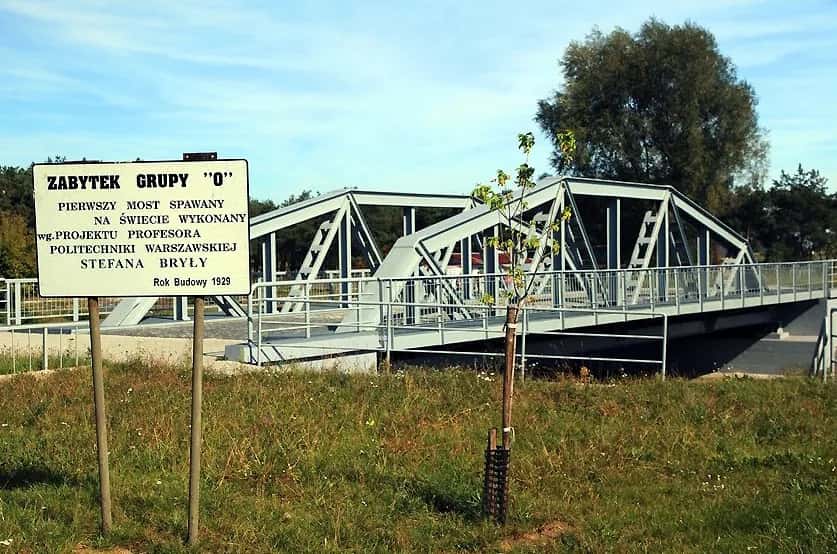
Two bridges cross the Słudwia west of Łowicz. Cars take the one on national road 92. A few steps away an empty roadway runs between two steel trusses. This older crossing opened in 1929. For the first time anywhere, road traffic was running on a steel bridge with an entirely welded structure.
Its size gives little away. The centers of the supports are just 27 meters apart. The place to look is beside the footway, where a diagonal steel member meets the chord of the truss. On a riveted bridge you would normally see rows of rounded rivet heads here. At Maurzyce a welded seam joins the pieces of steel along their edges.
What carries the roadway, and why weld the truss?
Follow the weight of a wheel down through the reinforced concrete deck. A grid of lengthwise and crosswise beams carries it to the two steel trusses. Their bottom chords run level with the road. Their top chords rise in straight segments toward the middle of the river. Vertical and diagonal members connect the chords. At each end the span rests on a concrete support.
In the riveted design, workers would drill holes, fit connecting plates over the ends of the members and hammer the rivets home. The fasteners add weight, and each hole takes away a little of the steel that carries the load. Electric arc welding allowed the crew to join pieces along their edges. Under the direction of Stefan Bryła, engineer Wenczesław Poniż redesigned the connections for welding.
Why are there bolt holes in photographs of a welded bridge?
Bryła himself explained this detail in a 1929 engineering journal. Before a joint could be welded, the beams had to be held in exactly the right position. At the K. Rudzki works in Mińsk Mazowiecki, east of Warsaw, the crew used jigs to line up the steel. On site, temporary bolts held the members together during assembly. The holes in the photographs are the marks of those bolts. After welding, the crew filled the holes with metal to keep rust out.
At the river a movable wooden crane lifted the members onto timber staging supported on piles. The crew assembled the grid beneath the deck first, then the main girders. Bryła recorded 1,100 hours of welding in the shop and another 900 at the river, the combined work of three welders. By December 1928 the steel span was in place. It would be several more months before the road opened.
How did the engineers test a weld and then a whole bridge?
Long before road traffic put the joints to the test, the engineers tested small samples. Bryła published drawings of flat bars joined in the middle and described how to test joints in tension, bending and shear. In one trial a welded bar was bent through 180 degrees and the joint examined for cracks. Each welder had to demonstrate the work on test pieces. Poland’s Ministry of Public Works approved the rules drawn up with a Belgian welding firm.
The finished bridge got a separate test. Bryła’s design calculations allowed for a 20-metric-ton road roller with additional loading ahead of and behind it. The load test took place on August 9, 1929. The Polish bridge engineers’ association reports deflections of 20 and 21 millimeters in the two main girders, against the 40 millimeters Bryła had anticipated. Three days later the bridge opened to traffic.
How much steel did welding save?
The designer left his own figures. Writing in June 1929, Bryła gave an estimated 70 metric tons for the riveted design and 59 for the completed welded steelwork. On those figures the saving was 11 tons. He was comparing the weights of the metal structures. The reinforced concrete deck and the massive concrete supports are separate parts of the bridge.
Later accounts differ. Poland’s National Institute of Cultural Heritage gives 55 tons for the welded steelwork, and the Łódź road authority gives 56. Neither explains the difference from Bryła’s figure. Bryła also noted the cost of bringing in the welding equipment and setting it up. A kilogram of finished welded steelwork cost more than a kilogram of riveted steelwork, so the saving in money was smaller than the saving in metal.
Why does the old bridge stand beside the road?
For nearly half a century the bridge served the Warsaw to Poznań road. In the 1970s the span was shifted sideways and upstream to make room for a crossing that could take heavier traffic. About 20 meters now separate the two bridges. From the side you can see the whole span at once and the open stretch of river between its supports.
During restoration in 2008–2009 the steelwork was cleaned and painted light gray. The original road surface was bituminous. The granite paving underfoot today came with the restoration. The steel span survived while the road around it changed. Beside it an information board tells the story of the bridge and its designer.
Practical info
- Where
- Over the Słudwia between Niedźwiada and Maurzyce, northwest of Łowicz in central Poland, on the north side of national road 92.
- What to look for
- From the footway find a joint where a diagonal member meets the chord of the truss. Then look down the granite roadway to see both trusses at once.
Questions and answers
What was the world first at Maurzyce?
It was the world’s first road bridge with an entirely welded steel structure. The crew finished assembling the steelwork in December 1928. The bridge opened to traffic in August 1929.
Who designed the Maurzyce bridge?
Stefan Bryła led the project. Wenczesław Poniż designed the welded connections under his direction, and K. Rudzki and Company built the steelwork.
Does national road 92 still use the historic bridge?
Traffic now uses the neighboring bridge. The original span was moved upstream and can be seen beside the road.
Sources
- Stefan Bryła’s 1929 account in Przegląd Techniczny (PDF in Polish) (opens in a new tab)
- National Institute of Cultural Heritage, the bridge at Maurzyce (in Polish) (opens in a new tab)
- Polish bridge engineers’ association, The Bridges of Professor Bryła (PDF in Polish) (opens in a new tab)
- Łódź road authority, the welded bridge and its designer (in Polish) (opens in a new tab)