The longest wooden pier in Europe
Show on mapThe Sopot Pier is 511.5 meters long and reaches 458 meters out into the Gulf of Gdańsk.
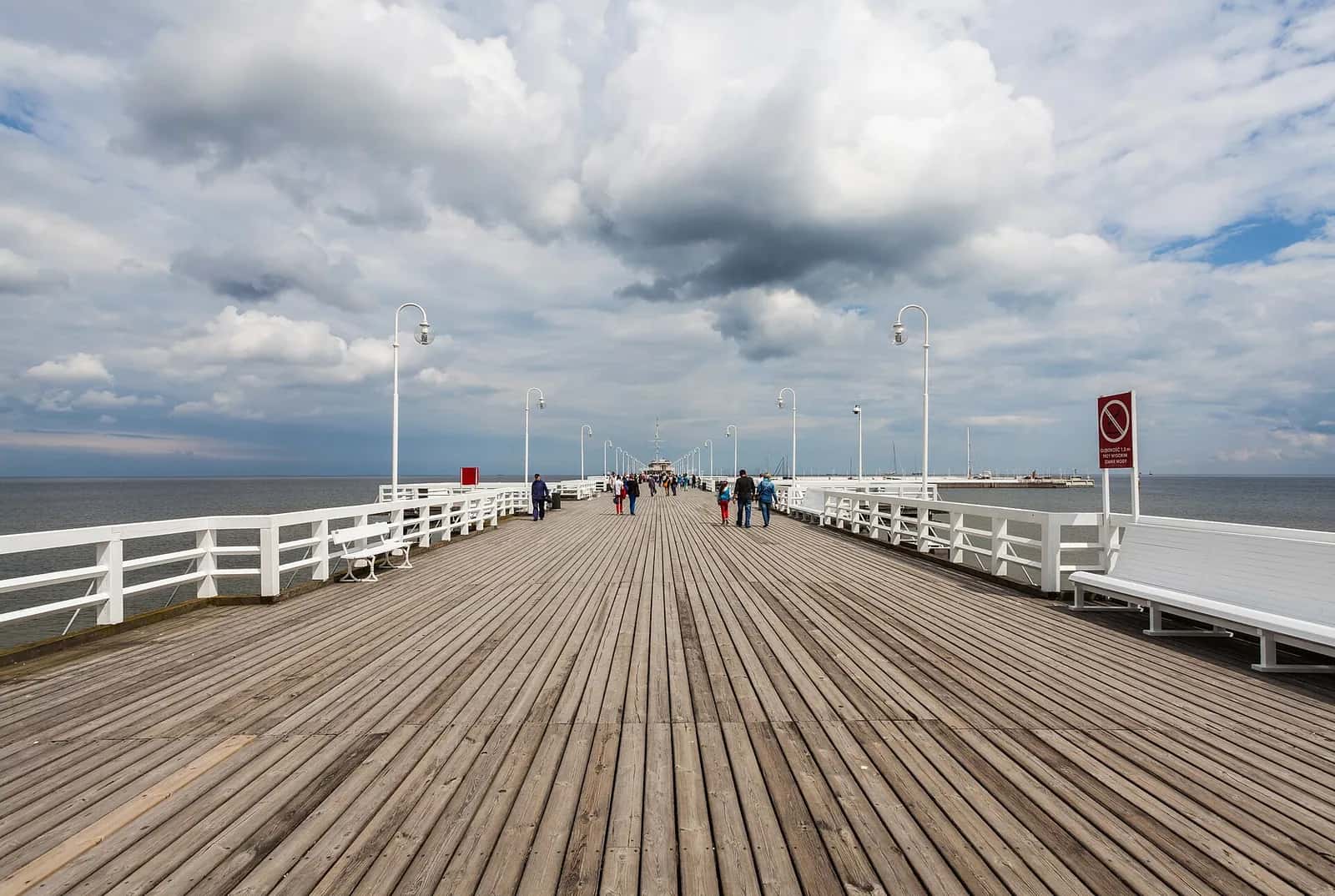
In 1948 the Sopot Pier was due to be torn down. The new communist authorities saw it as an expensive relic of a bourgeois resort. It survived, and today it is 511.5 meters long, the longest wooden pier in Europe. In 2021 alone, 960,000 tickets were sold to walk on it.
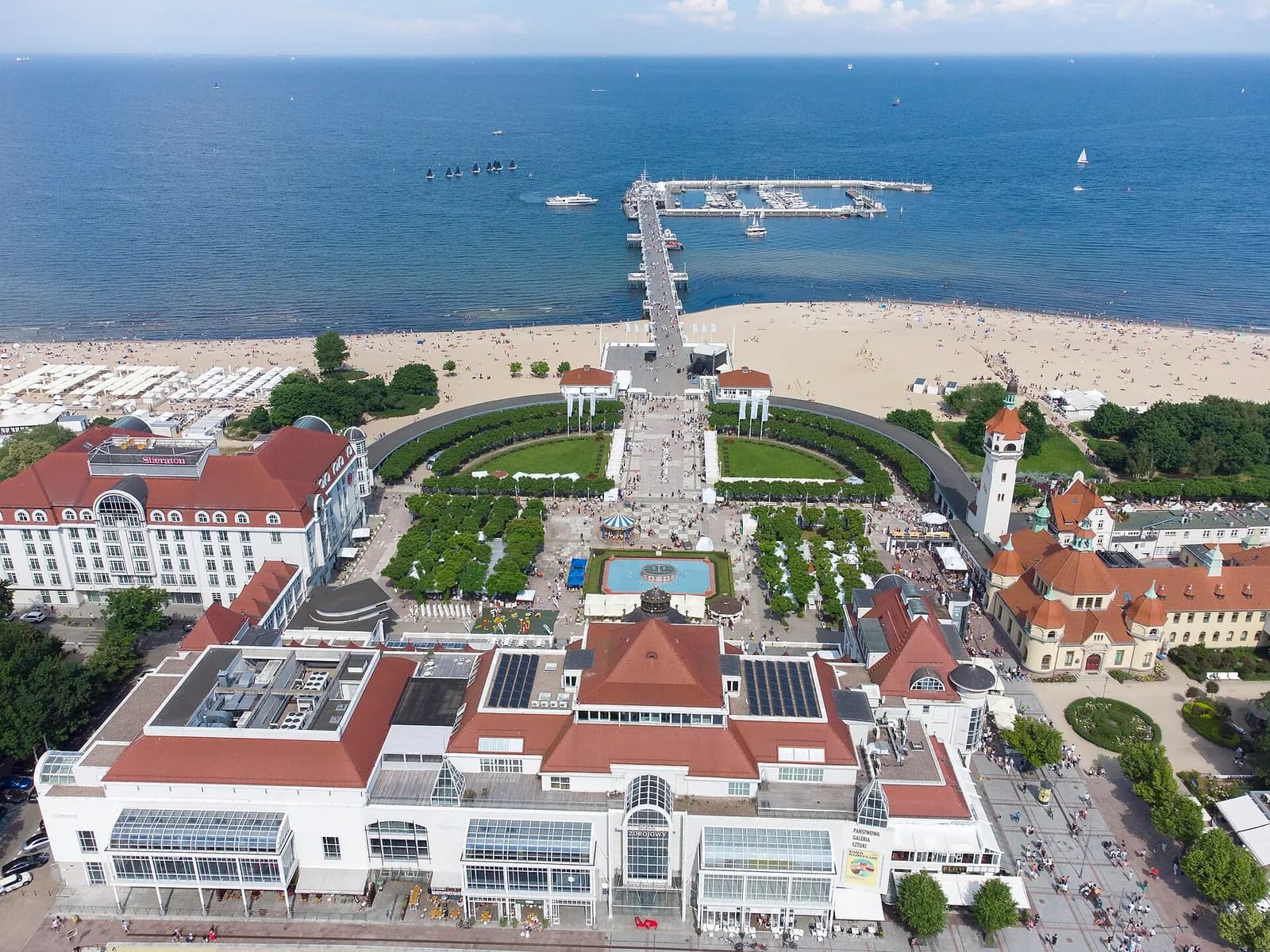
Of those 511.5 meters, 458 extend over the Gulf of Gdańsk; the rest crosses the beach. The walk starts at Spa Square (Plac Zdrojowy), by the lighthouse and the Spa House, and ends at the pier head, where yachts and excursion boats tie up. Underfoot the whole way are pine boards, and under the boards, pine piles driven into the seabed.
The pier did not start out this long. It is the result of a century of extensions: from a jetty for spa guests in 1827, to a landing stage for ocean liners in the 1930s, to a marina opened in 2011.
How long is the Sopot Pier, and why is it a record?
The walkway is 511.5 meters long. It is 10–26 meters wide, not counting the lower mooring decks, and locals call the widest section above the beach "the frying pan" (patelnia). A side arm called the spur (ostroga) branches off the main pier; it is 132 meters long and 5.5 meters wide.
The record is for wooden piers. Europe has longer ones: Southend Pier in eastern England is 2,158 meters long, but it is built mainly of iron. So Sopot remains the longest pier where you walk on wood from end to end, even though its head has been protected by reinforced concrete since the early 1990s.
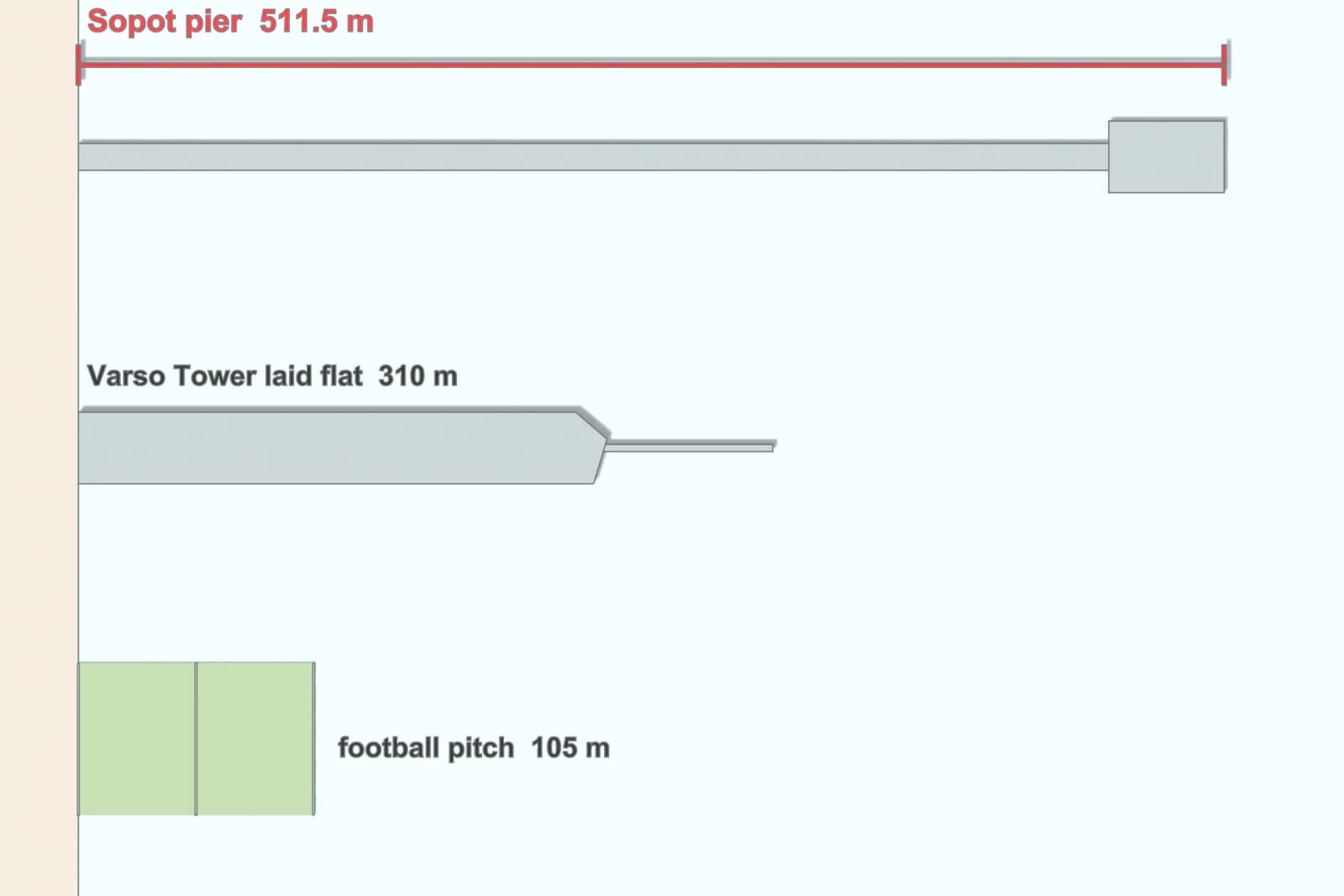
Comparisons help. Lay Varso Tower, the EU's tallest building, flat beside the pier and it would reach only about 60 percent of the way along. A soccer field would fit along the pier almost five times.
A short history of the Sopot Pier: from 31.5 meters to half a kilometer
Sopot became a resort thanks to Jean Georg Haffner, a surgeon in Napoleon's army who stayed on in Gdańsk (then Danzig) after 1814. In 1823 the Prussian authorities licensed him to open a bathing establishment in what was then called Zoppot, and in 1827 he built the first jetty. It was 31.5 meters long and served the guests of the baths.
As the resort grew, so did the pier. By the end of the 19th century it was about 150 meters long, and by 1910, 315 meters. The biggest rebuild came in 1927–1928, for the town's 25th anniversary and the centenary of the first jetty. That is when the pier reached its present 511.5 meters and the spa gardens at its entrance were redesigned.
After World War II the resort became part of Poland, and the pier became a problem. In 1948 there were plans to demolish it. It survived, and in 1989–1991 it gained a reinforced concrete head that shields the wooden deck from the open sea. In 2005 it was named after Pope John Paul II.
Steamers, seaplanes and ocean liners: the pier as a port
The pier was a landing stage from the start. In 1888 the first regular boat service linked Sopot with Gdańsk, and by 1922 a shipping company called Gryf ran boats between Gdańsk, Sopot, Gdynia, Puck and Hel. Since 1946, coastal services have been run by Żegluga Gdańska.
Between the wars, big passenger liners called at Sopot. They could not come alongside, so they anchored offshore and passengers were ferried to the pier in boats. The largest, the German liner Columbus at 32,364 gross tons, arrived on July 3, 1935; it was about twice the size of the Polish flagship Batory.
There was also a brief flirtation with aviation. In the summer of 1923 seaplanes landed by the pier many times, but currents and sandbars made regular service impractical. In 1925 a seaplane harbor opened in Gdańsk instead, and Sopot's flying days ended for good in 1927.
What is the Sopot Pier made of?
The wooden structure stands on pine piles 30 to 60 cm across, driven 5 to 12 meters into the seabed. On top lies a deck of pine boards 5 cm thick, 15 cm wide and 3 to 6 meters long. Baltic salt water, ice and storms mean boards and piles are constantly being replaced and repaired.
The pier has two parts. The wooden part, out at sea, is the promenade with its spur and lower mooring decks. The part on land is the Spa Square, about 20,000 m² with a historic fountain, a concert shell and a lighthouse with a viewing gallery. The pier's operator says the concentration of iodine in the air at the far end is twice that on land.
- piles: pine, 30–60 cm in diameter, driven 5–12 m into the seabed
- deck: pine boards 5 × 15 cm, 3–6 m long
- width of the walkway: 10–26 m
- spur: 132 m long, 5.5 m wide
- head: reinforced concrete, built 1989–1991
The Sopot marina and boat trips from the pier
In 2005 the pier was designated a harbor and the decision was made to build a marina. Work began on March 11, 2010, and the marina opened on July 6, 2011. It cost more than 65 million złoty (PLN) and added extra breakwaters, a harbor master's office and 103 berths. In spring 2021 an expansion began, adding a 100-meter floating dock and a new slipway for launching boats.
In summer, boats leave the pier head for Gdańsk, Gdynia and the Hel Peninsula. The pier also works as a grandstand for sailing regattas and triathlons held in the bay. From the far end you can see the Grand Hotel, the port of Gdańsk and the cliffs of Kępa Redłowska in Gdynia.
Why did the beach grow toward the marina?
Waves coming in at an angle carry sand along the Sopot shore. When the marina breakwaters went up at the end of the pier, they sheltered the water between the harbor and the beach. In the calmer water, sand settled on the seabed. This is how a tombolo begins to form. In nature, the ridge of sand can eventually join an island to the mainland. Here a breakwater takes the place of the island.
From the deck you can see that the beach has widened. Depth surveys reveal what happened offshore. Near the southern breakwater the water was about 3.5 meters deep in 2010. Two years later the depth at that spot was about 2.6 meters. Researchers used echo soundings to reconstruct the shape of the seabed. The profiles show where sand collects and help estimate how much to remove when dredging. The pier itself stayed the same length throughout.
Why is there a chimney inside the lighthouse?
Walking back from the end of the pier, look to the left as you approach the shore. The tall tower looks as though it was built for sailors. The designers of the early 20th-century bathhouse had a different problem to solve. The boilers that heated the water needed a flue tall enough to carry smoke above the building. They enclosed it in a tower with a viewing gallery. Spa guests could look out over the bay while the boilers worked below.
The tower did eventually guide ships. When the boiler house was modernized in 1975, a light with a range of five nautical miles was installed on top. In 1977 new optics took its nominal range to more than 17 nautical miles. The lighthouse name that visitors know today belongs to a much later chapter in the life of the tower.
What else drew summer visitors to the pier?
After gaining its town charter in 1901, Sopot rebuilt the waterfront around the pier. On the landward side, a new building offered hot baths, and an imposing spa house followed in 1910. New beach bathing facilities opened on either side of the pier, the northern complex in 1903 and the southern one in 1907. A walk out over the water was one of several things a guest could do within a short distance.
The resort also drew people inland. Sopot held its first Sports Week in 1901 and opened its Forest Opera in 1909. A casino and festivals of Wagner’s music followed after the First World War. Historian Janusz Dargacz puts the total for the 1928 summer season at more than 29,000 holidaymakers. That figure counts visitors to the resort in the year of the pier extension. A turnstile on the pier counts something different.
Do you have to pay to walk on the Sopot Pier?
Yes, but not all year. Paid entry runs from spring to the end of September; in 2026, from April 10 to September 30. In July and August the fee is charged around the clock; in the rest of the season, only during the day and evening. Outside that period the walk is free.
There are standard tickets, reduced tickets for children aged 3 to 16, family tickets and tickets for people over 70. Sopot residents and children under 3 walk in free. Prices change every season, so check the current list on the website of MOSiR Sopot, the municipal sports and recreation center that has run the pier since October 2020.
Timeline
- 1823Jean Georg Haffner is licensed to open a bathing establishment in Sopot.
- 1827The first jetty is built, 31.5 m long.
- 1910The pier is now 315 m long.
- 1927–1928The biggest rebuild: the pier reaches 511.5 m.
- 1935The Columbus, the largest of the liners calling at Sopot in those years, anchors offshore.
- 1948The authorities plan to demolish the pier.
- 1989–1991A reinforced concrete head is built to protect the deck.
- 2005The pier is named after John Paul II and becomes an official harbor.
- 2011A marina with 103 berths opens.
Practical info
- Where
- Sopot, Spa Square (Plac Zdrojowy), at the end of the Monte Cassino Street promenade.
- Best time
- A summer sunset, or the off season, when entry is free and the deck is quiet. In winter, fog often hangs over the bay.
- Getting there
- SKM commuter train to Sopot station, then walk down the promenade toward the sea.
- Tickets
- Paid from spring to the end of September, around the clock in July and August. Check current prices on the MOSiR Sopot website.
- On site
- A lighthouse with a viewing gallery on the Spa Square, boat trips from the pier head, a beach walk to Gdynia or Gdańsk.
Questions and answers
How long is the Sopot Pier?
The pier is 511.5 meters long, and 458 meters of it extend over the Gulf of Gdańsk. It is the longest wooden pier in Europe.
Is the Sopot Pier free?
It is free outside the paid season, which runs from spring to the end of September. Sopot residents and children under 3 never pay.
Is the Sopot Pier the longest pier in Europe?
It is Europe's longest wooden pier. Southend Pier in England is longer (2,158 m) but is built mainly of iron.
When was the Sopot Pier built?
The first 31.5-meter jetty was built in 1827. The pier reached its present length of 511.5 meters after a rebuild in 1927–1928.
Can you take a boat from Sopot to Hel?
Yes, in summer. Boats to Hel, Gdańsk and Gdynia leave from the pier head, the far end of the pier.
Sources
- Wikipedia: Sopot Pier (in Polish) (opens in a new tab)
- Pomeranian Regional Tourist Organization: how the chimney became a lighthouse (in Polish) (opens in a new tab)
- City and Museum of Sopot: the seaside resort between 1901 and 1939 (in Polish) (opens in a new tab)
- MOSiR Sopot: Sopot Pier (in Polish) (opens in a new tab)
- MOSiR Sopot: pier ticket prices (in Polish) (opens in a new tab)
- Specht et al.: mapping shoreline change at Sopot Pier, 2008–2018 (opens in a new tab)
- Makar et al.: seabed surveys around Sopot Pier (opens in a new tab)
- Polish Head Office of Geodesy and Cartography: aerial maps and archive imagery (in Polish) (opens in a new tab)
- Wikipedia: Sopot Pier (opens in a new tab)
- Wikipedia: Jean Georg Haffner (opens in a new tab)
- Wikipedia: Southend Pier (opens in a new tab)